Review
doi: 10.1038/embor.2012.65.
Chromosomal instability and aneuploidy in cancer: from yeast to man
Affiliations
- PMID: 22614003
- PMCID: PMC3367249
- DOI: 10.1038/embor.2012.65
Item in Clipboard
Review
Chromosomal instability and aneuploidy in cancer: from yeast to man
EMBO Rep.
.
Abstract
Aneuploidy is frequently associated with disease and developmental abnormalities. It is also a key characteristic of cancer. Several model systems have been developed to study the role of chromosomal instability and aneuploidy in tumorigenesis. The results are surprisingly complex, with the conditions sometimes promoting and sometimes inhibiting tumour formation. Here, we review the effects of aneuploidy and chromosomal instability in cells and model systems of cancer, propose a model that could explain these complex findings and discuss how the aneuploid condition could be exploited in cancer therapy.
Conflict of interest statement
The authors declare that they have no conflict of interest.
Figures
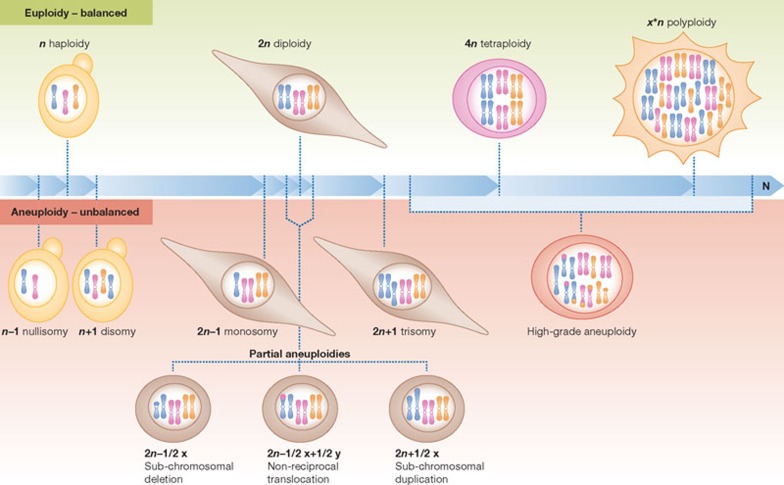
Aneuploidy defined. Euploidy defines a species-specific karyotype. Depending on the species, euploidy can describe a haploid, diploid or polyploid karyotype. Euploidy refers to a balanced genomic state. By contrast, aneuploidy is an unbalanced genomic state that describes a range of karyotypes. Whole chromosomes can be lost (nullisomy or monosomy) or gained (disomy or trisomy). Additionally, sub-chromosomal regions can be amplified, deleted or translocated (partial aneuploidies). ‘High-grade aneuploidy’ occurs when complex aneuploidies are present, often a combination of chromosome losses and gains, as well as sub-chromosomal rearrangements.
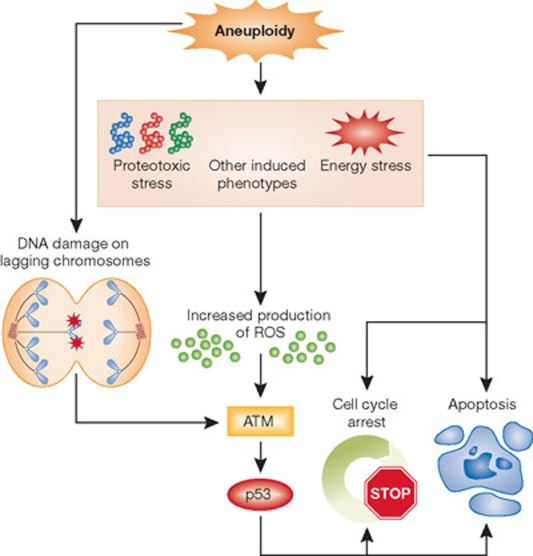
The effects of aneuploidy on cell physiology. The generation of aneuploidy after chromosome missegregation has been proposed to trigger a checkpoint-like cellular response. Energy, proteotoxic and other aneuploidy-associated stresses have been proposed to increase the production of reactive oxygen species, which activate p53 through ATM [26]. DNA damage on lagging chromosomes during aberrant mitoses triggers a p53-response through ATM [30]. Depending on the level of aneuploidy, this p53 response can either trigger a cell-cycle arrest or promote apoptosis. Aneuploidy can also interfere with cell proliferation by p53-independent mechanisms, as trisomic MEFs do not mount a p53 response but have proliferation defects. ATM, ataxia telangiectasia mutated; MEF, mouse embryonic fibroblast; ROS, reactive oxgen species.
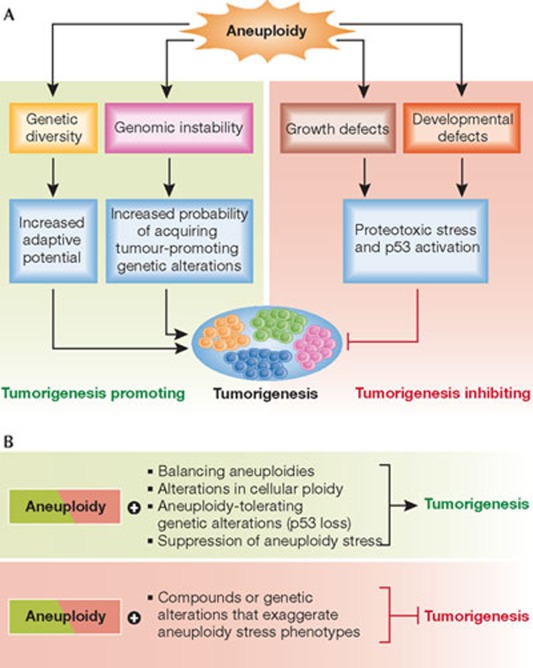
A model for the role of aneuploidy in tumorigenesis. (A) Aneuploidy is most frequently associated with characteristic phenotypes, such as defects in cell proliferation and developmental defects in whole organisms. These phenotypes are often accompanied by particular cellular responses, such as increased proteotoxic stress and activation of p53. Generally, these adverse effects of aneuploidy serve to inhibit tumorigenesis. Aneuploidy can also generate genetic diversity, which can provide cells with increased adaptive potential when challenged and thus could be a means for promoting special aspects of tumorigenesis, such as metastasis. Finally, aneuploidy is also commonly associated with genomic instability, increasing the probability of acquiring tumour-promoting genetic alterations and thereby significantly contributing to tumorigenesis. (B) The adverse effects of aneuploidy can impair tumorigenesis, but in the presence of aneuploidy-tolerating mutations, increased ploidy or balancing aneuploidies, this anti-tumorigenic effect is lessened and the potential tumorigenesis-promoting effects of aneuploidy reach their full potential. Conversely, compounds or genetic alterations that enhance the adverse effects of aneuploidy could shift the equilibrium towards its anti-proliferative effects, thus preventing the growth of aneuploid cancer cells.
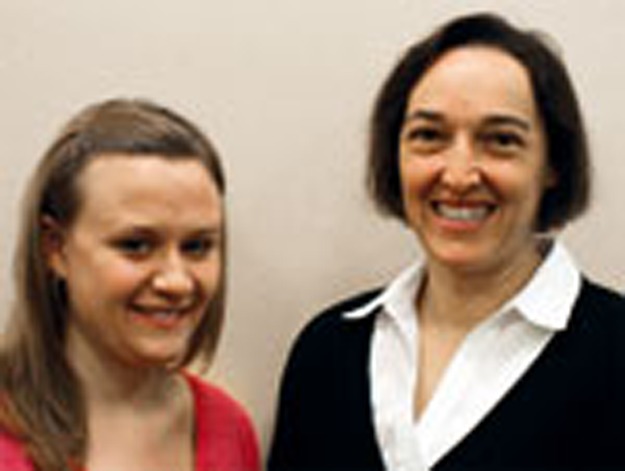
Sarah J Pfau & Angelika Amon
References
-
- Vogelstein B, Kinzler KW (2004) Cancer genes and the pathways they control. Nat Med 10: 789–799 - PubMed
-
- Balmain A, Gray J, Ponder B (2003) The genetics and genomics of cancer. Nat Genet 33: 238–244 - PubMed
-
- Longo D (2012) Tumor heterogeneity and personalized medicine. N Engl J Med 366: 956–957 - PubMed
-
- Rajagopalan H, Lengauer C (2004) Aneuploidy and cancer. Nature 432: 338–341 - PubMed
-
- Ganem NJ, Storchova Z, Pellman D (2007) Tetraploidy, aneuploidy and cancer. Curr Opin Genet Dev 17: 157–162 - PubMed
Publication types
MeSH terms
Substances
Grants and funding
LinkOut - more resources
Full Text Sources
Molecular Biology Databases