. 2012 Aug;40(15):7280-90.
doi: 10.1093/nar/gks451. Epub 2012 May 22.

Cryptic transcripts from a ubiquitous plasmid origin of replication confound tests for cis-regulatory function

Affiliations

Cryptic transcripts from a ubiquitous plasmid origin of replication confound tests for cis-regulatory function

Nathan A Lemp et al. Nucleic Acids Res. 2012 Aug.

Abstract

A vast amount of research on the regulation of gene expression has relied on plasmid reporter assays. In this study, we show that plasmids widely used for this purpose constitutively produce substantial amounts of RNA from a TATA-containing cryptic promoter within the origin of replication. Readthrough of these RNAs into the intended transcriptional unit potently stimulated reporter activity when the inserted test sequence contained a 3' splice site (ss). We show that two human sequences, originally reported to be internal ribosome entry sites and later to instead be promoters, mimic both types of element in dicistronic reporter assays by causing these cryptic readthrough transcripts to splice in patterns that allow efficient translation of the downstream cistron. Introduction of test sequences containing 3' ss into monocistronic luciferase reporter vectors widely used in the study of transcriptional regulation also created the false appearance of promoter function via the same mechanism. Across a large number of variants of these plasmids, we found a very highly significant correlation between reporter activity and levels of such spliced readthrough transcripts. Computational estimation of the frequency of cryptic 3' ss in genomic sequences suggests that misattribution of cis-regulatory function may be a common occurrence.


Figures
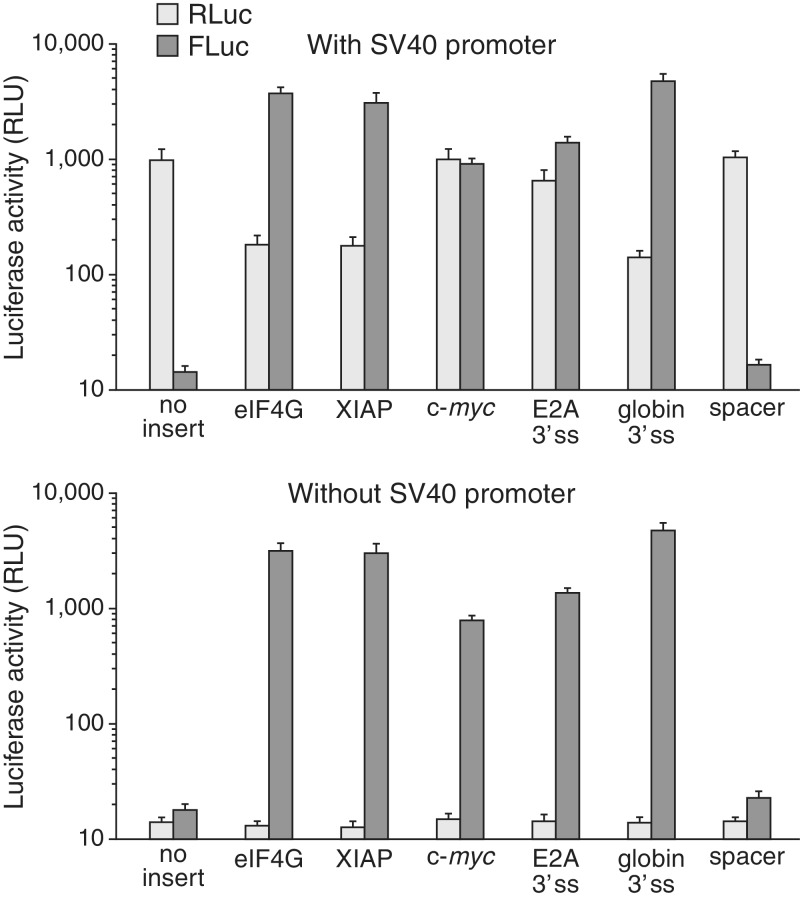
Figure 1.
Figure 1.
Second-cistron expression from dicistronic reporter plasmid pRF is potently stimulated by insertion of 3′ ss-containing test sequences or putative IRES/promoter elements, but is unaffected by deletion of the SV40 promoter and chimeric intron. RLuc and FLuc activities were measured from cells transfected with the indicated constructs. Shown are mean values ± SD (n = 3).
Figure 2.
Figure 2.
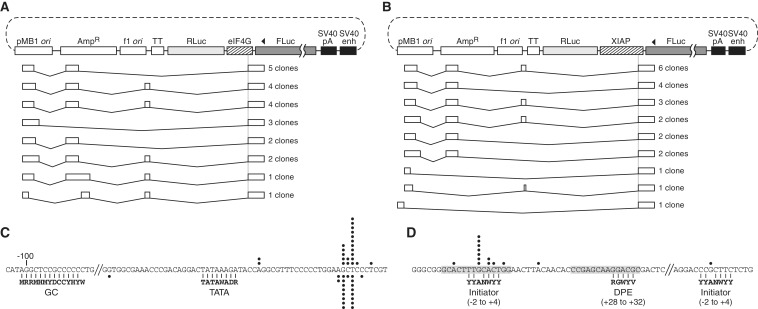
Mapping of the initiation sites of FLuc-encoding RNA produced from promoterless pRF constructs containing the eIF4G, XIAP and c-myc sequences. (A and B) 5′ RACE products from promoterless pR-eIF4G-F (A) and pR-XIAP-F (B). The cloned transcripts are grouped by splicing pattern and aligned to maps of the corresponding plasmids. AmpR, ampicillin resistance gene; f1 ori, bacteriophage f1 origin; TT, transcriptional terminator. Arrowheads denote the location of the reverse primer used. (C) Sequence detail of the proximal cryptic promoter in the pMB1 ori. Black circles above and below the sequence represent the start site of cloned transcripts from promoterless pR-eIF4G-F and pR-XIAP-F, respectively. Homologies to consensus vertebrate GC and TATA boxes (obtained from the Eukaryotic Promoter Database) (31) are indicated. (D) Detail of the region of the major and one minor transcription start site identified in the c-myc sequence. The region shown is the c-myc 5′ UTR between −194 and −74 relative to the AUG start codon. Black circles indicate the initiation sites of cloned transcripts. Inr and DPE consensus sequences and their canonical locations relative to transcription start sites (32) are shown below homologous c-myc sequence. Sequences highlighted in gray are 14-nt elements previously reported (33) to mediate apparent IRES function in reporter assays.
Figure 3.
Figure 3.
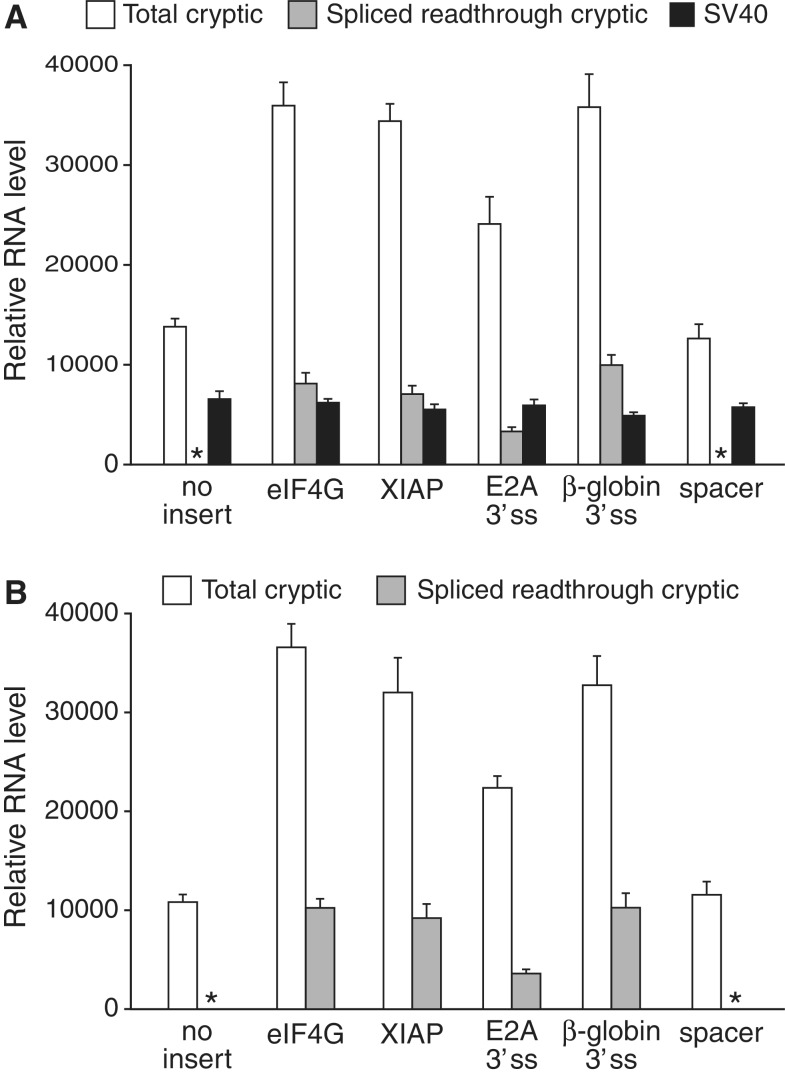
The cryptic promoter in the pMB1 ori within pRF is robust and constitutively active. Shown are levels of cryptic and expected RNA produced from pRF constructs containing (A) or lacking (B) the SV40P. RNA from transfected cells was analysed by quantitative RT-PCR to detect total cryptic RNA, spliced readthrough cryptic RNA, or the expected RNA from the SV40P. Asterisks indicate the absence of detectable transcript. Error bars, SD.
Figure 4.
Figure 4.
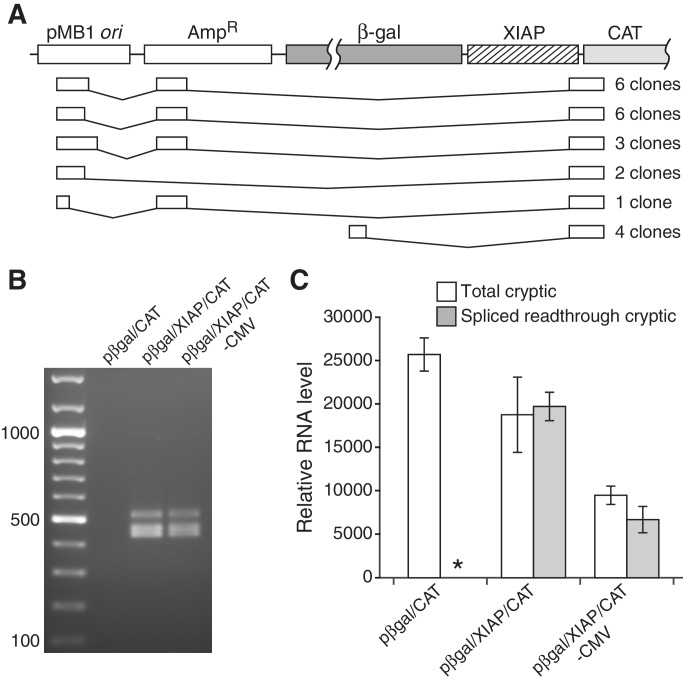
Production of CAT-encoding monocistronic transcripts from the pMB1 cryptic promoter within the pβgal/CAT reporter system. (A) Structure of transcripts identified by 5′ RACE analysis of RNA from promoterless pβgal/XIAP/CAT. (B) Amplification by standard RT-PCR of cryptic CAT-encoding transcripts from pβgal/CAT plasmids with or without the XIAP insert or CMV promoter. The forward primer was specific for the first exon and the reverse primer was specific for the CAT gene. Sequencing showed that the three major amplified species correspond to the three most prevalent splice isoforms identified by 5′ RACE. (C) Quantitation of cryptic transcripts by real-time RT-PCR. The asterisk indicates the absence of detectable transcript. Error bars, SD.
Figure 5.
Figure 5.
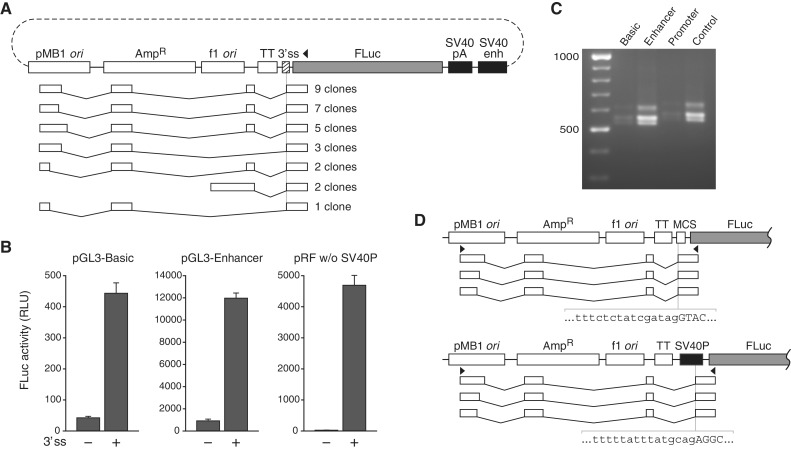
Production of luciferase-encoding cryptic readthrough RNA by the pGL3 system. (A) The presence of a 3′ ss in a test sequence introduced into pGL3-Enhancer results in production of spliced readthrough transcripts similar to those observed with pRF. Shown are the 5′ RACE products from pGL3-Enhancer containing the globin 30-ss site as the test sequence. (B) Insertion of the globin sequence into pGL3-Basic or pGL3-Enhancer stimulates luciferase activity strongly, despite substantial preexisting background. Results of luciferase assays with promoterless pRF from Figure 1 are shown here in linear scale for comparison. (C and D) Cryptic 3′ ss upstream of the FLuc gene in the unmodified parental plasmids of the pGL3 system are activated in readthrough transcripts. (C) Results of RT-PCR reactions to detect RNA from the pMB1 ori in which a cryptic 3′ ss upstream of the FLuc gene had been utilized. (D) Structure of the RT-PCR products as determined by sequencing. Top, transcripts from pGL3-Basic and pGL3-Enhancer; bottom, transcripts from pGL3-Promoter and pGL3-Control. Arrowheads indicate the location of the primers used. The sequences of the activated cryptic 3′ ss are shown.
Figure 6.
Figure 6.
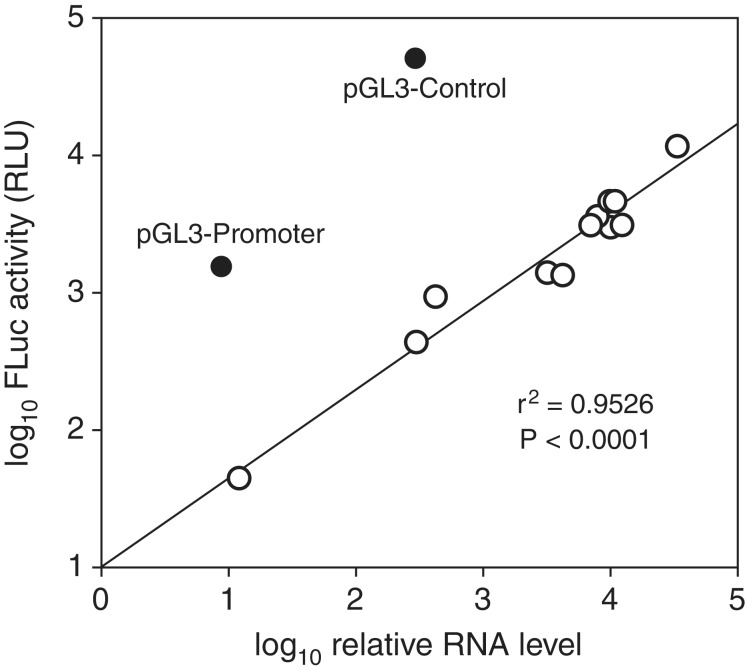
Correlation between levels of spliced readthrough RNA and luciferase expression among the pRF and promoterless pGL3 plasmids tested in this study. Open circles represent the promoterless and promoter-containing pRF plasmids, pGL3-Basic, pGL3-Enhancer and the variants of these plasmids with 3′ ss-containing test inserts. The pRF plasmids containing either no insert or the spacer are not shown since they produced no detectable spliced readthrough RNA. The line represents the linear regression for the values obtained with these plasmids. The values for pGL3-Promoter and pGL3-Control, which were excluded from the regression analysis, are shown for comparison. Supplementary Table S1 provides the identities and values for all plasmids represented.
Figure 7.
Figure 7.
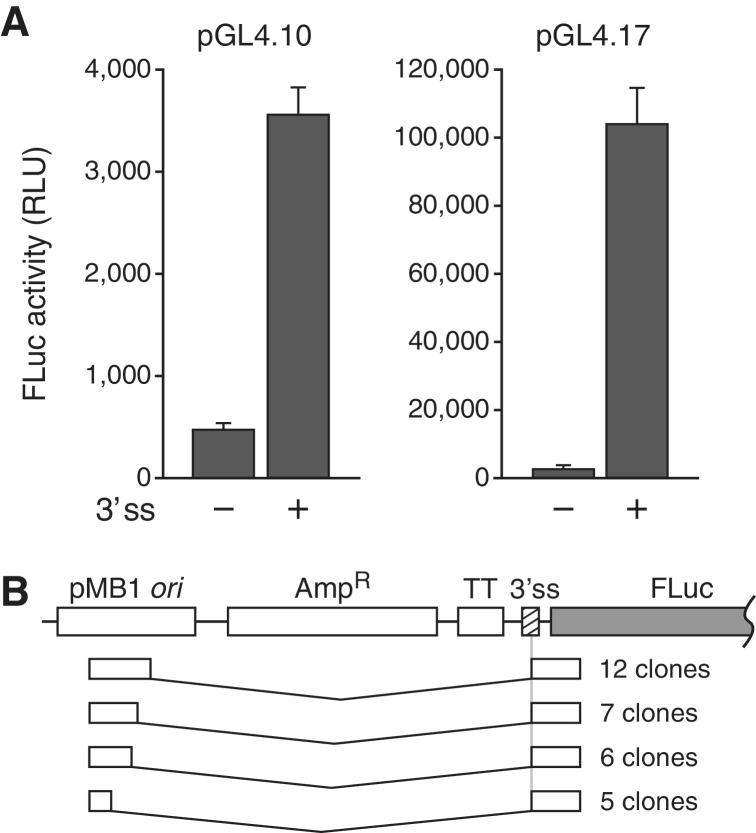
A 3′ ss can mimic a promoter in the pGL4 system by inducing production of spliced readthrough transcripts. (A) Expression of luciferase from pGL4.10 and pGL4.17 with and without the globin 3′ ss inserted into the MCS. Error bars, SD. (B) 5′ RACE products from pGL4.17 containing the globin insert.
Figure 8.
Figure 8.
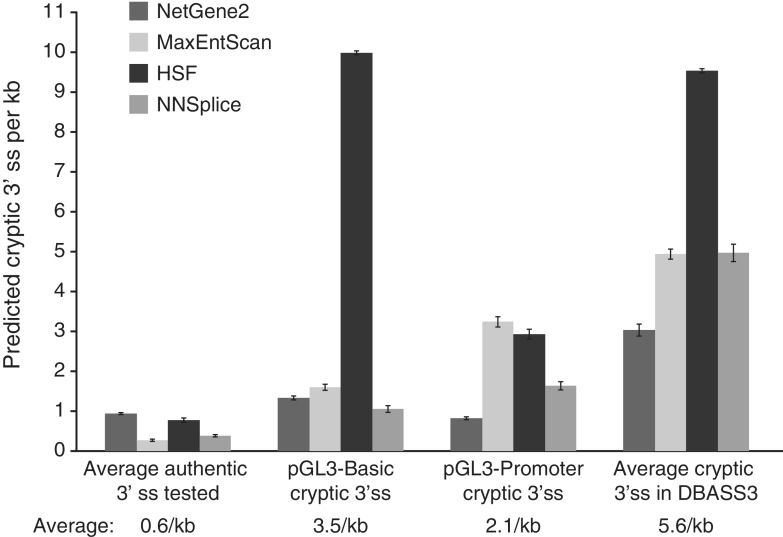
Estimation of the frequency of randomly occurring cryptic 3′ ss in the untranscribed upstream region of genes in the human genome. Three 100-kb random sequences, generated as detailed in Materials and Methods, were analysed by the splice site prediction programs NetGene2, MaxEntScan, HSF and NNSplice. Shown are the average number of predicted 3′ ss per kilobase having scores at least as high as that of the indicated 3′ ss. The ‘average authentic 3′ ss tested’ is the average score of the eIF4G, XIAP, E2A and globin 3′ ss. The pGL3-Control and pGL3-Enhancer cryptic 3′ ss are those identified in this study and shown in figure 5D. The ‘average cryptic 3′ ss in DBASS3’ is the estimated average score of all 3′ ss in the Database of Aberrant 3′ ss (27). Error bars, SD.

References

    1. Gorman CM, Moffat LF, Howard BH. Recombinant genomes which express chloramphenicol acetyltransferase in mammalian cells. Mol. Cell. Biol. 1982;2:1044–1051. - PMC - PubMed
    1. Carey M, Peterson CL, Smale ST. Transcriptional Regulation in Eukaryotes: Concepts, Strategies, and Techniques. 2nd edn. Cold Spring Harbor, NY: Cold Spring Harbor Laboratory Press; 2009.
    1. Maston GA, Evans SK, Green MR. Transcriptional regulatory elements in the human genome. Annu. Rev. Genomics Hum. Genet. 2006;7:29–59. - PubMed
    1. Kozak M. A second look at cellular mRNA sequences said to function as internal ribosome entry sites. Nucleic Acids Res. 2005;33:6593–6602. - PMC - PubMed
    1. Pelletier J, Sonenberg N. Internal initiation of translation of eukaryotic mRNA directed by a sequence derived from poliovirus RNA. Nature. 1988;334:320–325. - PubMed

Publication types