


Ideal cardiovascular health predicts lower risks of myocardial infarction, stroke, and vascular death across whites, blacks, and hispanics: the northern Manhattan study
- PMID: 22619283
- PMCID: PMC3396556
- DOI: 10.1161/CIRCULATIONAHA.111.081083
Ideal cardiovascular health predicts lower risks of myocardial infarction, stroke, and vascular death across whites, blacks, and hispanics: the northern Manhattan study
Abstract
Background: Evidence of the relationship of cardiovascular health (CVH), defined by the American Heart Association, and specific cardiovascular outcomes is lacking, particularly among Hispanics. This study sought to evaluate the relationship between the number of ideal CVH metrics and cardiovascular risk, overall and by event subtype, in a multiethnic community-based prospective cohort.
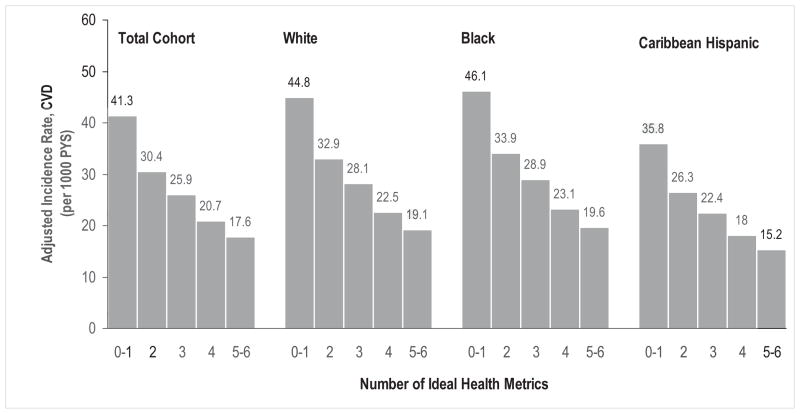
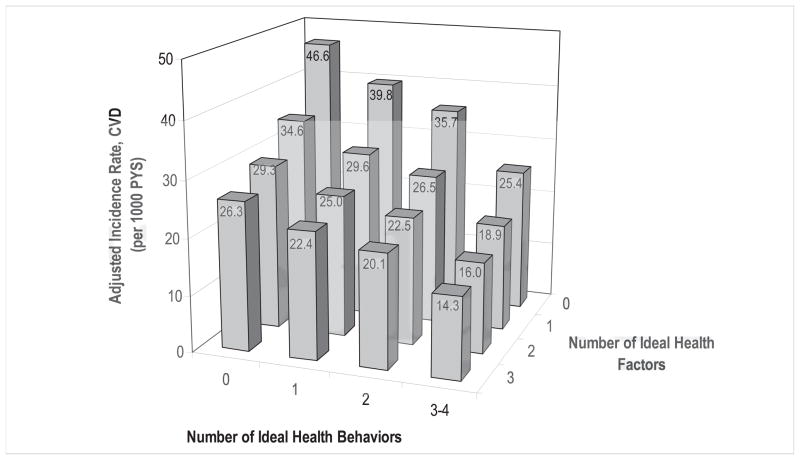
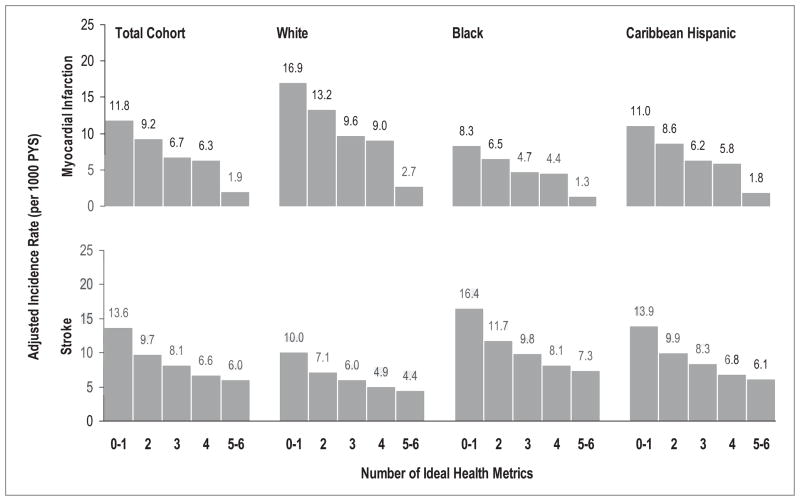
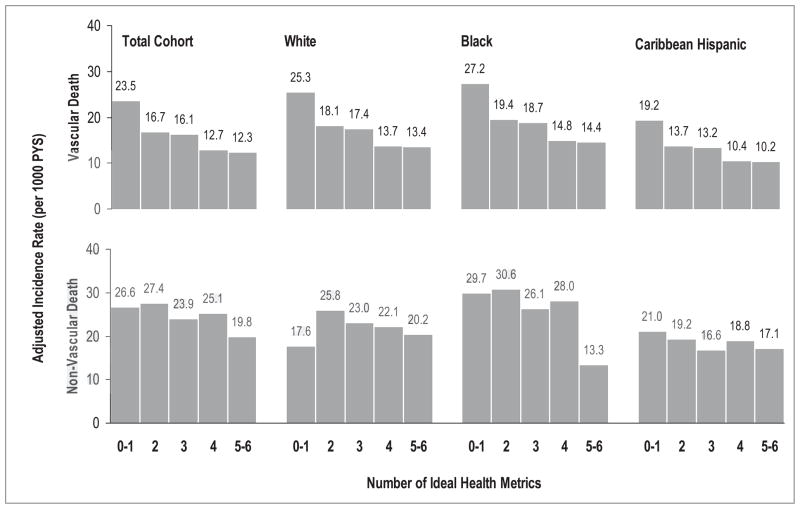
Methods and results: A total of 2981 subjects (mean age, 69±10 years; 54% Caribbean Hispanic, 25% black, 21% white) free of myocardial infarction and stroke at baseline in the Northern Manhattan Study were prospectively followed up (median follow-up, 11 years). The relationship between the number of ideal CVH metrics and the risk of cardiovascular disease, including myocardial infarction, stroke, and vascular death, was investigated. Overall, a strong gradient relationship was observed between the adjusted hazard ratios for cardiovascular disease and the number of ideal CVH metrics: 0.73 (95% confidence interval, 0.60-0.89), 0.61 (95% confidence interval, 0.50-0.76), 0.49 (95% confidence interval, 0.38-0.63), and 0.41 (95% confidence interval, 0.26-0.63) for those having 2, 3, 4, and 5 to 6 ideal CVH metrics, respectively, compared with those having 0 to 1 ideal CVH metrics (P for trend <0.0001). Similar graded relationships were found between the number of ideal CVH metrics and the adjusted incidence rate for each specific outcome and among whites, blacks, and Caribbean Hispanics.
Conclusions: Our findings demonstrated a steep gradient relationship between ideal CVH and individual cardiovascular disease end points, including stroke, that was similar for whites, blacks, and Caribbean Hispanics. This evidence supports the application of the AHA ideal cardiovascular health metrics for cardiovascular disease risk assessment and health promotion for all Americans regardless of race-ethnic background.
Conflict of interest statement
Figures
Comment in
-
Disparities in ideal cardiovascular health: a challenge or an opportunity?Circulation. 2012 Jun 19;125(24):2963-4. doi: 10.1161/CIRCULATIONAHA.112.112680. Epub 2012 May 22. Circulation. 2012. PMID: 22619285 Free PMC article. No abstract available.
References
-
- Kochanek KD, Xu J, Murphy SL, Minino AM, Kung HC. Deaths: Preliminary data for 2009. National Vital Statistics Report. 2011;59:1–67. - PubMed
-
- Ford ES, Capewell S. Coronary heart disease mortality among young adults in the U.S. from 1980 through 2002: concealed leveling of mortality rates. J Am Coll Cardiol. 2007;50:2128–2132. - PubMed
-
- Young F, Capewell S, Ford ES, Critchley JA. Coronary mortality declines in the U.S. between 1980 and 2000 quantifying the contributions from primary and secondary prevention. Am J Prev Med. 2010;39:228–234. - PubMed
-
- Ford ES, Ajani UA, Croft JB, Critchley JA, Labarthe DR, Kottke TE, Giles WH, Capewell S. Explaining the decrease in U.S. deaths from coronary disease, 1980–2000. N Engl J Med. 2007;356:2388–2398. - PubMed
Publication types
MeSH terms
Grants and funding
LinkOut - more resources
Full Text Sources
Medical
