


Low-temperature threshold for egg survival of a post-diapause and non-diapause European aedine strain, Aedes albopictus (Diptera: Culicidae)
- PMID: 22621367
- PMCID: PMC3403971
- DOI: 10.1186/1756-3305-5-100
Low-temperature threshold for egg survival of a post-diapause and non-diapause European aedine strain, Aedes albopictus (Diptera: Culicidae)
Abstract
Background: The interplay between global warming and invasive arthropods in temperate zones is of utmost interest in terms of the potential expansions of vector-borne diseases. Up to now, investigations on the recent establishment of mosquito vectors have focused on temperatures during their phases of activity. However, cold temperatures may also act as a strong ecological constraint. Projected changes in winter climate indicate an increase of mean minimum temperatures of the coldest quarter, less frequent days with frost and a shorter frost-season in Europe at the end of the century. Nevertheless, single cold extremes are also expected to persist under warming scenarios, which have a strong impact on reproduction success.
Methods: Here, the temperature constraints of European Aedes albopictus eggs, which had passed through a diapause, compared to non-diapausing eggs were examined systematically under controlled laboratory conditions. Additionally, one tropical strain of Ae. albopictus and of Ae. aegypti was used in the comparison.
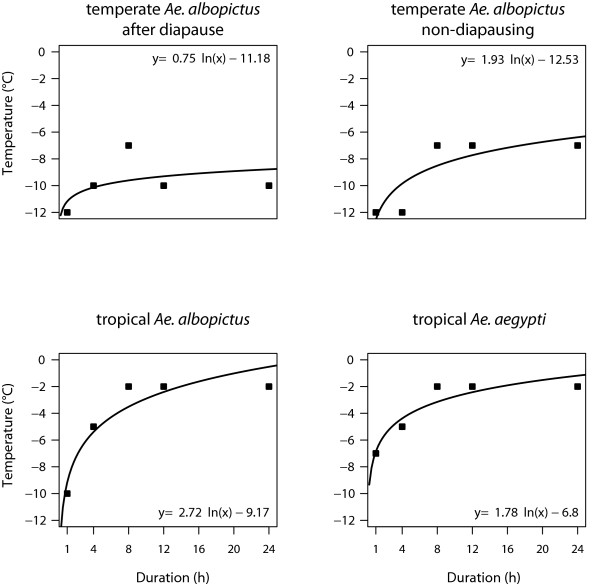
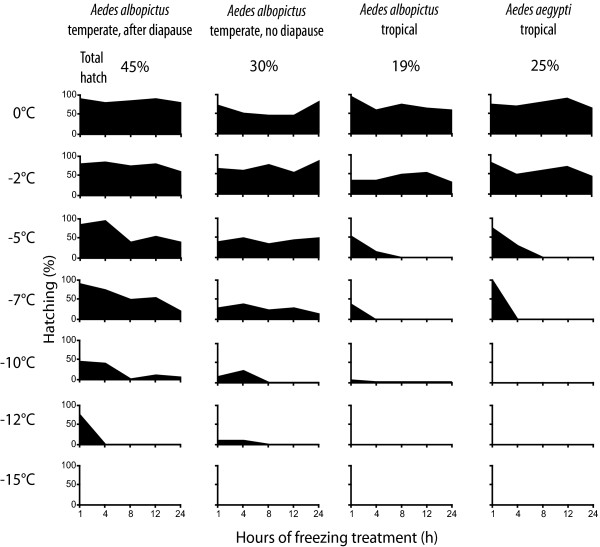
Results: The lower temperature threshold tolerated by the European eggs of Ae. albopictus which have undergone a diapause, was -10°C for long term exposures (12 and 24h) and -12°C for 1h exposure. Non-diapausing eggs of European Ae. albopictus were found to hatch after a -7°C cold treatment (8, 12 and 24h exposure). Both tropical aedine species only tolerated the long term treatment at -2°C. Neither Ae. albopictus nor Ae. aegypti eggs hatched after being exposed to -15°C. Survival was mainly influenced by temperature (F = 329.2, df = 1, p < 0.001), whereas the duration of the cold treatment only significantly influenced the hatching response at the thermal limits of survival (F = 5.6, df = 1, p = 0.031) but not at 0°C (F = 0.1, df = 1, p = 0.730). Hatching success after the cold treatment was significantly increased in European eggs, which have undergone a diapause compared to non-diapausing eggs (F = 14.7, df = 3, p < 0.001). These results illustrate rapid adaptation.
Conclusions: Here, low temperature thresholds for aedine mosquito egg survival were detected. The compilation of risk maps for temperate regions can substantially be improved by considering areas where an establishment of a vector population is unlikely due to winter conditions.
Figures
References
-
- Capelli G, Drago A, Martini S, Montarsi F, Soppelsa M, Delai N, Ravagnan S, Mazzon L, Schaffner F, Mathis A, Di Luca M, Romi R, Russo F. First report in italy of the exotic mosquito species Aedes (Finlaya) koreicus, a potential vector of arboviruses and filariae. Parasites & Vectors. 2011;4:188. doi: 10.1186/1756-3305-4-188. - DOI - PMC - PubMed
Publication types
MeSH terms
LinkOut - more resources
Full Text Sources
Miscellaneous
