


Mild hyperthermia with magnetic resonance-guided high-intensity focused ultrasound for applications in drug delivery
- PMID: 22621734
- PMCID: PMC7641882
- DOI: 10.3109/02656736.2012.680173
Mild hyperthermia with magnetic resonance-guided high-intensity focused ultrasound for applications in drug delivery
Erratum in
- Int J Hyperthermia. 2012;28(5):473
Abstract
Purpose: Mild hyperthermia (40-45 °C) is a proven adjuvant for radiotherapy and chemotherapy. Magnetic resonance guided high intensity focused ultrasound (MR-HIFU) can non-invasively heat solid tumours under image guidance. Low temperature-sensitive liposomes (LTSLs) release their drug cargo in response to heat (>40 °C) and may improve drug delivery to solid tumours when combined with mild hyperthermia. The objective of this study was to develop and implement a clinically relevant MR-HIFU mild hyperthermia heating algorithm for combination with LTSLs.
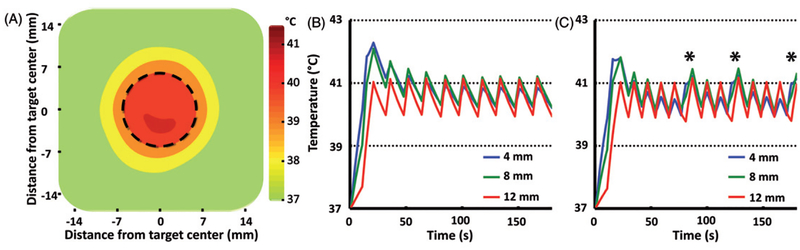
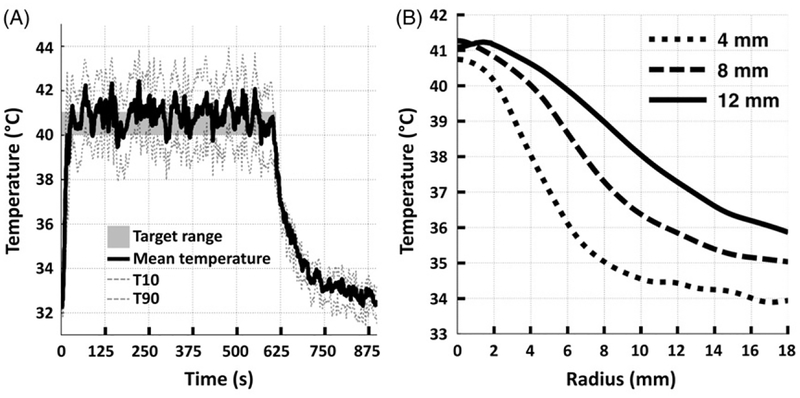
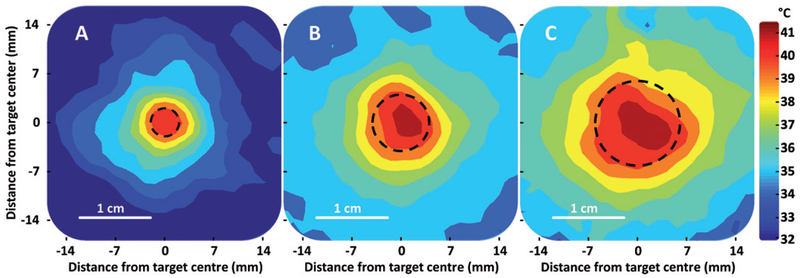
Materials and methods: Sonications were performed with a clinical MR-HIFU platform in a phantom and rabbits bearing VX2 tumours (target = 4-16 mm). A binary control algorithm was used for real-time mild hyperthermia feedback control (target = 40-41 °C). Drug delivery with LTSLs was measured with HPLC. Data were compared to simulation results and analysed for spatial targeting accuracy (offset), temperature accuracy (mean), homogeneity of heating (standard deviation (SD), T10 and T90), and thermal dose (CEM43).
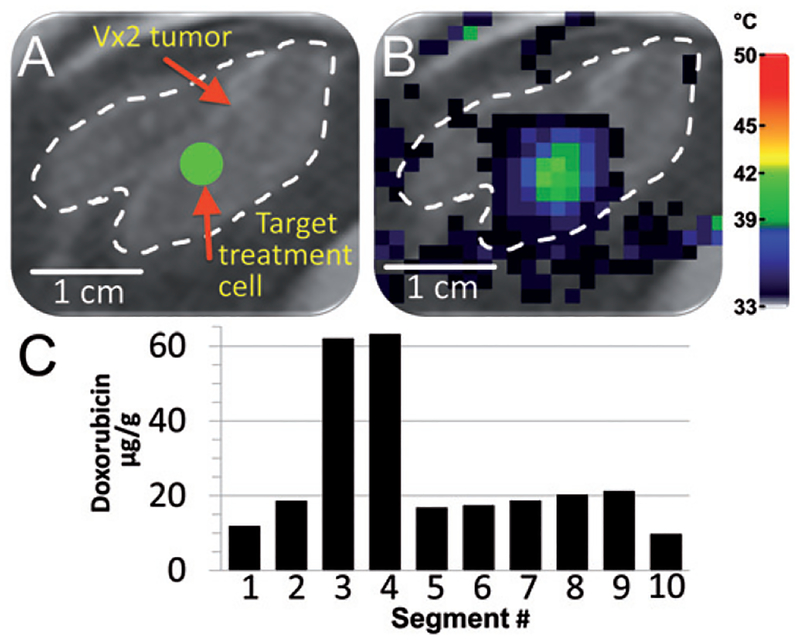
Results: Sonications in a phantom resulted in better temperature control than in vivo. Sonications in VX2 tumours resulted in mean temperatures between 40.4 °C and 41.3 °C with a SD of 1.0-1.5 °C (T10 = 41.7-43.7 °C, T90 = 39.0-39.6 °C), in agreement with simulations. 3D spatial offset was 0.1-3.2 mm in vitro and 0.6-4.8 mm in vivo. Combination of MR-HIFU hyperthermia and LTSLs demonstrated heterogeneous delivery to a partially heated VX2 tumour, as expected.
Conclusions: An MR-HIFU mild hyperthermia heating algorithm was developed, resulting in accurate and homogeneous heating within the targeted region in vitro and in vivo, which is suitable for applications in drug delivery.
Figures
References
-
- Viglianti BL, Stauffer P, Repasky E, Jones E, Vujaskovic Z, Dewhirst MW. Hyperthermia In: Hong W, Bast R Jr, Hait W, Kufe DW, Holland JF, Pollock RE, et al. , editors. Holland Frei Cancer Medicine. Shelton, CT: Peoples Medical Publishing House-USA; 2010. pp 528–540.
-
- Meshorer A, Prionas SD, Fajardo LF, Meyer JL, Hahn GM, Martinez AA. The effects of hyperthermia on normal mesenchymal tissues. Application of a histologic grading system. Arch Pathol Lab Med 1983;107:328–334. - PubMed
-
- Köhler MO, Mougenot C, Quesson B, Enholm J, Le Bail B, Laurent C, et al. Volumetric HIFU ablation under 3D guidance of rapid MRI thermometry. Med Phys 2009;36:3521–3535. - PubMed
Publication types
MeSH terms
Substances
Grants and funding
LinkOut - more resources
Full Text Sources
Research Materials
