


Behavior change counseling curricula for medical trainees: a systematic review
- PMID: 22622220
- PMCID: PMC3386427
- DOI: 10.1097/ACM.0b013e31825837be
Behavior change counseling curricula for medical trainees: a systematic review
Abstract
Purpose: Unhealthy behaviors contribute to half of U.S. deaths. However, physicians lack sufficient skill in counseling patients to change behaviors. Characterizing effective published curricular interventions for behavior change counseling for medical trainees would inform educators toward improved training.
Method: The authors conducted a systematic literature search of studies published between 1965 and 2011 evaluating curricula on behavior change counseling for medical trainees. Included studies described behavior change counseling, teaching interventions for medical trainees, and assessment of interventions. The authors extracted eligible articles, rated outcomes for learners and patients using Kirkpatrick's hierarchy, and determined study quality.
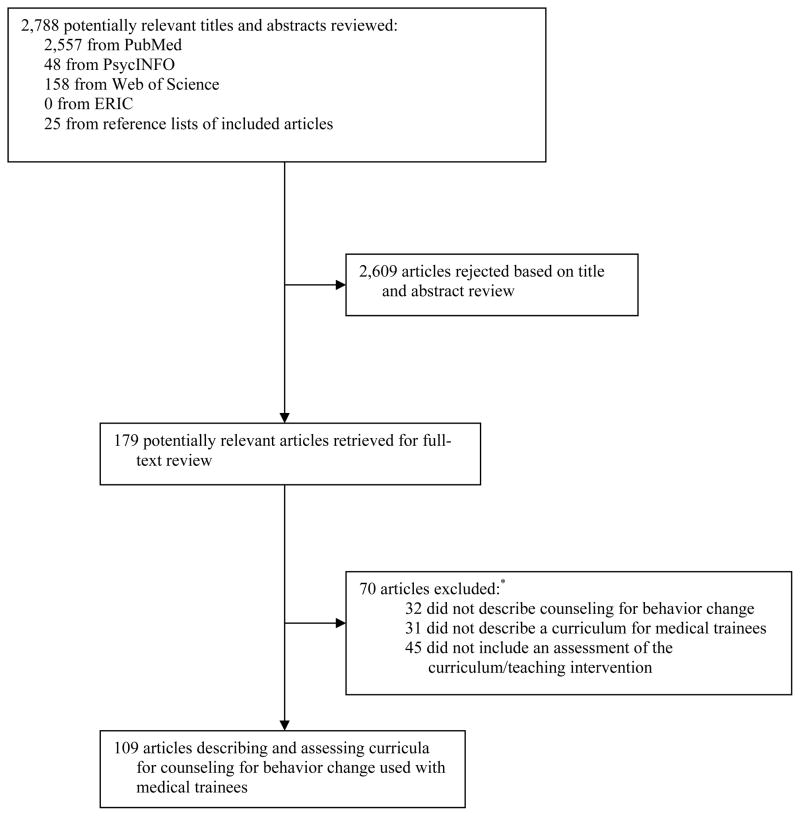
Results: Of 2,788 identified citations, 109 met inclusion criteria. Most studies were performed in the United States (98), 93 at a single institution, and 81 in primary care settings. Curricular topics for counseling included smoking (67 studies), nutrition (30), alcohol/drug use (26), and exercise (22). Although most studies did not include theoretical frameworks, 39 used the Transtheoretical Model of Change. Sixty-two studies involved eight or fewer hours of curricular time, and 51 spanned four or fewer weeks. The studies with highest-level outcomes and quality employed multiple curricular techniques and included practice of counseling techniques in either simulated or actual clinical settings.
Conclusions: Existing literature suggests that trainees learn behavior change counseling through active, realistic practice and implementation of reminder and feedback systems within actual clinical practice settings. Multiinstitutional medical education research on methods of teaching behavior change counseling that influence patients' health outcomes are needed to ensure trainees' clinical competence and improve patient care.
Figures
Comment in
-
Commentary: adding realism and perspective to behavioral counseling curricula for medical students.Acad Med. 2012 Jul;87(7):840-1. doi: 10.1097/ACM.0b013e3182580f56. Acad Med. 2012. PMID: 22735559
References
-
- McGinnis JM, Foege WH. Actual causes of death in the United States. JAMA. 1993;270:2207–2212. - PubMed
-
- Gortmaker SL, Must A, Perrin JM, Sobol AM, Dietz WH. Social and economic consequences of overweight in adolescence and young adulthood. N Engl J Med. 1993;329:1008–1012. - PubMed
-
- Bodenheimer T, Wagner EH, Grumbach K. Improving primary care for patients with chronic illness: The chronic care model, part 2. JAMA. 2002;288:1909–1914. - PubMed
-
- Health Care Financing and Administration, Department of Health and Human Services. [Accessed March 22, 2012];HHS Fiscal Year 2000 Freedom of Information Annual Report. http://www.hhs.gov/foia/reports/00anlrpt.html.
-
- Breckon JD, Johnston LH, Hutchison A. Physical activity counseling content and competency: a systematic review. J Phys Act Health. 2008;5:398–417. - PubMed
Cited Only in Table 2
-
- Haist SA, Wilson JF, Pursley HG, et al. Domestic violence: Increasing knowledge and improving skills with a four-hour workshop using standardized patients. Prev Med. 2003;78(10 Suppl):S24–S26. - PubMed
-
- Martino S, Haeseler F, Belitsky R, Pantalon M, Fortin AF., 4th Teaching brief motivational interviewing to year three medical students. Med Educ. 2007;41:160–167. - PubMed
-
- Leong SL, Lewis PR, Curry WJ, Gingrich DL. Tobacco World: Evaluation of a tobacco cessation training program for third-year medical students. Prev Med. 2008;83(10 Suppl):S25–S28. - PubMed
-
- Allen SS, Bland CJ, Dawson SJ. A mini-workshop to train medical students to use a patient-centered approach to smoking cessation. Am J Prev Med. 1990;6:28–33. - PubMed
