


The early decline in renal function in patients with type 1 diabetes and proteinuria predicts the risk of end-stage renal disease
- PMID: 22622493
- PMCID: PMC3425658
- DOI: 10.1038/ki.2012.189
The early decline in renal function in patients with type 1 diabetes and proteinuria predicts the risk of end-stage renal disease
Abstract
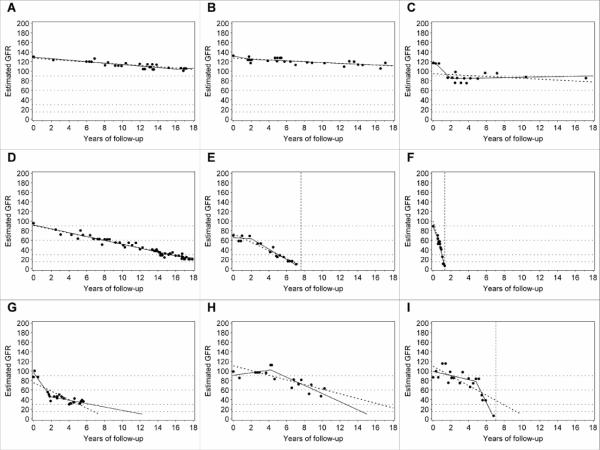
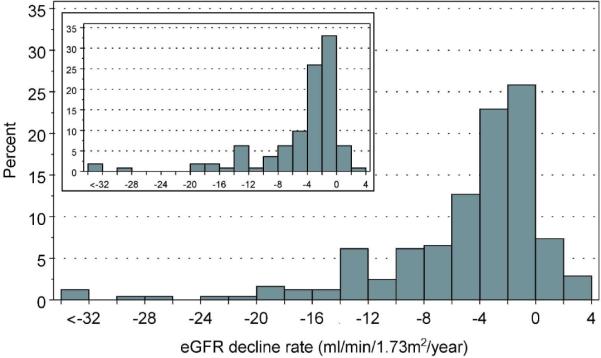
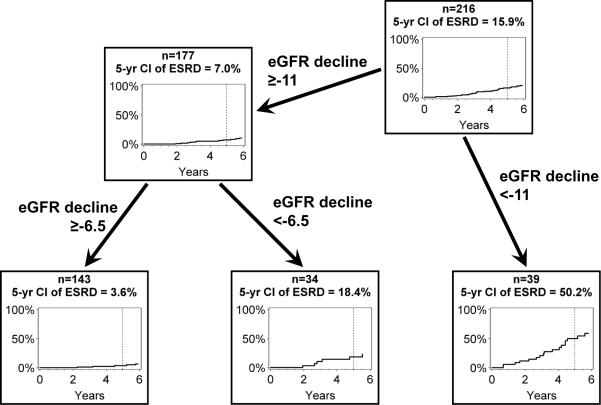
The risk of end-stage renal disease (ESRD) remains high in patients with type 1 diabetes and proteinuria; however, little is known about the rate of decline in their renal function. To help determine this, we enrolled patients with type 1 diabetes and proteinuria whose estimated glomerular filtration rate (eGFR) was normal (equal to or above 60 ml/min per 1.73 m(2)). Using a minimum of five serial measurements of serum creatinine for 161 patients, we determined individual trajectories of eGFR change and the occurrence of ESRD during 5-18 years of follow-up. The rates were linear for 110 patients, for 24 the nonlinear rate was mild enough to satisfy a linear model, and the rates were clearly nonlinear for only 27 patients. Overall, in more than one-third of patients, the eGFR decline was less than 3.5 ml/min per 1.73 m(2) per year and the lifetime risk of ESRD could be considered negligible. In the remainder of patients, eGFR declined with widely different slopes and ESRD developed within 2 to 18 years. Based on up to 5 years observation, when renal function was within the normal range, the estimates of early eGFR slope predicted the risk of ESRD during subsequent follow-up better than the baseline clinical characteristics of glycated hemoglobin, blood pressure, or the albumin to creatinine ratio. Thus, the early slope of eGFR decline in patients with type 1 diabetes and proteinuria can be used to predict the risk of ESRD.
Figures
References
-
- Kelly KJ, Dominguez JH. Rapid progression of diabetic nephropathy is linked to inflammation and episodes of acute renal failure. Am J Nephrol. 2010;32:469–475. - PubMed
-
- Mitch WE, Walser M, Buffington GA, et al. A Simple Method of Estimating Progression of Chronic Renal Failure. Lancet. 1976;2:1326–1328. - PubMed
-
- Jones RH, Hayakawa H, Mackay JD, Parsons V, Watkins PJ. Progression of diabetic nephropathy. Lancet. 1979;1:1105–1106. - PubMed
Publication types
MeSH terms
Substances
Grants and funding
LinkOut - more resources
Full Text Sources
Other Literature Sources
Medical
Research Materials
Miscellaneous
