


Wasting is associated with stunting in early childhood
- PMID: 22623393
- PMCID: PMC3374667
- DOI: 10.3945/jn.111.154922
Wasting is associated with stunting in early childhood
Abstract
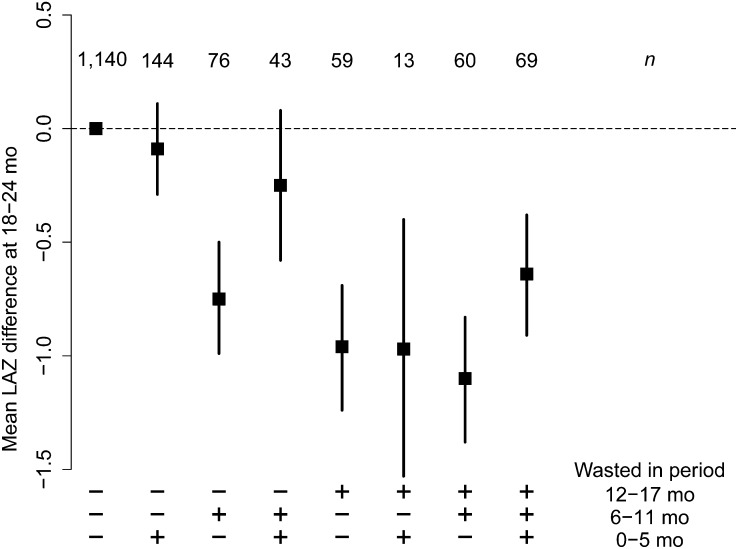
The longitudinal relationship between stunting and wasting in children is poorly characterized. Instances of wasting or poor weight gain may precede linear growth retardation. We analyzed longitudinal anthropometric data for 1599 children from 8 cohort studies to determine the effect of wasting [weight-for-length Z-score (WLZ) < -2] and variability in WLZ in the first 17 mo on length-for-age Z-score (LAZ) at 18-24 mo of age. In addition, we considered the effects of change in WLZ during the previous 6-mo period on length at 18 and 24 mo. Wasting at 6-11 or 12-17 mo was associated with decreased LAZ; however, children who experienced wasting only at 0-5 mo did not suffer any long-term growth deficits compared with children with no wasting during any period. Children with greater WLZ variability (≥0.5 SD) in the first 17 mo of life were shorter [LAZ = -0.51 SD (95% CI: -0.67, -0.36 SD)] at 18-24 mo of age than children with WLZ variability <0.5. Change in WLZ in the previous 6-mo period was directly associated with greater attained length at 18 mo [0.33 cm (95% CI: 0.11, 0.54 cm)] and 24 mo [0.72 cm (95% CI: 0.52, 0.92 cm)]. Children with wasting, highly variable WLZ, or negative changes in WLZ are at a higher risk for linear growth retardation, although instances of wasting may not be the primary cause of stunting in developing countries.
Conflict of interest statement
Author disclosures: S. A. Richard, R. E. Black, R. H. Gilman, R. L. Guerrant, G. Kang, C. F. Lanata, K. Mølbak, Z. A. Rasmussen, R. Bradley Sack, P. Valentiner-Branth, and W. Checkley, no conflicts of interest.
Figures


References
-
- Black RE, Allen LH, Bhutta ZA, Caulfield LE, de Onis M, Ezzati M, Mathers C, Rivera J. Maternal and child undernutrition: global and regional exposures and health consequences. Lancet. 2008;371:243–60 - PubMed
-
- The Millennium Development Goals Report 2010. New York: United Nations Department of Economic and Social Affairs; 2010
-
- Hoddinott J, Maluccio JA, Behrman JR, Flores R, Martorell R. Effect of a nutrition intervention during early childhood on economic productivity in Guatemalan adults. Lancet. 2008;371:411–6 - PubMed
Publication types
MeSH terms
Grants and funding
LinkOut - more resources
Full Text Sources
Medical
