. 2012 Jul;21(7):1019-27.
doi: 10.1158/1055-9965.EPI-12-0190-T. Epub 2012 May 23.

The MTAP-CDKN2A locus confers susceptibility to a naturally occurring canine cancer

Affiliations

The MTAP-CDKN2A locus confers susceptibility to a naturally occurring canine cancer

Abigail L Shearin et al. Cancer Epidemiol Biomarkers Prev. 2012 Jul.

Abstract

Background: Advantages offered by canine population substructure, combined with clinical presentations similar to human disorders, makes the dog an attractive system for studies of cancer genetics. Cancers that have been difficult to study in human families or populations are of particular interest. Histiocytic sarcoma is a rare and poorly understood neoplasm in humans that occurs in 15% to 25% of Bernese Mountain Dogs (BMD).

Methods: Genomic DNA was collected from affected and unaffected BMD in North America and Europe. Both independent and combined genome-wide association studies (GWAS) were used to identify cancer-associated loci. Fine mapping and sequencing narrowed the primary locus to a single gene region.

Results: Both populations shared the same primary locus, which features a single haplotype spanning MTAP and part of CDKN2A and is present in 96% of affected BMD. The haplotype is within the region homologous to human chromosome 9p21, which has been implicated in several types of cancer.

Conclusions: We present the first GWAS for histiocytic sarcoma in any species. The data identify an associated haplotype in the highly cited tumor suppressor locus near CDKN2A. These data show the power of studying distinctive malignancies in highly predisposed dog breeds.

Impact: Here, we establish a naturally occurring model of cancer susceptibility due to CDKN2 dysregulation, thus providing insight about this cancer-associated, complex, and poorly understood genomic region.


Figures

Figure 1
Figure 1
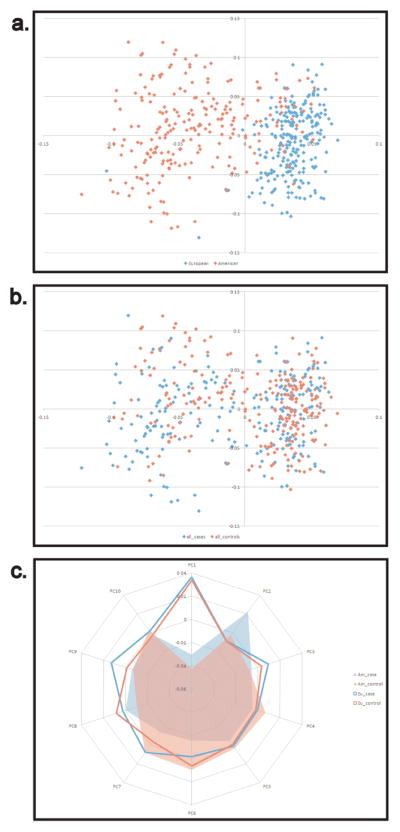
PCA of BMD populations from Europe and North America. PCs were calculated from whole genome SNP data in cases and controls from NA and Europe. a) Two distinct yet overlapping populations are identified when comparing North American (red) and European (blue) populations (Fst = 0.01). b) Cases and controls are distributed evenly throughout both populations (Fst=0.001). c) Only one of the top ten principal components differentiates cases from controls, all others divided the samples along continental lines. NA cases=red fill, NA controls=blue fill, European cases=red line, European controls=blue line.
Figure 2
Figure 2
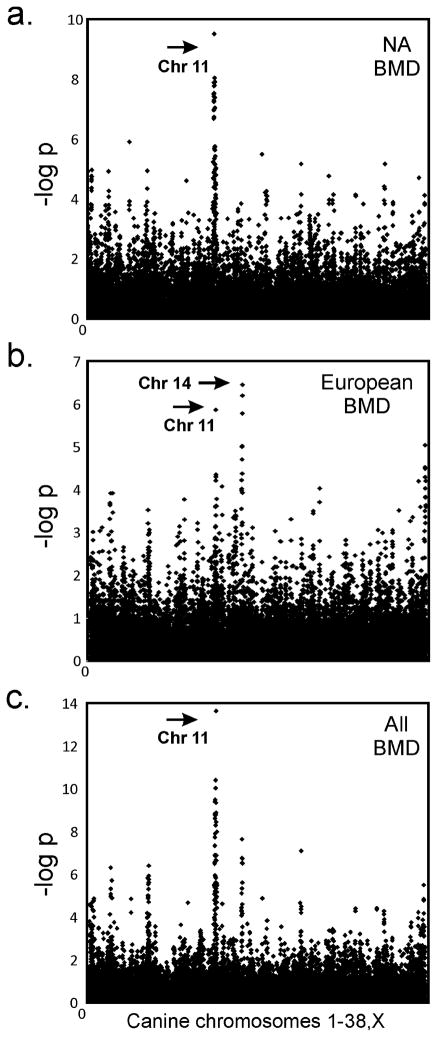
Genome wide analyses of HS in two populations of BMD identify an association on CFA11. The Y-axis indicates the negative log of the uncorrected p-value. The X- axis shows marker position from the top of CFA1 through CFAX. a) 240 U.S. BMD with maximum association at CFA11 bp 41,359,032, praw=1.41 × 10−09. b) 234 European BMD with two peaks of association, CFA11 bp 47,179,346, praw=1.50 × 10⁻⁶ and CFA14, praw=9.80 × 10⁻⁸. c) U.S. and European cohorts combined for a total of 474 dogs with maximum association at CFA11 bp 47,179,346, praw=1.11 × 10⁻¹³. Additional peaks found on chromosomes 2, 5 and 20 are reduced to background levels after correcting for population structure.
Figure 3
Figure 3
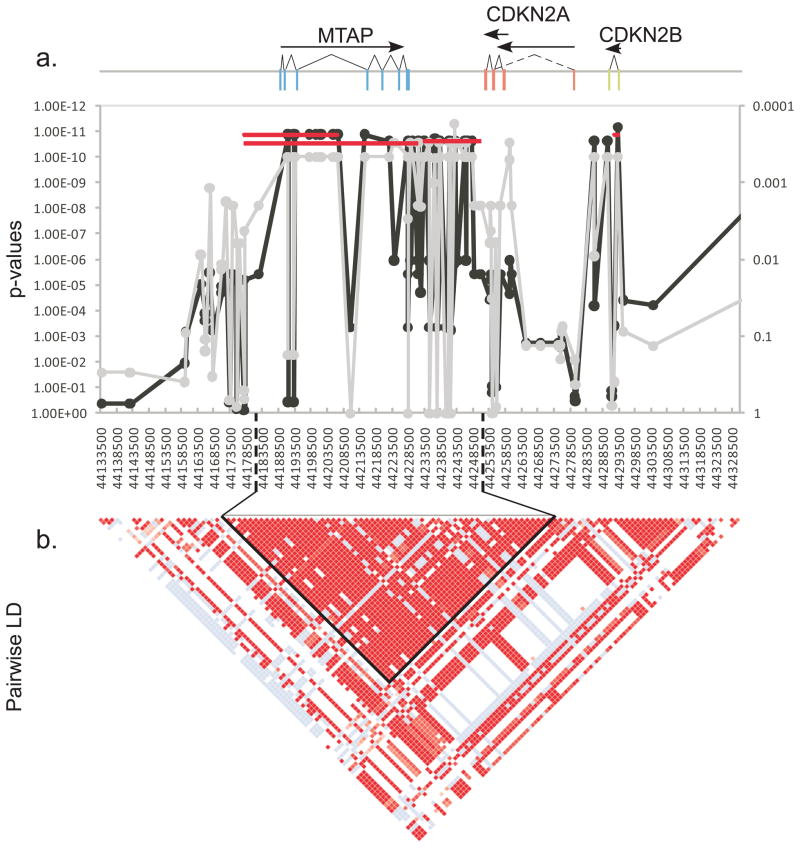
A 75 kb region spanning the MTAP gene and continuing through the last exon of CDKN2A is highly associated with histiocytic sarcoma. A 195 kb region between CFA11 44,133,500 and 44,328,500 is shown. The X-axes for all plots list the SNPs in order from centromere to telomere. a) Positions of three genes are shown at the top of the graph. Exons are indicated as colored rectangles, introns are the connecting lines. Transcripts are indicated as arrows below gene names. Fisher’s exact association of allele frequency with HS is plotted along the Y-axis for each SNP. The gray line shows association in the discovery set of 24 cases and 20 controls with p-values on the right Y-axis. The black line shows association in the full dataset after imputation, with p-values on the left Y-axis. The red lines show association of the haplotypes across the region with the p-values in the left y-axis. b) Pairwise LD plot was calculated using Haploview. Solid red blocks indicate D′ =1 with a LOD score of 2. The haplotype block containing 28 of 30 equally associated SNPs is outlined in black. Another two SNPs form a short 3.4 kb haplotype in the CDKN2B region in perfect LD with the larger 75kb haplotype. Differences in p-values between the haplotypes are the result of a single crossover in a control dog.
Figure 4
Figure 4
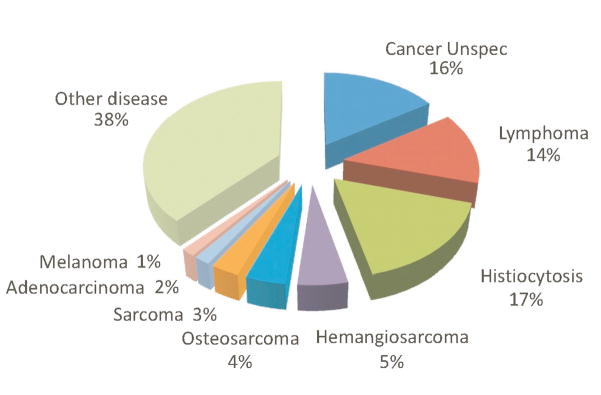
Diagnoses for 3,785 BMD who have died since 1995 collected by the Berner Garde Foundation. Frequency was determined by dividing individual cancers by the total number of BMD deaths. “Histiocytosis” includes histiocytic sarcomas, malignant histiocytosis, reactive histiocytoses.

References

    1. Bodmer W, Bonilla C. Common and rare variants in multifactorial susceptibility to common diseases. Nat Genet. 2008;40:695–701. - PMC - PubMed
    1. Ioannidis JP, Castaldi P, Evangelou E. A compendium of genome-wide associations for cancer: critical synopsis and reappraisal. J Natl Cancer Inst. 2010;102:846–58. - PMC - PubMed
    1. Khanna C, Lindblad-Toh K, Vail D, London C, Bergman P, Bergman P, et al. The dog as a cancer model. Nat Biotech. 2006;24:1065–6. - PubMed
    1. Shearin AL, Ostrander EA. Leading the way: canine models of genomics and disease. Dis Model Mech. 2010;3:27–34. - PMC - PubMed
    1. Bronson RT. Variation in age at death of dogs of different sexes and breeds. Am J Vet Res. 1982;43:2057–9. - PubMed

Publication types

Substances