


Exposure to radiofrequency electromagnetic fields and sleep quality: a prospective cohort study
- PMID: 22624036
- PMCID: PMC3356284
- DOI: 10.1371/journal.pone.0037455
Exposure to radiofrequency electromagnetic fields and sleep quality: a prospective cohort study
Abstract
Background: There is persistent public concern about sleep disturbances due to radiofrequency electromagnetic field (RF-EMF) exposure. The aim of this prospective cohort study was to investigate whether sleep quality is affected by mobile phone use or by other RF-EMF sources in the everyday environment.
Methods: We conducted a prospective cohort study with 955 study participants aged between 30 and 60 years. Sleep quality and daytime sleepiness was assessed by means of standardized questionnaires in May 2008 (baseline) and May 2009 (follow-up). We also asked about mobile and cordless phone use and asked study participants for consent to obtain their mobile phone connection data from the mobile phone operators. Exposure to environmental RF-EMF was computed for each study participant using a previously developed and validated prediction model. In a nested sample of 119 study participants, RF-EMF exposure was measured in the bedroom and data on sleep behavior was collected by means of actigraphy during two weeks. Data were analyzed using multivariable regression models adjusted for relevant confounders.
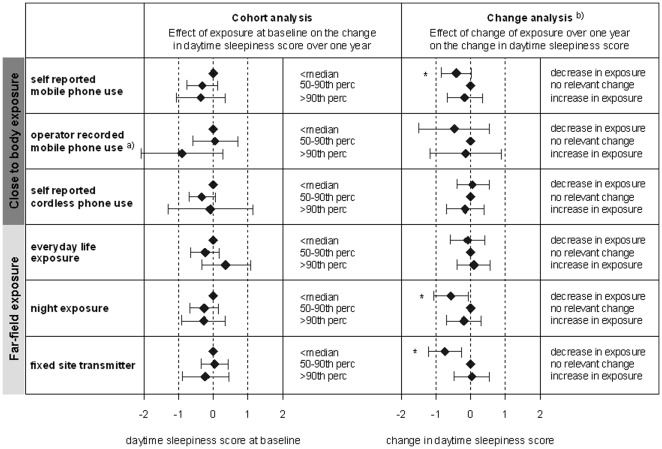
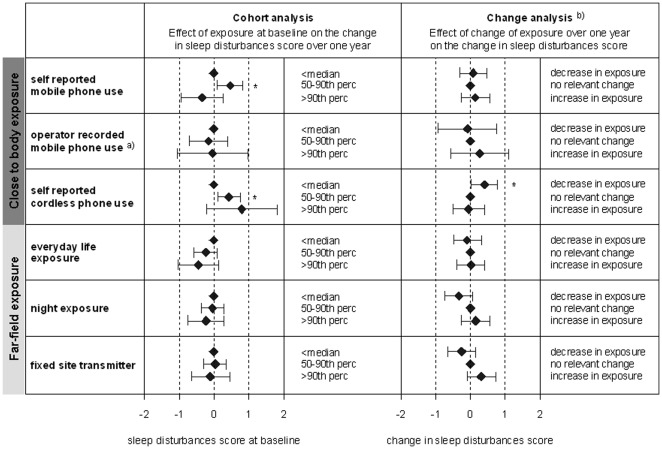
Results: In the longitudinal analyses neither operator-recorded nor self-reported mobile phone use was associated with sleep disturbances or daytime sleepiness. Also, exposure to environmental RF-EMF did not affect self-reported sleep quality. The results from the longitudinal analyses were confirmed in the nested sleep study with objectively recorded exposure and measured sleep behavior data.
Conclusions: We did not find evidence for adverse effects on sleep quality from RF-EMF exposure in our everyday environment.
Conflict of interest statement
Figures
References
-
- Frei P, Mohler E, Neubauer G, Theis G, Bürgi A, et al. Temporal and spatial variability of personal exposure to radio frequency electromagnetic fields. Environ Res. 2009;109:779–785. - PubMed
-
- Neubauer G, Feychting M, Hamnerius Y, Kheifets L, Kuster N, et al. Feasibility of future epidemiological studies on possible health effects of mobile phone base stations. Bioelectromagnetics. 2007;28:224–230. - PubMed
-
- Huss A, Kuchenhoff J, Bircher A, Heller P, Kuster H, et al. Symptoms attributed to the environment–a systematic, interdisciplinary assessment. Int J Hyg Environ Health. 2004;207:245–254. - PubMed
-
- Infas . Ermittlung der Befürchtungen und Ängste der breiten Öffentlichkeit hinsichtlich möglicher Gefahren der hochfrequenten elektromagnetischen Felder des Mobilfunks: Abschlussbericht über die Befragung im Jahr 2010. Bonn: Institut für angewandte Sozialwissenschaft GmbH; 2010.
-
- Schreier N, Huss A, Röösli M. The prevalence of symptoms attributed to electromagnetic field exposure: a cross-sectional representative survey in Switzerland. Soz Praventivmed. 2006;51:202–209. - PubMed
Publication types
MeSH terms
LinkOut - more resources
Full Text Sources
Medical
