


Cluster-randomized trial on complementary and responsive feeding education to caregivers found improved dietary intake, growth and development among rural Indian toddlers
- PMID: 22625182
- PMCID: PMC3434308
- DOI: 10.1111/j.1740-8709.2012.00413.x
Cluster-randomized trial on complementary and responsive feeding education to caregivers found improved dietary intake, growth and development among rural Indian toddlers
Abstract
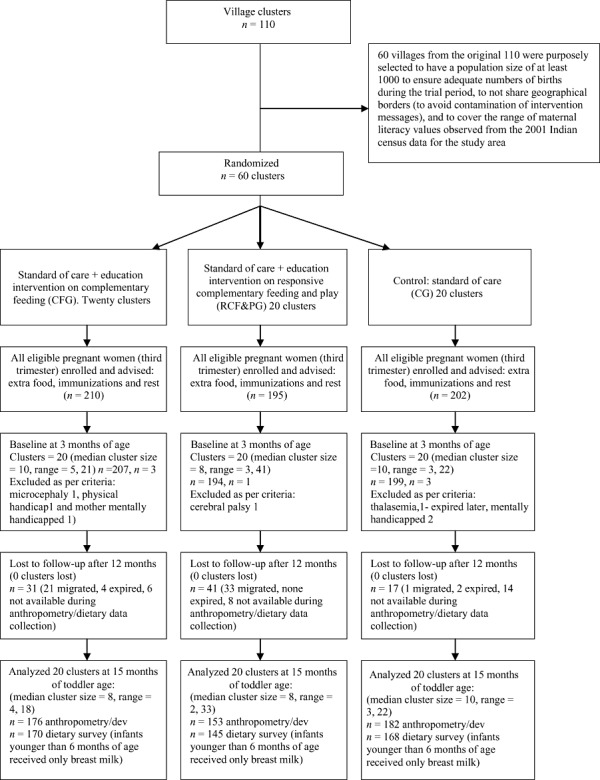
Inadequate feeding and care may contribute to high rates of stunting and underweight among children in rural families in India. This cluster-randomized trial tested the hypothesis that teaching caregivers appropriate complementary feeding and strategies for how to feed and play responsively through home-visits would increase children's dietary intake, growth and development compared with home-visit-complementary feeding education alone or routine care. Sixty villages in Andhra Pradesh were randomized into three groups of 20 villages with 200 mother-infant dyads in each group. The control group (CG) received routine Integrated Child Development Services (ICDS); the complementary feeding group (CFG) received the ICDS plus the World Health Organization recommendations on breastfeeding and complementary foods; and the responsive complementary feeding and play group (RCF&PG) received the same intervention as the CFG plus skills for responsive feeding and psychosocial stimulation. Both intervention groups received bi-weekly visits by trained village women. The groups did not differ at 3 months on socioeconomic status, maternal and child nutritional indices, and maternal depression. After controlling for potential confounding factors using the mixed models approach, the 12-month intervention to the CFG and RCF&PG significantly (P < 0.05) increased median intakes of energy, protein, Vitamin A, calcium (CFG), iron and zinc, reduced stunting [0.19, confidence interval (CI): 0.0-0.4] in the CFG (but not RCF&PG) and increased (P < 0.01) Bayley Mental Development scores (mean = 3.1, CI: 0.8-5.3) in the RCF&PG (but not CFG) compared with CG. Community-based educational interventions can improve dietary intake, length (CFG) and mental development (RCF&PG) for children under 2 years in food-secure rural Indian families.
© 2012 Blackwell Publishing Ltd.
Conflict of interest statement
The authors declare that they have no conflicts of interest.
Figures
References
-
- Aboud F.E. & Akhter S. (2011) A cluster‐randomized evaluation of a responsive stimulation and feeding intervention in Bangladesh. Pediatrics 127, e1191–e1197. - PubMed
-
- Aboud F.E., Shafique S. & Akhter S. (2009) A responsive feeding intervention increases children's self‐feeding and maternal responsiveness but not weight gain. The Journal of Nutrition 139, 1738–1743. - PubMed
-
- Bayley N. (1993) Bayley Scales of Infant Development (BSID‐II). The Psychological Corporation: San Antonio, TX.
