


Relationships between total and allergen-specific serum IgE concentrations and lung function in young adults
- PMID: 22626596
- PMCID: PMC3956048
- DOI: 10.1016/j.anai.2012.04.008
Relationships between total and allergen-specific serum IgE concentrations and lung function in young adults
Abstract
Background: Prior studies have shown relationships between serum immunoglobulin E (IgE) and asthma.
Objective: To investigate relationships between total and allergen-specific IgE concentrations and lung function in young adults.
Methods: Measurements of total IgE, allergen-specific IgE to 6 common allergens, and spirometry (forced expiratory volume in one second [FEV(1)], forced vital capacity [FVC], FEV(1)/FVC, and percent change in FEV(1) after bronchodilation) were used to calculate correlations between the logarithmically transformed IgE values and measures of lung function among participants in a birth cohort not selected for risk of allergic disease stratified by current asthma, prior asthma, or no asthma.
Results: The 428 participants were 51.6% female, 93% white, and 18.4 (standard deviation = 0.6) years old. Forty-eight (11.2%) had current asthma, 55 (12.9%) had a history of asthma, and 325 (75.9%) never had asthma. For males with current asthma, correlations between total IgE and FEV(1)% and FVC% were -0.51 (P = .06) and -0.70 (P = .005), respectively. For females with current asthma, the only significant correlation was between total IgE and the FEV(1)/FVC ratio (-0.55, P = .001). After excluding smokers and individuals without detectable allergen-specific IgE, the negative correlations for both males and females remained statistically significant. The correlations among males or females with prior asthma or no history of asthma were minimal and not statistically significant. The sum of the allergen-specific IgEs showed the same pattern of relationships to lung function as did total IgE.
Conclusion: Our results show significant negative correlations that vary by gender between both total and allergen-specific IgE and measurements of lung function in young adults with current asthma.
Copyright © 2012 American College of Allergy, Asthma & Immunology. Published by Elsevier Inc. All rights reserved.
Conflict of interest statement
None of the authors have any real or potential conflicts of interest with any of the information presented in the manuscript.
Figures
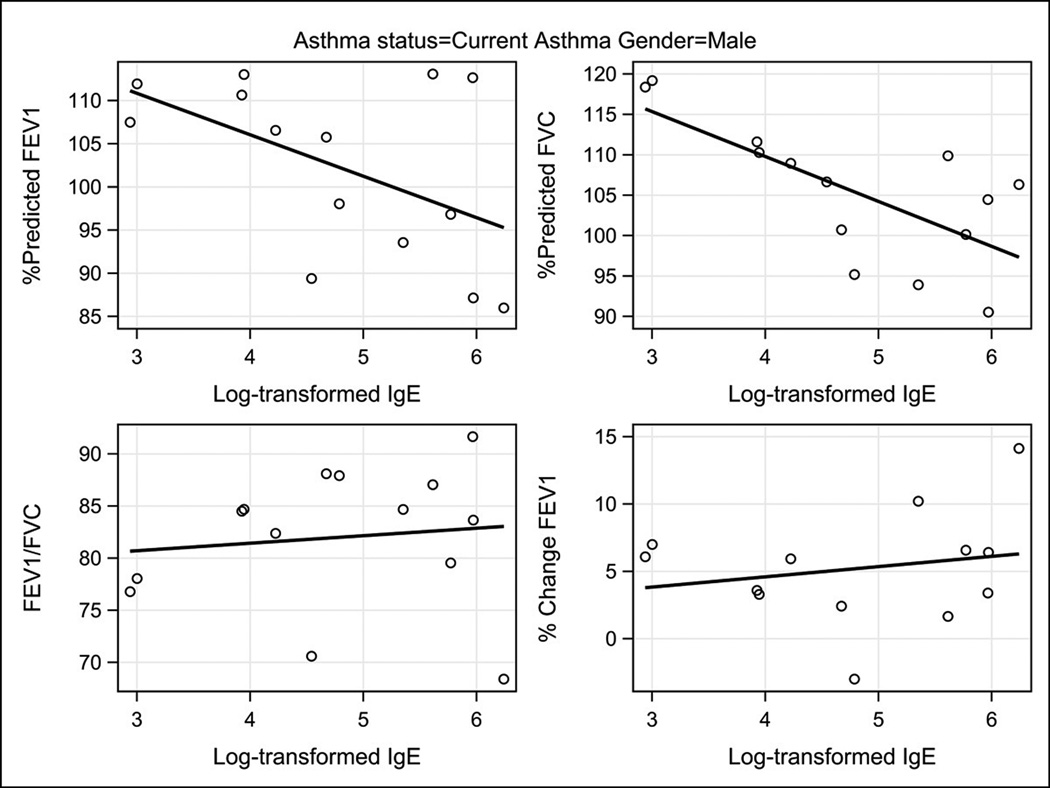
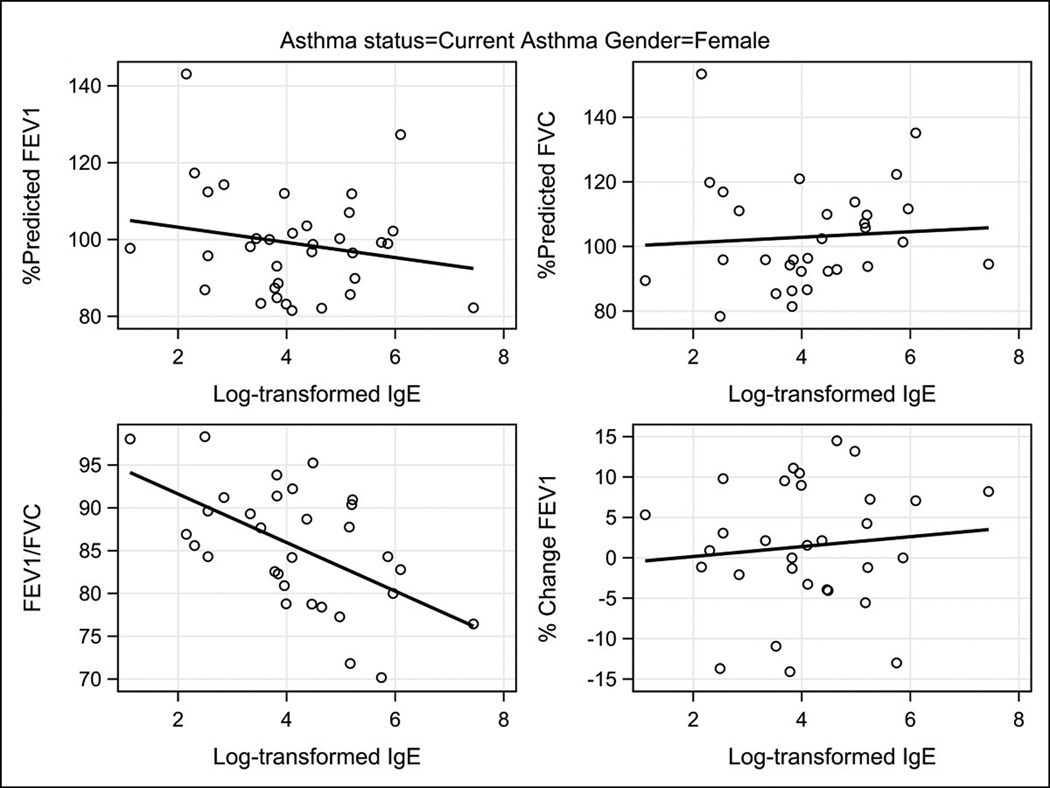
References
-
- Burrows B, Martinez FD, Halonen M, Barbee RA, Cline MG. Association of asthma with serum IgE levels and skin-test reactivity to allergens. N Engl J Med. 1989;320:271–277. - PubMed
-
- Sears MR, Burrows B, Flannery EM, Herbison GP, Hewitt CJ, Holdaway MD. Relation between airway responsiveness and serum IgE in children with asthma and in apparently normal children. N Engl J Med. 1991;325:1067–1071. - PubMed
-
- Vollmer WM, Buist AS, Johnson LR, McCamant LE, Halonen M. Relationship between serum IgE and cross-sectional and longitudinal FEV1 in two cohort studies. Chest. 1986;90:416–423. - PubMed
-
- Grunstein MM, Hakonarson H, Leiter J, et al. IL-13-dependent autocrine signaling mediates altered responsiveness of IgE-sensitized airway smooth muscle. Am J Physiol Lung Cell Mol Physiol. 2002;282(3):L520–L528. - PubMed
