


Improving growth and productivity of Oleiferous Brassicas under changing environment: significance of nitrogen and sulphur nutrition, and underlying mechanisms
- PMID: 22629181
- PMCID: PMC3353521
- DOI: 10.1100/2012/657808
Improving growth and productivity of Oleiferous Brassicas under changing environment: significance of nitrogen and sulphur nutrition, and underlying mechanisms
Abstract
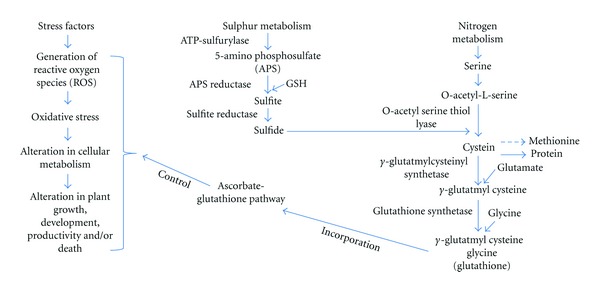
Mineral nutrients are the integral part of the agricultural systems. Among important plant nutrients, nitrogen (N) and sulphur (S) are known essential elements for growth, development, and various physiological functions in plants. Oleiferous brassicas (rapeseed and mustard) require higher amounts of S in addition to N for optimum growth and yield. Therefore, balancing S-N fertilization, optimization of nutrient replenishment, minimization of nutrient losses to the environment, and the concept of coordination in action between S and N could be a significant strategy for improvement of growth and productivity of oleiferous brassicas. Additionally, positive interaction between S and N has been reported to be beneficial for various aspects of oilseed brassicas. The current paper updates readers on the significance of N and S for the improvement of plant growth, development, and productivity in detail. In addition, S-N nutrition-mediated control of major plant antioxidant defense system components involved in the removal and/or metabolism of stress-induced/generated reactive oxygen species in plants (hence, the control of plant growth, development, and productivity) has been overviewed.
Figures
References
-
- Körbitz W. Biodiesel production in Europe and North America, an encouraging prospect. Renewable Energy. 1999;16(1–4):1078–1083.
-
- Cardone M, Mazzoncini M, Menini S, et al. Brassica carinata as an alternative oil crop for the production of biodiesel in Italy: agronomic evaluation, fuel production by transesterification and characterization. Biomass and Bioenergy. 2003;25(6):623–636.
-
- Bouaid A, Martinez M, Aracil J. Production of biodiesel from bioethanol and Brassica carinata oil: oxidation stability study. Bioresource Technology. 2009;100(7):2234–2239. - PubMed
-
- Jham GN, Moser BR, Shah SN, et al. Wild Brazilian mustard (Brassica juncea L.) seed oil methyl esters as biodiesel fuel. JAOCS: Journal of the American Oil Chemists’ Society. 2009;86(9):917–926.
-
- FAOSTAT (2006-2007) http://faostat.fao.org/, http://www.springerlink.com/content/n1q5848216146kj6/fulltext.pdf.
Publication types
MeSH terms
Substances
LinkOut - more resources
Full Text Sources
