


Evaluation of expression and function of vascular endothelial growth factor receptor 2, platelet derived growth factor receptors-alpha and -beta, KIT, and RET in canine apocrine gland anal sac adenocarcinoma and thyroid carcinoma
- PMID: 22630170
- PMCID: PMC3542001
- DOI: 10.1186/1746-6148-8-67
Evaluation of expression and function of vascular endothelial growth factor receptor 2, platelet derived growth factor receptors-alpha and -beta, KIT, and RET in canine apocrine gland anal sac adenocarcinoma and thyroid carcinoma
Abstract
Background: Toceranib phosphate (Palladia) has a reported objective response rate of 25% in both canine apocrine gland anal sac adenocarcinoma (AGASACA) and thyroid carcinoma (TC), with stable disease occurring in an additional 50-60% of dogs. The basis for the observed responses to toceranib is not known. The purpose of this study was to evaluate AGASACA and TC samples for the expression and activation of VEGFR2, PDGFRα, PDGFRβ, KIT and RET to assess whether dysregulation of these receptor tyrosine kinases (RTKs) may contribute to the biologic activity of toceranib.
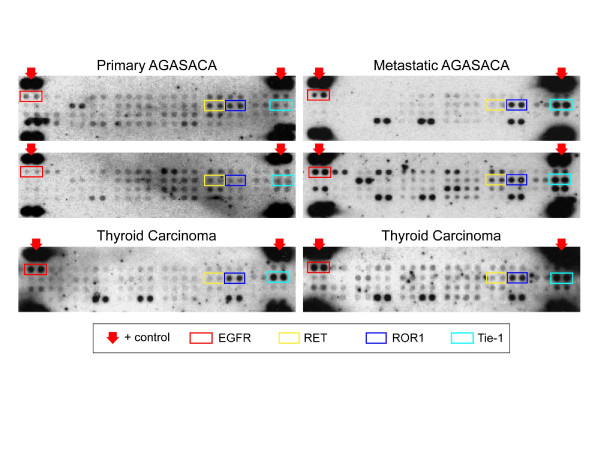
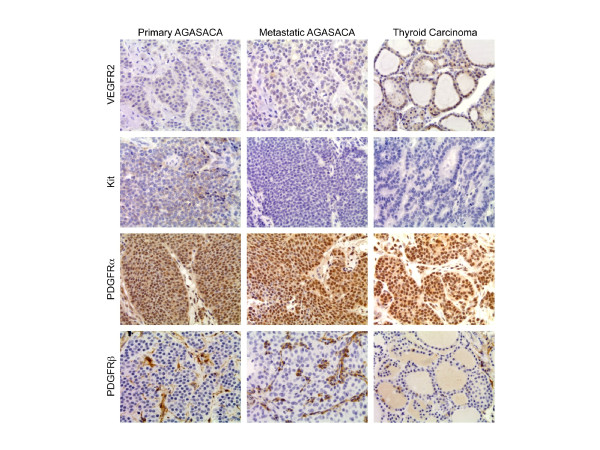
Results: mRNA for VEGFR2, PDGFRα/β, KIT and RET was detected in all AGASACA samples. mRNA for VEGFR2, PDGFRα/β, and KIT was detected in all TC samples, while mRNA for RET was amplified in 10/15 samples. No phosphorylation of VEGFR2, PDGFRα/β, or KIT was observed on the arrays. However, phosphorylation of RET was detected in 54% of the primary AGASACA and 20% of TC. VEGFR2 was expressed in 19/24 primary and 6/10 metastatic AGASACA and 6/15 TC samples. KIT was present in 8/24 primary and 3/10 metastatic AGASACA and 9/15 TC samples. PDGFRα expression was noted in all tumor samples. In contrast PDGFRβ expression was found in only a few tumor samples but was evident in the stroma of all tumor specimens.
Conclusions: Known targets of toceranib are expressed in both AGASAC and TC. Given the observed expression of VEGFR and PDGFRα/β and phosphorylation of RET, these RTKs merit investigation as to their roles in the biology of AGSACA and TC and their contribution to toceranib's activity.
Figures
References
-
- London C. Toceranib phosphate (Palladia) kinome. 2011. Unpublished data.
-
- London CA MP, Wood-Follis SL, Boucher JF, Rusk AW, Rosenberg MP, Henry CJ, Mitchener KL, Klein MK, Hintermeister JG, Bergman PJ, Couto GC, Mauldin GN, Michels GM. Multi-center, placebo-controlled, double-blind, randomized study of oral toceranib phosphate (SU11654), a receptor tyrosine kinase inhibitor, for the treatment of dogs with recurrent (either local or distant) mast cell tumor following surgical excision. Clin Cancer Res. 2009;15(11)):3856–3865. - PubMed
-
- London CA HA, Zadovoskaya R, Chien MB, Kollias-Baker C, Rosenberg M, Downing S, Post G, Boucher J, Shenoy N, Mendel DB, McMahon G, Cherrington JM. Phase I dose-escalating study of SU11654, a small molecule receptor tyrosine kinase inhibitor, in dogs with spontaneous malignancies. Clin Cancer Res. 2003;9(7)):2755–2768. - PubMed
-
- Gild ML BM, Robinson BG, Clifton-Bligh R. Multikinase inhibitors: a new option for the treatment of thyroid cancer. Nat Rev Endocrinol. 2011;7:624–627. - PubMed
Publication types
MeSH terms
Substances
Grants and funding
LinkOut - more resources
Full Text Sources
Medical
