


Natural variability in bovine milk oligosaccharides from Danish Jersey and Holstein-Friesian breeds
- PMID: 22632419
- PMCID: PMC3386800
- DOI: 10.1021/jf300015j
Natural variability in bovine milk oligosaccharides from Danish Jersey and Holstein-Friesian breeds
Abstract
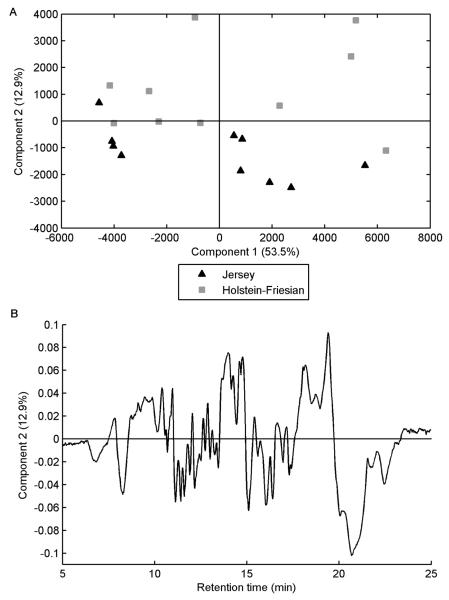
Free oligosaccharides are key components of human milk and play multiple roles in the health of the neonate, by stimulating growth of selected beneficial bacteria in the gut, participating in development of the brain, and exerting antipathogenic activity. However, the concentration of oligosaccharides is low in mature bovine milk, normally used for infant formula, compared with both human colostrum and mature human milk. Characterization of bovine milk oligosaccharides in different breeds is crucial for the identification of viable sources for oligosaccharide purification. An improved source of oligosaccharides can lead to infant formula with improved oligosaccharide functionality. In the present study we have analyzed milk oligosaccharides by high-performance liquid chromatography chip quadrupole time-of-flight mass spectrometry and performed a detailed data analysis using both univariate and multivariate methods. Both statistical tools revealed several differences in oligosaccharide profiles between milk samples from the two Danish breeds, Jersey and Holstein-Friesians. Jersey milk contained higher relative amounts of both sialylated and the more complex neutral fucosylated oligosaccharides, while the Holstein-Friesian milk had higher abundance of smaller and simpler neutral oligosaccharides. The statistical analyses revealed that Jersey milk contains levels of fucosylated oligosaccharides significantly higher than that of Holstein-Friesian milk. Jersey milk also possesses oligosaccharides with a higher degree of complexity and functional residues (fucose and sialic acid), suggesting it may therefore offer advantages in term of a wider array of bioactivities.
Figures
References
-
- Fox PF, McSweeney PLH. Dairy chemistry and biochemistry. Blackie Academic & Professional; 1998.
-
- Sela D, Chapman J, Adeuya A, Kim J, Chen F, Whitehead T, Lapidus A, Rokhsar D, Lebrilla C, German J, Price N, Richardson P, Mills D. The genome sequence of Bifidobacterium longum subsp infantis reveals adaptations for milk utilization within the infant microbiome. Proc. Natl. Acad. Sci. USA. 2008;105:18964–18969. - PMC - PubMed
-
- Sela DA. Bifidobacterial utilization of human milk oligosaccharides. Int. J. Food Microbiol. 2011;149:58–64. - PubMed
-
- LoCascio RG, Ninonuevo MR, Freeman SL, Sela DA, Grimm R, Lebrilla CB, Mills DA, German JB. Glycoprofiling of Bifidobacterial consumption of human milk oligosaccharides demonstrates strain specific, preferential consumption of small chain glycans secreted in early human lactation. J. Agric. Food Chem. 2007;55:8914–8919. - PubMed
Publication types
MeSH terms
Substances
Grants and funding
LinkOut - more resources
Full Text Sources
Other Literature Sources
Medical
