


Resistance exercise for knee osteoarthritis
- PMID: 22632702
- PMCID: PMC3635671
- DOI: 10.1016/j.pmrj.2012.01.019
Resistance exercise for knee osteoarthritis
Abstract
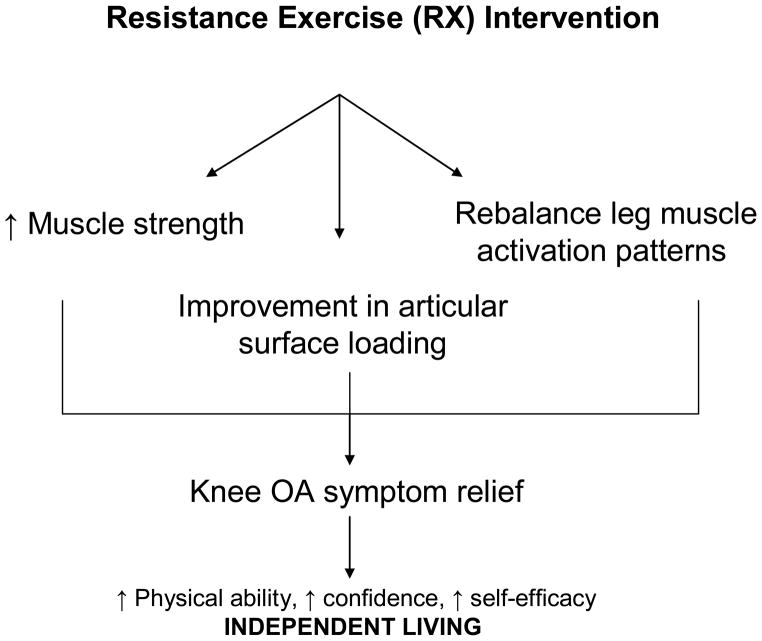
The initiation, progression, and severity of knee osteoarthritis (OA) have been associated with decreased muscular strength and alterations in joint biomechanics. Chronic OA pain may lead to anxiety, depression, fear of movement, and poor psychological outlook. The fear of movement may prevent participation in exercise and social events, which could lead to further physical and social isolation. Resistance exercise (RX) has been shown to be an effective intervention both for decreasing pain and improving physical function and self-efficacy. RX may restore muscle strength and joint mechanics while improving physical function. RX also may normalize muscle firing patterns and joint biomechanics, leading to reductions in joint pain and cartilage degradation. These physical adaptations could lead to improved self-efficacy and decreased anxiety and depression. RX can be prescribed and performed by patients across the spectrum of OA severity. When designing and implementing an RX program for a patient with knee OA, one should consider both the degree of OA severity and the level of pain. RX, either in the home or at a fitness facility, is an important component of a comprehensive regimen designed to offset the physical and psychological limitations associated with knee OA. Unique considerations for this population include (1) monitoring pain during and after exercise, (2) providing days of rest when disease flares occur, and (3) infusing variety into the exercise regimen to encourage adherence.
Copyright © 2012 American Academy of Physical Medicine and Rehabilitation. Published by Elsevier Inc. All rights reserved.
Figures
References
-
- Garstang SVST. Osteoarthritis: epidemiology, risk factors, and pathophysiology. Am J Phys Med Rehabil. 2006;85(11):S2–11. - PubMed
-
- Jinks C, Jordan K, Croft P. Osteoarthritis as a public health problem: the impact of developing knee pain on physical function in adults living in the community: (KNEST 3) Rheumatology (Oxford) 2007;46(5):877–881. - PubMed
-
- American Medical Association white paper on elderly health. Report of the Council on Scientific Affairs. Arch Intern Med. 1990;150(12):2459–2472. - PubMed
-
- Prevalence and impact of arthritis by race and ethnicity--United States, 1989–1991. MMWR Morb Mortal Wkly Rep. 1996;45(18):373–378. - PubMed
-
- Lange AK, Vanwanseele B, Fiatarone Singh MA. Strength training for treatment of osteoarthritis of the knee: a systematic review. Arthritis Rheum. 2008;59(10):1488–1494. - PubMed
Publication types
MeSH terms
Grants and funding
LinkOut - more resources
Full Text Sources
Medical
