Review
. 2012 Jun;159(6):430-53.
doi: 10.1016/j.trsl.2011.12.009. Epub 2012 Jan 15.

Translational research in infectious disease: current paradigms and challenges ahead

Affiliations
Review

Translational research in infectious disease: current paradigms and challenges ahead

Judith M Fontana et al. Transl Res. 2012 Jun.

Abstract

In recent years, the biomedical community has witnessed a rapid scientific and technologic evolution after the development and refinement of high-throughput methodologies. Concurrently and consequentially, the scientific perspective has changed from the reductionist approach of meticulously analyzing the fine details of a single component of biology to the "holistic" approach of broadmindedly examining the globally interacting elements of biological systems. The emergence of this new way of thinking has brought about a scientific revolution in which genomics, proteomics, metabolomics, and other "omics" have become the predominant tools by which large amounts of data are amassed, analyzed, and applied to complex questions of biology that were previously unsolvable. This enormous transformation of basic science research and the ensuing plethora of promising data, especially in the realm of human health and disease, have unfortunately not been followed by a parallel increase in the clinical application of this information. On the contrary, the number of new potential drugs in development has been decreasing steadily, suggesting the existence of roadblocks that prevent the translation of promising research into medically relevant therapeutic or diagnostic application. In this article, we will review, in a noninclusive fashion, several recent scientific advancements in the field of translational research, with a specific focus on how they relate to infectious disease. We will also present a current picture of the limitations and challenges that exist for translational research, as well as ways that have been proposed by the National Institutes of Health to improve the state of this field.


Figures

Fig 1
Fig 1
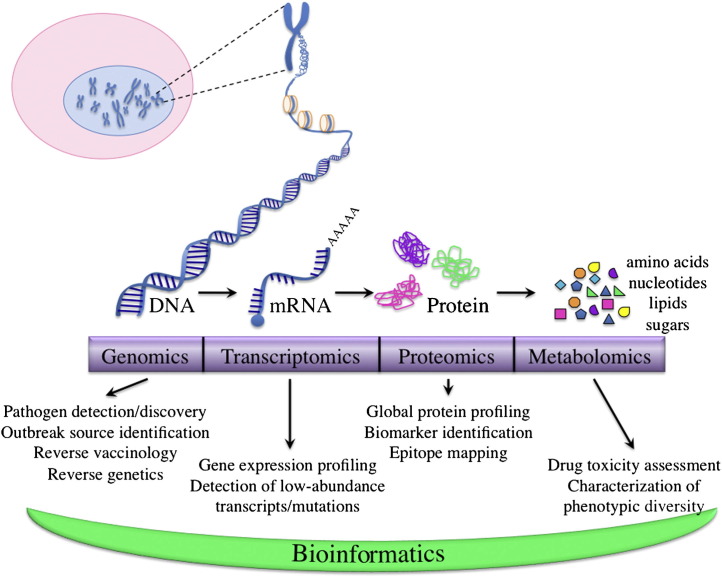
A “top-down” explanation of “omics.” Genomics is the study of the complete set of hereditary genetic information in an organism. With the advent of microarray technology and next-generation sequencing, numerous applications have arisen from the field of genomics, including pathogen discovery, epidemiologic advances, and a variety of molecular techniques that allow for precise manipulation of microbial genomes. As DNA begets RNA and protein, so do the fields of transcriptomics and proteomics follow logically from genomics. Transcriptomics, which is a subset of the field of genomics and concerns the collection of messenger RNA transcripts expressed within an organism, has emerged as a result of more sophisticated techniques that allow for the highly sensitive determination of low-abundance mutations, transcripts, and SNPs. Proteomics is the next major “omics” field after genomics, and it focuses on the complement of proteins, their modifications, and their interactions within an organism. With the aid of analytical techniques such as 2-DE, MS/MS, and shotgun proteomics, the field of proteomics has found useful application for the identification of biomarkers and mapping of epitopes that may provide targets for antimicrobial drug development. The field of metabolomics is a natural offshoot of proteomics as it uses many of the same MS techniques. A major difference, however, is that whereas genomics and proteomics provide insight into the potential of cellular processes, metabolomics gives an instantaneous snapshot of what is actually happening in a cell. Each one of these “omics” fields generates massive amounts of rich, detailed data that surpass the capabilities of manual data analysis. This therefore necessitates the incorporation of bioinformatics for the development of computer algorithms that are used to analyze and model data. (Color version of figure is available online.)
Fig 2
Fig 2
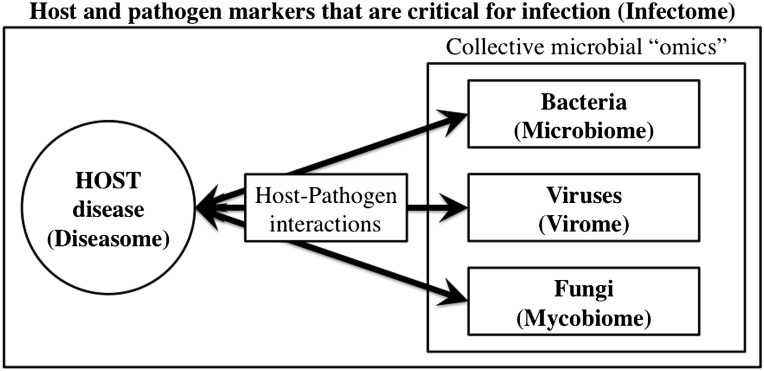
The “omics” paradigm for host–microbe interactions. State-of-the-art “omics” technologies have paved the way for the comprehensive characterization of a variety of hosts and microbes. The microbiome, virome, and mycobiome are 3 microorganism-specific data sets that have arisen from the “omics” revolution. Although each subset comprises distinct information about its target (bacteria, viruses, fungi, etc), they do not exist in isolation. An increasing number of studies is focused on the intersection between the collective set of microbial “omics” and the profile of gene expression that is associated with human disease (diseasome). Thus, investigation into the complex dynamics that occur during infection (infectome) can provide significant insight regarding the etiology and progression of disease, as well as lead to the identification of targets at which to aim therapeutic intervention.

References

    1. Lost in clinical translation. Nat Med. 2004;10:879. [No authors listed] - PubMed
    1. Woolf S.H. The meaning of translational research and why it matters. JAMA. 2008;299:211–213. - PubMed
    1. National Center for Research Resources. Clinical and Translational Science Awards. 2011.
    1. National Institutes of Health . NIH; Bethesda, Md: 2011. National Center for Research Resources.
    1. Steele S.J. Working with the CTSA Consortium: what we bring to the table. Sci Transl Med. 2010;2:63mr5. - PubMed

Publication types