


Pediatric idiopathic intracranial hypertension and extreme childhood obesity
- PMID: 22633290
- PMCID: PMC3572898
- DOI: 10.1016/j.jpeds.2012.03.047
Pediatric idiopathic intracranial hypertension and extreme childhood obesity
Abstract
Objective: To estimate the magnitude of the association between overweight, moderate, and extreme childhood obesity and the risk of idiopathic intracranial hypertension (IIH).
Study design: Risk estimates were obtained from the Kaiser Permanente Southern California Children's Health Study (n = 913 178). Weight classes were assigned by body mass index specific for age and sex. A combination of electronic database searches followed by complete medical records review was used to identify all children diagnosed with IIH between 2006 and 2009.
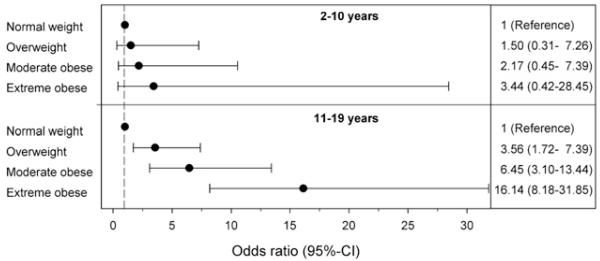
Results: We identified 78 children with IIH, the majority of whom were girls (n = 66, 84.5%), age 11-19 (n = 66, 84.5%), non-Hispanic Whites (n = 37, 47.4%), and overweight or obese (n = 57, 73.1%). The adjusted ORs and 95% CIs of IIH with increasing weight class were 1.00, 3.56 (1.72-7.39), 6.45 (3.10-13.44), and 16.14 (8.18-31.85) for underweight/normal weight (reference category), overweight, moderately obese and extremely obese 11-19 year olds, respectively (P for trend < .001). Other independent IIH risk factors included White non-Hispanic race/ethnicity for all age groups and female sex, but only in older children. Overweight/obese children also had more IIH symptoms at onset than normal weight children.
Conclusions: We found that childhood obesity is strongly associated with an increased risk of pediatric IIH in adolescents. Our findings suggest that the childhood obesity epidemic is likely to lead to increased morbidity from IIH particularly among extremely obese, White non-Hispanic teenage girls. Our findings also suggest careful screening of these at risk individuals may lead to earlier detection and opportunity for treatment of IIH.
Copyright © 2012 Mosby, Inc. All rights reserved.
Figures
Comment in
-
Pediatric idiopathic intracranial hypertension and extreme childhood obesity: a comment on visual outcomes.J Pediatr. 2012 Nov;161(5):972. doi: 10.1016/j.jpeds.2012.07.058. Epub 2012 Sep 6. J Pediatr. 2012. PMID: 22959139 No abstract available.
-
Pediatric idiopathic intracranial hypertension and extreme childhood obesity: a role for weight gain.J Pediatr. 2013 May;162(5):1084. doi: 10.1016/j.jpeds.2013.01.048. Epub 2013 Feb 26. J Pediatr. 2013. PMID: 23452583 No abstract available.
-
Reply: To PMID 22633290.J Pediatr. 2013 May;162(5):1084. doi: 10.1016/j.jpeds.2013.01.058. Epub 2013 Feb 27. J Pediatr. 2013. PMID: 23453770 No abstract available.
References
-
- Ball AK, Clarke CE. Idiopathic intracranial hypertension. Lancet Neurol. 2006;5:433–42. - PubMed
-
- Durcan FJ, Corbett JJ, Wall M. The incidence of pseudotumor cerebri. Population studies in Iowa and Louisiana. Arch Neurol. 1988;45:875–7. - PubMed
-
- Balcer LJ, Liu GT, Forman S, Pun K, Volpe NJ, Galetta SL, Maguire MG. Idiopathic intracranial hypertension: relation of age and obesity in children. Neurology. 1999;52:870–2. - PubMed
-
- Babikian P, Corbett J, Bell W. Idiopathic intracranial hypertension in children: the Iowa experience. J Child Neurol. 1994;9:144–9. - PubMed
