. 2012 Aug;40(15):7123-31.
doi: 10.1093/nar/gks442. Epub 2012 May 25.

Linear motifs confer functional diversity onto splice variants

Affiliations

Linear motifs confer functional diversity onto splice variants

Robert J Weatheritt et al. Nucleic Acids Res. 2012 Aug.

Abstract

The pre-translational modification of messenger ribonucleic acids (mRNAs) by alternative promoter usage and alternative splicing is an important source of pleiotropy. Despite intensive efforts, our understanding of the functional implications of this dynamically created diversity is still incomplete. Using the available knowledge of interaction modules, particularly within intrinsically disordered regions (IDRs), we analysed the occurrences of protein modules within alternative exons. We find that regions removed or included by pre-translational variation are enriched in linear motifs suggesting that the removal or inclusion of exons containing these interaction modules is an important regulatory mechanism. In particular, we observe that PDZ-, PTB-, SH2- and WW-domain binding motifs are more likely to occur within alternative exons. We also determine that regions removed or included by alternative promoter usage are enriched in IDRs suggesting that protein isoform diversity is tightly coupled to the modulation of IDRs. This study, therefore, demonstrates that short linear motifs are key components for establishing protein diversity between splice variants.


Figures

Figure 1.
Figure 1.
A comparison of intrinsic disorder between exons. The proportion of exons predicted as intrinsically disordered, defined as residues that the IUPred algorithm predicted with a score above 0.4. Exons altered by alternative splicing and exons altered by alternative promoter usage were analysed for IDRs as compared with the average human exon. Error bars represent 90.0% error rate.
Figure 2.
Figure 2.
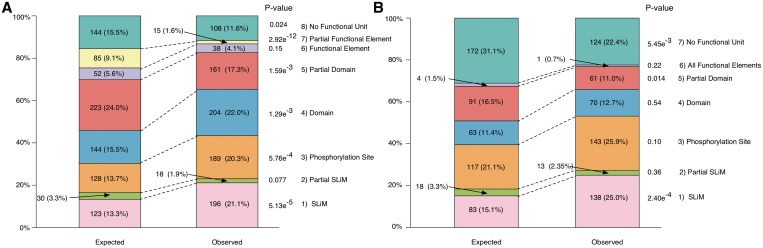
The distribution of functional units within AltSeqs. The observed and expected counts of AltSeqs disrupting an entire or partial SLiM, a phosphorylation site, an entire or partial globular domain, an entire or partial functional element (transmembrane domain or signal peptide) or no functional units from the annotated data set. The number of elements in each class is shown and their percentage in brackets. (A) The observed distribution of functional units within AltSeqs when compared with the expected distribution. (B) The observed distribution of functional units within AltSeqs when compared with the expected distribution within IDRs (regions with IUPred scores > 0.4). Both partial and entire transmembrane domains and signal peptides (functional elements) are combined, as their observed occurrences were very low.
Figure 3.
Figure 3.
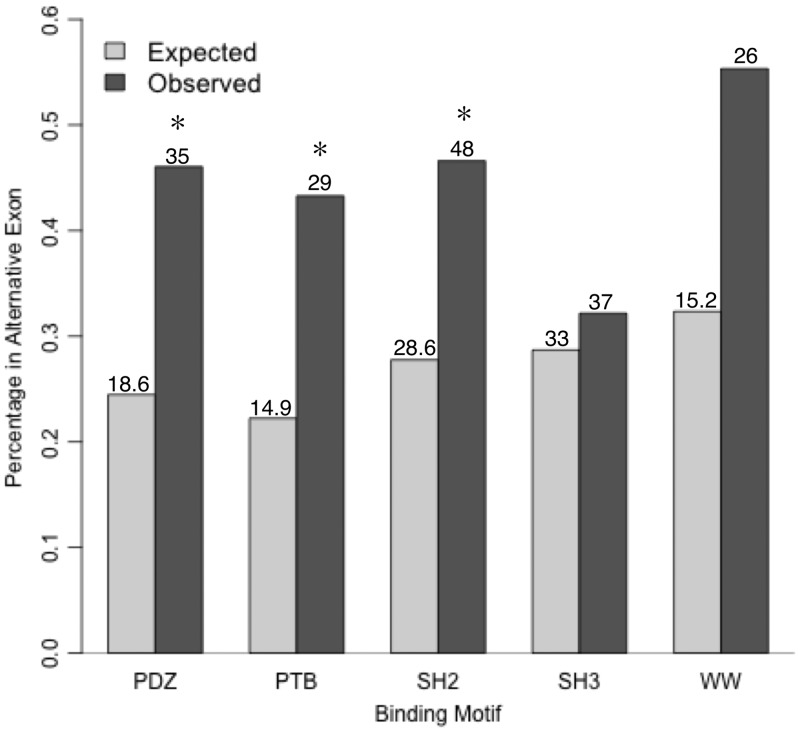
A comparison of the occurrences of five highly studied binding motifs within alternative exons. The observed and expected occurrences of linear motifs identified in HTP experimental studies of proteins with known isoforms (30). The PDZ, PTB and SH2-binding sites are all enriched within AltSeqs (χ2, P < 0.05). The WW domain-binding motif is not enriched to a level of statistical significance but has 26 instances observed in AltSeqs compared with the 15.2 instances expected. The expected occurrence of binding motifs was calculated using Equation 1 except for the PDZ-binding motif, which was calculated based on the occurrence of AltSeqs at the C terminal. (*statistical enrichment and numbers = occurrences).
Figure 4.
Figure 4.
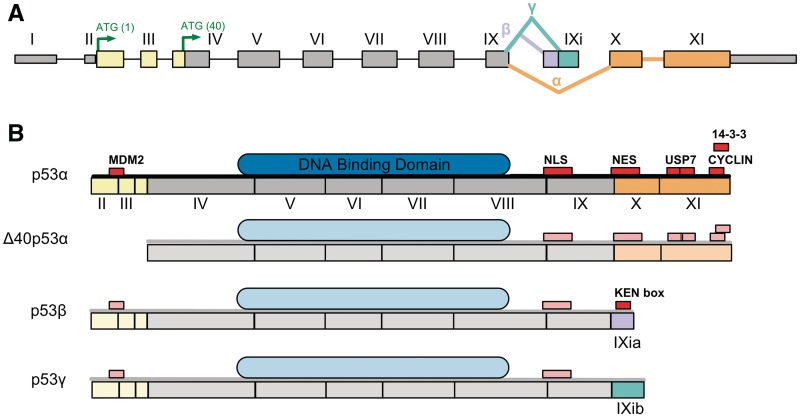
Bioinformatics can identify functional differences between protein variants. (A) The exon sequence of the TP53 gene. The coloured (non-grey) exons are alternative exons that vary between protein isoforms. The yellow exons are absent in Δ40p53, the mauve exon is specific to p53β, the mint green exon is exclusive to p53γ and the orange exons are present only in p53α. (B) The four distinct isoforms of TP53 are shown with modular architecture annotated onto the full-length protein isoform (p53α) using ELM and Pfam, the exception being the KEN-box, which is predicted. The protein sequences of the TP53 isoforms are shown as a grey line, SLiMs in red, globular domains in blue and previously shown modular structures are opaque. Sequence diversity between the alternative protein products leads to changes in the SLiM content of the p53 alternative products, for example, p53γ loses a cyclin binding site and two USP7 binding sites, a nuclear export signal and a 14-3-3 binding site.

References

    1. Wang ET, Sandberg R, Luo S, Khrebtukova I, Zhang L, Mayr C, Kingsmore SF, Schroth GP, Burge CB. Alternative isoform regulation in human tissue transcriptomes. Nature. 2008;456:470–476. - PMC - PubMed
    1. Davuluri RV, Suzuki Y, Sugano S, Plass C, Huang TH. The functional consequences of alternative promoter use in mammalian genomes. Trends Genet. 2008;24:167–177. - PubMed
    1. Li JB, Levanon EY, Yoon JK, Aach J, Xie B, Leproust E, Zhang K, Gao Y, Church GM. Genome-wide identification of human RNA editing sites by parallel DNA capturing and sequencing. Science. 2009;324:1210–1213. - PubMed
    1. Stamm S, Ben-Ari S, Rafalska I, Tang Y, Zhang Z, Toiber D, Thanaraj TA, Soreq H. Function of alternative splicing. Gene. 2005;344:1–20. - PubMed
    1. Resch A, Xing Y, Modrek B, Gorlick M, Riley R, Lee C. Assessing the impact of alternative splicing on domain interactions in the human proteome. J. Proteome. Res. 2004;3:76–83. - PubMed

Publication types

Substances