


The cell wall-associated kinases, WAKs, as pectin receptors
- PMID: 22639672
- PMCID: PMC3355716
- DOI: 10.3389/fpls.2012.00088
The cell wall-associated kinases, WAKs, as pectin receptors
Abstract
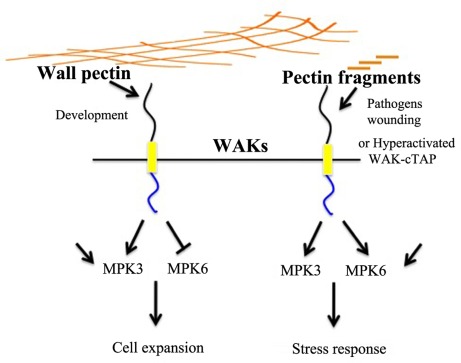
The wall-associated kinases, WAKs, are encoded by five highly similar genes clustered in a 30-kb locus in Arabidopsis. These receptor-like proteins contain a cytoplasmic serine threonine kinase, a transmembrane domain, and a less conserved region that is bound to the cell wall and contains a series of epidermal growth factor repeats. Evidence is emerging that WAKs serve as pectin receptors, for both short oligogalacturonic acid fragments generated during pathogen exposure or wounding, and for longer pectins resident in native cell walls. This ability to bind and respond to several types of pectins correlates with a demonstrated role for WAKs in both the pathogen response and cell expansion during plant development.
Keywords: WAKs; cell expansion; cell wall; pathogen response; pectin; receptor kinase.
Figures
References
-
- Anderson C. M., Wagner T. A., Perret M., He Z. H., He D., Kohorn B. D. (2001). WAKs: cell wall-associated kinases linking the cytoplasm to the extracellular matrix. Plant Mol. Biol. 47 197–206 - PubMed
-
- Andreasson E., Ellis B. (2010). Convergence and specificity in the Arabidopsis MAPK nexus. Trends Plant Sci. 15 106–113 - PubMed
-
- Caffall K. H., Mohnen D. (2009). The structure, function, and biosynthesis of plant cell wall pectic polysaccharides. Carbohydr. Res. 344 1879–1900 - PubMed
LinkOut - more resources
Full Text Sources
