


doi: 10.1186/gb-2012-13-5-r40.
A high-throughput approach to identify genomic variants of bacterial metabolite producers at the single-cell level
Affiliations
- PMID: 22640862
- PMCID: PMC3446293
- DOI: 10.1186/gb-2012-13-5-r40
Item in Clipboard
A high-throughput approach to identify genomic variants of bacterial metabolite producers at the single-cell level
Genome Biol.
.
Abstract
We present a novel method for visualizing intracellular metabolite concentrations within single cells of Escherichia coli and Corynebacterium glutamicum that expedites the screening process of producers. It is based on transcription factors and we used it to isolate new L-lysine producing mutants of C. glutamicum from a large library of mutagenized cells using fluorescence-activated cell sorting (FACS). This high-throughput method fills the gap between existing high-throughput methods for mutant generation and genome analysis. The technology has diverse applications in the analysis of producer populations and screening of mutant libraries that carry mutations in plasmids or genomes.
Figures
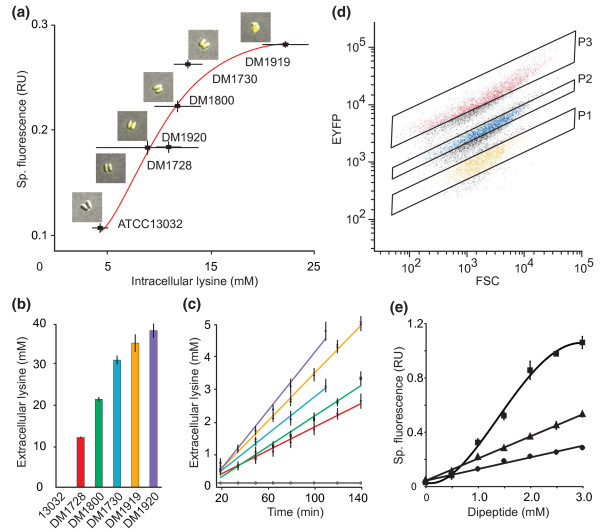
Characterization of lysine sensor and lysine-producing recombinant cells. (a) Cytosolic L-lysine concentration in C. glutamicum WT and five defined lysine producer strains, all carrying pSenLys, and specific fluorescence (Sp. fluorescence) of the cultures. Error bars give the means of three independent cultures for each strain. Fitting the data to the Hill equation describes the signal transfer function by an napp of 3.19 ± 1.45 and this is shown as the red curve. (b) Extracellular accumulation of lysine after 48 h by the strains used in (a). (c) Lysine excretion rates of the same strains showing that strains with increased final lysine accumulation have increased excretion rates. Strain DM1920 has two copies of the lysine exporter gene lysE present in its chromosome and shows the highest excretion rate, but an intermediate cytosolic lysine concentration (color code as in (b)). (d) Differentiation of an equal mixture of cells of ATCC13032, DM1728 and DM1919 each carrying pSenLys by flow cytometry. The success of strain-specific sorting using gates P1 to P3 was over 90%. (e) Influence of dipeptide addition on specific fluorescence of C. glutamicum WT carrying pSenLys. The peptides Lys-Ala (circle), Arg-Ala (triangle) and His-Ala (square) were added to the cultures at the indicated concentrations. Additionally, Ala-Ala was added to give a total dipeptide concentration of 3 mM. The specific fluorescence was measured 1.5 h after dipeptide addition. FSC, forward scatter; RU, relative units.
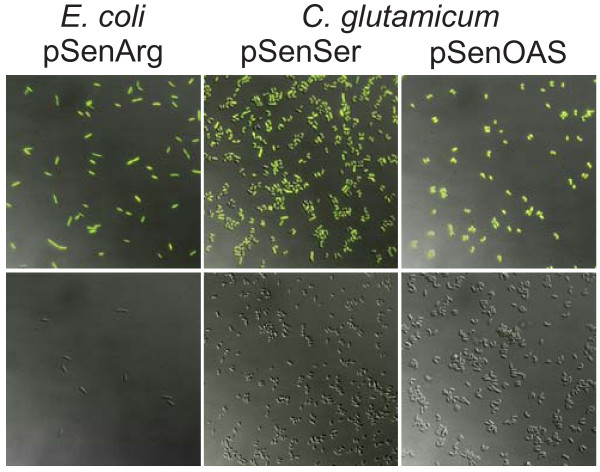
Metabolite sensors reporting on cytosolic arginine, serine, and O-acetyl-serine. Cells of E. coli DH5α (left) carrying pSenArg fluoresce when Arg-Ala was added (top), but not following supplementation with Ala-Ala (bottom). The peptide-dose response curves for Arg-Ala, Lys-Ala and His-Ala are shown in Figure S3 of Additional file 1. The serine-producing strain C. glutamicum-Ser4 (middle) [45] with pSenSer is fluorescent (top), but the WT carrying pSenSer is not (bottom). (c) Fluorescence is seen with the L-cysteine producer C. glutamicum-Cys3 carrying pSenOAS (top right), but not with the control strain (bottom right). Epifluorescence microscopic analysis was done at λex = 490 to 510 nm and λem = 520 to 550 nm.
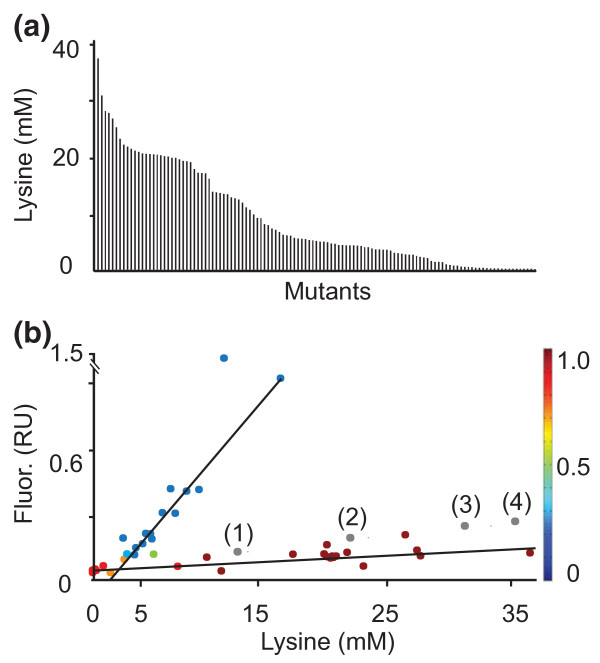
Characterization of L-lysine-producing mutants isolated by FACS from a library of chemically mutagenized wild type cells. (a) The spectrum of L-lysine accumulation in the culture supernatant of 120 mutants obtained using FACS selection. Mutants were grown in minimal medium with 4% (w/v) glucose and lysine concentrations determined after 48 h. (b) Specific culture fluorescence was determined for 40 arbitrarily chosen mutants. Two clusters are apparent after applying an expectation maximization (EM) algorithm to construct a distribution containing maximum likelihood estimates of the parameters in a Gaussian mixture model with two components for data in the 40-by-2 data matrix [22]. The heat bar on the right gives the probability of clones belonging to cluster one, which corresponds to that with the flat curve. The probability of clones belonging to cluster two, corresponding to that with the steep curve, uses the same heat bar with the highest probability in blue and lowest in red. The four gray circles marked (1) to (4) give lysine accumulation and specific fluorescence for the defined recombinants DM1728 (1), DM1800 (2), DM1730 (3), and DM1919 (4) used in Figure 1a. RU, relative units.
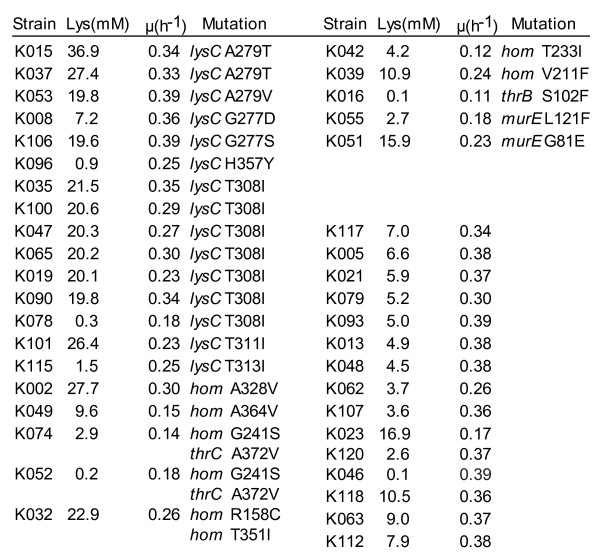
Genetic characterization of mutants. In 40 mutants, targeted sequencing revealed mutations in lysC, hom, thrC and thrB, with some of the mutations already known from prior work (see text). Mutations that resulted in amino acid exchanges are indicated, along with growth rates and final external lysine titers. The mutation murE-G81E in strain K051 was identified by whole-genome sequencing. The second murE mutation, murE-L121F, was identified by subsequent targeted sequencing. In 15 mutants (plus K051), it was not possible to identify any mutation by site-directed mutagenesis.
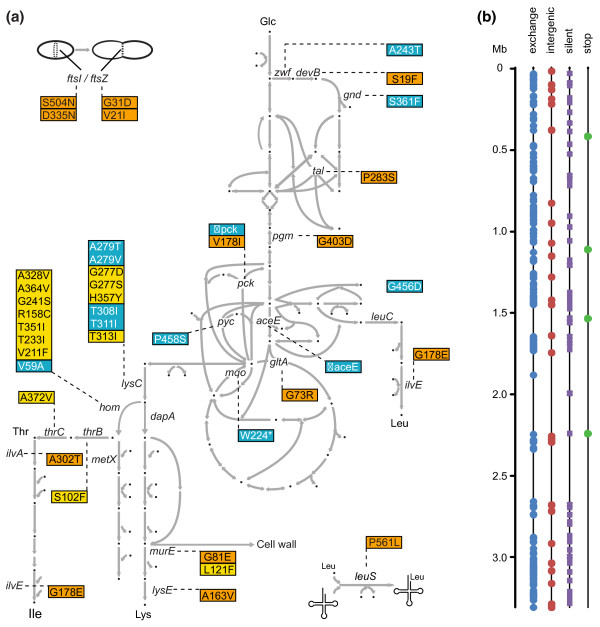
Sketch of the central metabolism and localization of mutations in C. glutamicum together with whole-genome sequencing results of the mutant K051. (a) Pathways and reactions required for and related to lysine synthesis. Genes that carry mutations leading to amino acid exchanges are indicated as follows: blue box, mutations known previously; yellow box, new mutations identified by targeted sequencing in 40 mutants; orange box, new mutations derived from the K051 genome. (b) Localization of the 268 SNPs in the genome of strain K051 determined by whole-genome sequencing. The size of the genome is 3.28 Mb, scale on the left. The mutations are classified into those causing an amino acid exchange, those that are silent, those leading to a stop codon, and those located in non-coding regions. The genome sequence of strain K051 is deposited at the European Nucleotide Archive under the accession number HE802067.

Effect of murE mutations on lysine accumulation. Lysine production by different strains modified to carry a chromosomal murE mutation. Color code: gray, ancestor strains; orange, strains carrying the amino acid exchange L121F in MurE; green, strains carrying the amino acid exchange G81E in MurE.
References
-
- Demain AL, Adrio JL. Strain improvement for production of pharmaceuticals and other microbial metabolites by fermentation. Prog Drug Res. 2008;65:253–289. - PubMed
-
- Tsuruta H, Paddon CJ, Eng D, Lenihan JR, Horning T, Anthony LC, Regentin R, Keasling JD, Renninger NS, Newman JD. High-level production of amorpha-4,11-diene, a precursor of the antimalarial agent artemisinin, in Escherichia coli. PLoS One. 2009;4:e4489. doi: 10.1371/journal.pone.0004489. - DOI - PMC - PubMed
Publication types
MeSH terms
Substances
LinkOut - more resources
Full Text Sources
Other Literature Sources
Molecular Biology Databases
Miscellaneous
