doi: 10.1085/jgp.201210797.
Perspectives on: SGP symposium on mitochondrial physiology and medicine: mitochondrial proteome design: from molecular identity to pathophysiological regulation
Affiliations
- PMID: 22641634
- PMCID: PMC3362520
- DOI: 10.1085/jgp.201210797
Item in Clipboard
Perspectives on: SGP symposium on mitochondrial physiology and medicine: mitochondrial proteome design: from molecular identity to pathophysiological regulation
J Gen Physiol.
2012 Jun.
No abstract available
Figures
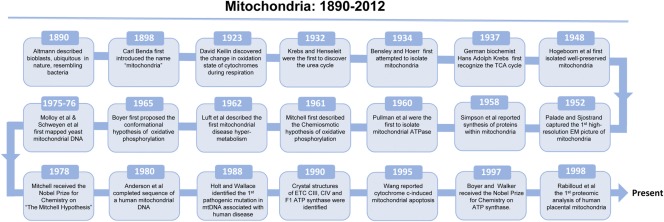
Milestones in mitochondrial research. Representative milestones in mitochondrial research, including mitochondrial function, structure, and mitochondrial medicine, are listed in a chronological sequence (1890–current). Our apologies to those not represented in this timeline.
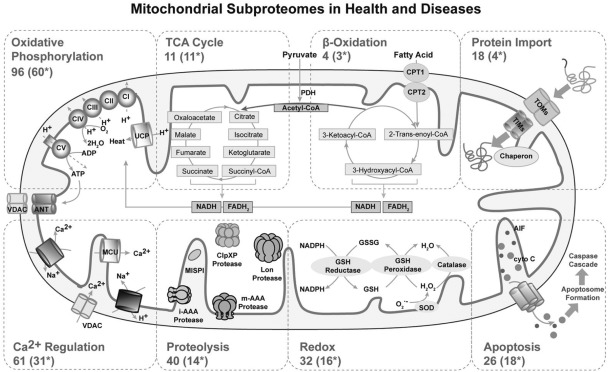
Schematic overview of mitochondrial subproteomes in health and disease. This figure contextualizes mitochondrial proteomes to their biological pathways and the consequences of the proteome compositions to clinical phenotypes. Mitochondrial pathways responsible for fundamental cellular functions within the cell, including OXPHOS, TCA cycle, β oxidation, apoptosis, proteolysis, redox, protein import, and calcium regulation, are detailed. Other mitochondrial functions related to specific cell types are not listed. Within each mitochondrial subproteome, the first number represents the total number of proteins associated with its function (the number of proteins was collected in our previous study; Zhang et al., 2008); the next number inside the parentheses (*) signifies the portion of the total proteins in this particular subproteome reported to be implicated in metabolic diseases.
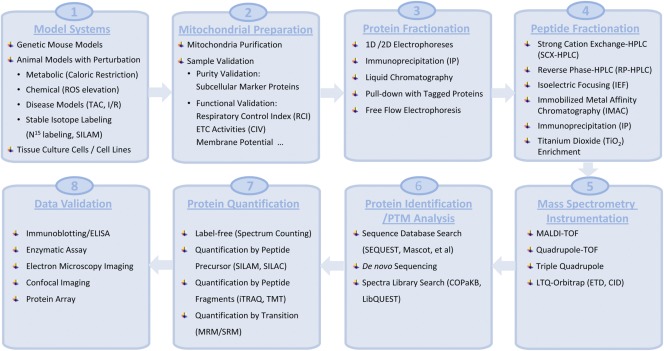
Current state-of-the-art technology platform to characterize mitochondrial proteomes. This figure depicts the current technology platform used to characterize mitochondrial proteomes from model systems, including mitochondrial preparation, protein/peptide fractionations, MS instrumentation, protein identification/PTM analyses, protein quantification, and data validation.
References
-
- Baseler W.A., Dabkowski E.R., Williamson C.L., Croston T.L., Thapa D., Powell M.J., Razunguzwa T.T., Hollander J.M. 2011. Proteomic alterations of distinct mitochondrial subpopulations in the type 1 diabetic heart: contribution of protein import dysfunction. Am. J. Physiol. Regul. Integr. Comp. Physiol. 300:R186–R200 10.1152/ajpregu.00423.2010 - DOI - PMC - PubMed
Publication types
MeSH terms
Substances
Grants and funding
LinkOut - more resources
Full Text Sources