


Determinants of infant formula use and relation with growth in the first 4 months
- PMID: 22642271
- PMCID: PMC6860242
- DOI: 10.1111/j.1740-8709.2012.00415.x
Determinants of infant formula use and relation with growth in the first 4 months
Abstract
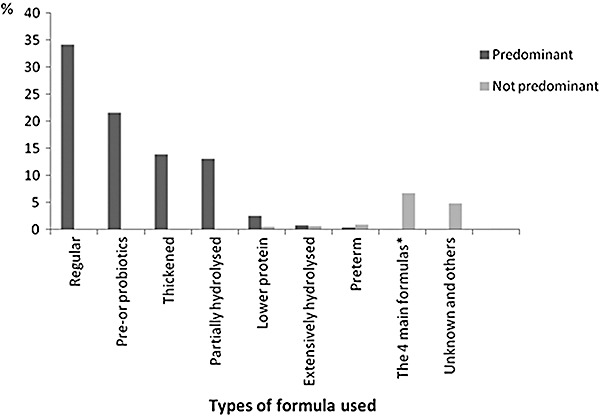
The wide variety of infant formula available on the market can be confusing for parents and physicians. We aimed to determine associations between predominant type of formula used from birth to 4 months and parental and child characteristics and type of physician consulted, and then to describe relations between type of formula used and growth. Our analyses included 1349 infants from the EDEN mother-child cohort. Infant's feeding mode and type of formula used were assessed at 4 months by maternal self-report. Infant's weight and height from birth to 4 months, measured in routine follow-up, were documented by health professionals in the infant's personal health record. Anthropometric z-scores were calculated by using World Health Organization growth standards. Multinomial logistic regression was used to identify factors associated with the type of formula predominantly used; relations with growth were analysed by linear regressions. Partially hydrolysed formulas were more likely to be used by primiparous women (P < 0.001), those breastfeeding longer (P < 0.001) and for infants with family history of allergies (P = 0.002). Thickened formulas were more often used by mothers returning to employment in the first 4 months (P = 0.05) and breastfeeding shortly (P < 0.001). No significant relation was found between infant's growth and type of formula (P > 0.20). Infants breastfed shorter showed higher weight-for-age (P < 0.001) and length-for-age (P = 0.001) z-score changes between birth and 4 months. The use of a specific type of infant formula seems to be mainly related to parental characteristics. Infant's growth in the first 4 months is related to other factors than to the type of formula used.
Keywords: breastfeeding; formula feeding; growth; infant; longitudinal study; socio-demographic factors.
© 2012 John Wiley & Sons Ltd.
Conflict of interest statement
The authors declare that they have no conflicts of interest.
Figures
References
-
- Agostoni C. , Braegger C. , Decsi T. , Kolacek S. , Koletzko B. , Michaelsen K.F. et al . ( 2009. ) Breast‐feeding: a commentary by the ESPGHAN Committee on Nutrition . Journal of Pediatric Gastroenterology and Nutrition 49 , 112 – 125 . - PubMed
-
- Blondel B. , Supernant K. , Du Mazaubrun C. & Breart G. ( 2006. ) Trends in perinatal health in metropolitan France between 1995 and 2003: results from the National Perinatal Surveys . Journal de Gynecologie, Obstetrique et Biologie de la Reproduction 35 , 373 – 387 . - PubMed
-
- Boehm G. & Moro G. ( 2008. ) Structural and functional aspects of prebiotics used in infant nutrition . The Journal of Nutrition 138 , 1818S – 1828S . - PubMed
