Memory for time and place contributes to enhanced confidence in memories for emotional events
- PMID: 22642353
- PMCID: PMC3968901
- DOI: 10.1037/a0028003
Memory for time and place contributes to enhanced confidence in memories for emotional events
Abstract
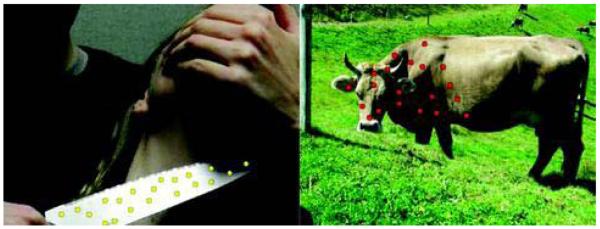
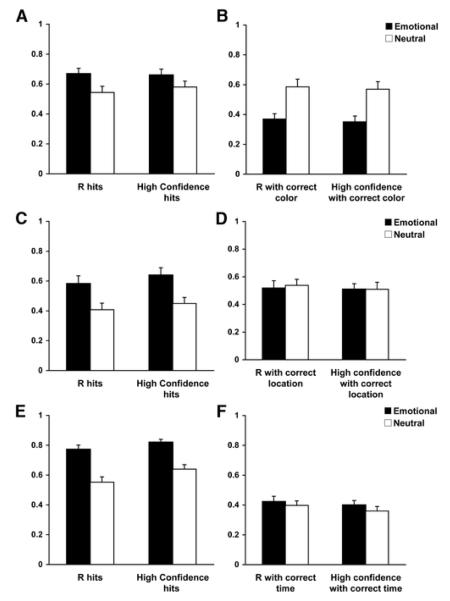
Emotion strengthens the subjective sense of remembering. However, these confidently remembered emotional memories have not been found be more accurate for some types of contextual details. We investigated whether the subjective sense of recollecting negative stimuli is coupled with enhanced memory accuracy for three specific types of central contextual details using the remember/know paradigm and confidence ratings. Our results indicate that the subjective sense of remembering is indeed coupled with better recollection of spatial location and temporal context, but not higher memory accuracy for colored dots placed in the conceptual center of negative and neutral scenes. These findings show that the enhanced subjective recollective experience for negative stimuli reliably indicates objective recollection for spatial location and temporal context, but not for other types of details, whereas for neutral stimuli, the subjective sense of remembering is coupled with all the types of details assessed. Translating this finding to flashbulb memories, we found that, over time, more participants correctly remembered the location where they learned about the terrorist attacks on 9/11 than any other canonical feature. Likewise, participants' confidence was higher in their memory for location versus other canonical features. These findings indicate that the strong recollective experience of a negative event corresponds to an accurate memory for some kinds of contextual details but not for other kinds. This discrepancy provides further evidence that the subjective sense of remembering negative events is driven by a different mechanism than the subjective sense of remembering neutral events.
Figures
References
-
- Adolphs R, Denburg NL, Tranel D. The amygdala’s role in long-term declarative memory for gist and detail. Behav Neurosci. 2001;115(5):983–992. - PubMed
-
- Adolphs R, Tranel D, Buchanan TW. Amygdala damage impairs emotional memory for gist but not details of complex stimuli. Nat Neurosci. 2005;8(4):512–518. - PubMed
-
- Brown R, Kulik J. Flashbulb memories. Cognition. 1977;5:73–99.