


Aerobic performance and body composition changes during military service
- PMID: 22643154
- PMCID: PMC3378011
- DOI: 10.3109/02813432.2012.649631
Aerobic performance and body composition changes during military service
Abstract
Objective: To examine the association between aerobic performance and body composition changes by body mass index (BMI).
Design: 6-12 months' follow-up during military service.
Setting: Conscripts entering military service in 2005 in Sodankylä Jaeger Brigade (Finland).
Subjects: 945 men (19 years, SD 1 years).
Main outcome measures: Height, weight, waist circumference, BMI, and aerobic performance (Cooper test) were recorded. Body composition was measured by bioelectrical impedance analysis (BIA). The measured parameters were fat mass (FM), fat free mass (FFM), and visceral fat area (VFA). All the measurements were performed at the beginning and end of service.
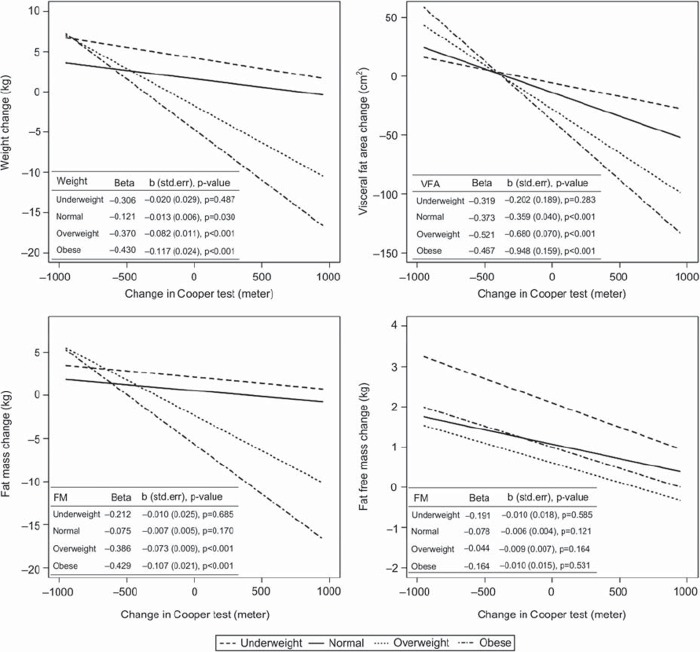
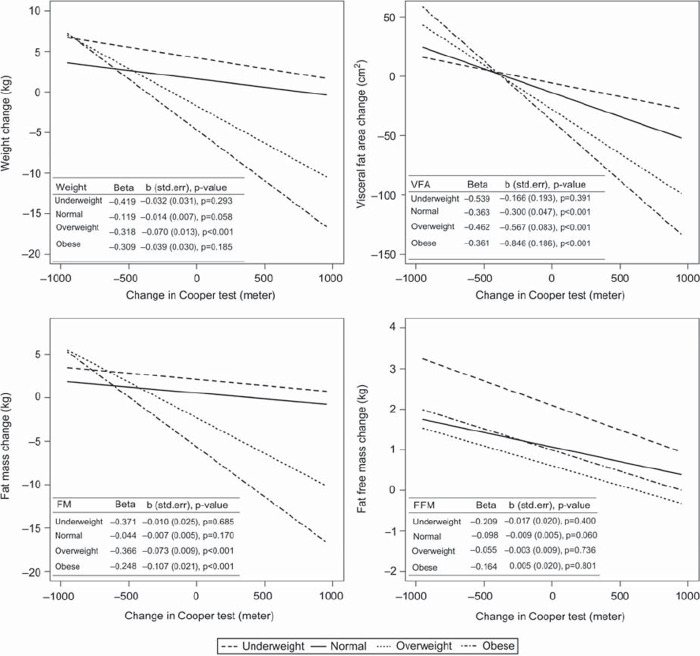
Results: On average, the military training period improved the running distance by 6.8% (169 m, p < 0.001) and the improvements were more pronounced in overweight (223.9 m/9.5%, p < 0.001) and obese (273.3 m/13.6%, p < 0.001) conscripts. A strong inverse correlation between aerobic performance and body composition changes was observed, especially for weight (r = -0.305, p < 0.001) and VFA (r = -0.465, p < 0.001). A significant association between aerobic performance and changes in weight (p < 0.001), waist circumference (p < 0.001), FM (p < 0.001), and VFA (p < 0.001) by BMI was detected. The associated decrease in weight, waist circumference, FM, and VFA with improved aerobic performance was more substantial between overweight and obese compared with normal-weight subjects.
Conclusions: Favourable changes in body composition are associated with improved aerobic performance during a physical training period such as military service. These findings are pronounced among overweight and obese men and can be applied at the population level in reducing obesity and co-morbidities.
Figures
References
-
- Dyearstad SM, Aandstad A, Hallén J. Aerobic fitness in young Norwegian men: A comparison between 1980 and 2002. Scand J Med Sci Sports. 2005;15:298–303. - PubMed
-
- Santtila M, Kyröläinen H, Vasankari T, Tiainen S, Palvalin K, Häkkinen A, Häkkinen K. Physical fitness profiles in young Finnish men during the years 1975–2004. Med Sci Sports Exerc. 2006;38:1990–94. - PubMed
-
- Rasmussen F, Johansson M, Hansen HO. Trends in overweight and obesity among 18-year-old males in Sweden between 1971 and 1995. Acta Paediatr. 1999;88:431–7. - PubMed
-
- Mikkola I, Keinanen-Kiukaanniemi S, Laakso M, Jokelainen J, Harkonen P, Meyer-Rochow VB, Juuti AK, Peitso A, Timonen M. Metabolic syndrome in connection with BMI in young Finnish male adults. Diabetes Res Clin Pract. 2007;76:404–9. - PubMed
-
- Dumortier M, Brandou F, Perez-Martin A, Fedou C, Mercier J, Brun JF. Low intensity endurance exercise targeted for lipid oxidation improves body composition and insulin sensitivity in patients with the metabolic syndrome. Diabetes Metab. 2003;29:509–18. - PubMed
MeSH terms
LinkOut - more resources
Full Text Sources
Medical
