Review
. 2012 Aug;30(8):1587-96.
doi: 10.1002/stem.1136.

Concise review: stem cell-derived erythrocytes as upcoming players in blood transfusion

Affiliations
Review

Concise review: stem cell-derived erythrocytes as upcoming players in blood transfusion

Ann Zeuner et al. Stem Cells. 2012 Aug.

Abstract

Blood transfusions have become indispensable to treat the anemia associated with a variety of medical conditions ranging from genetic disorders and cancer to extensive surgical procedures. In developed countries, the blood supply is generally adequate. However, the projected decline in blood donor availability due to population ageing and the difficulty in finding rare blood types for alloimmunized patients indicate a need for alternative red blood cell (RBC) transfusion products. Increasing knowledge of processes that govern erythropoiesis has been translated into efficient procedures to produce RBC ex vivo using primary hematopoietic stem cells, embryonic stem cells, or induced pluripotent stem cells. Although in vitro-generated RBCs have recently entered clinical evaluation, several issues related to ex vivo RBC production are still under intense scrutiny: among those are the identification of stem cell sources more suitable for ex vivo RBC generation, the translation of RBC culture methods into clinical grade production processes, and the development of protocols to achieve maximal RBC quality, quantity, and maturation. Data on size, hemoglobin, and blood group antigen expression and phosphoproteomic profiling obtained on erythroid cells expanded ex vivo from a limited number of donors are presented as examples of the type of measurements that should be performed as part of the quality control to assess the suitability of these cells for transfusion. New technologies for ex vivo erythroid cell generation will hopefully provide alternative transfusion products to meet present and future clinical requirements.


Conflict of interest statement

DISCLOSURE OF POTENTIAL CONFLICTS OF INTEREST

The authors indicate no potential conflicts of interest.

Figures
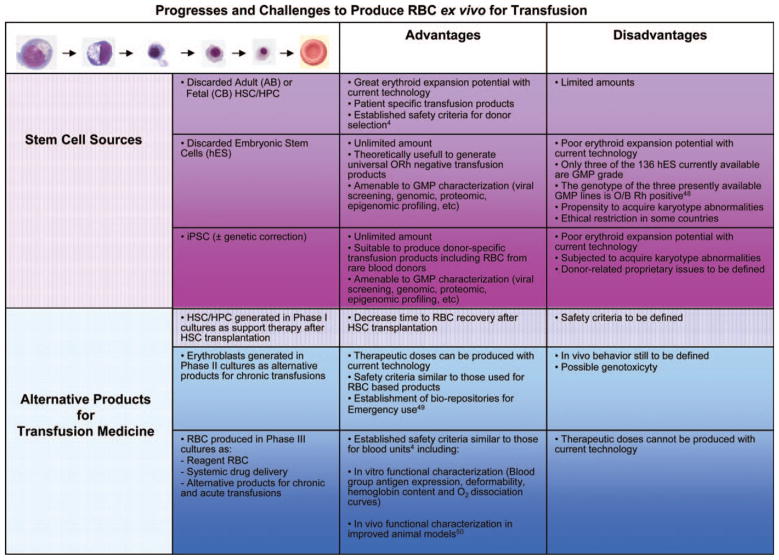
Figure 1
Figure 1
Outline of progressively more mature human erythroid cells generated ex vivo under conditions of massive expansion and of the stem cell sources, alternative transfusion products, and relative safety criteria currently under development. Abbreviations: CB, cord blood; GMP, good manufacturing practice; hES, human embryonic stem; HPC, hematopoietic progenitor cell; HSC, hematopoietic stem cell; iPSC, induced pluripotent stem cell.
Figure 2
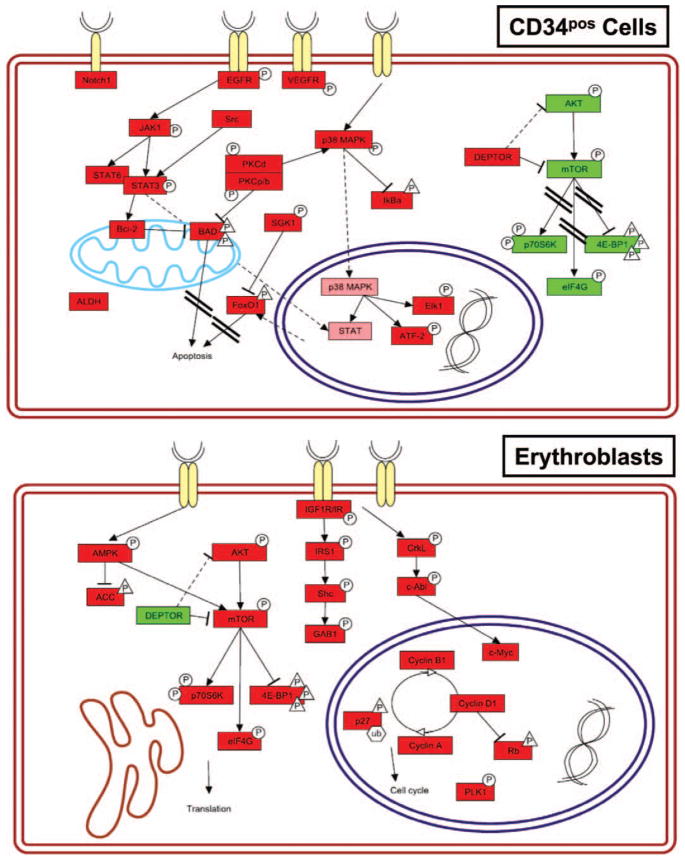
Figure 2
Signaling pathways activated in cord blood-derived CD34pos hematopoietic progenitor cells (upper panel) and in erythroblasts at day 6 of differentiation (erythroblasts, lower panel). Selected statistically significant proteins are shown. Phosphorylated and total proteins were distinguished as hyperphosphorylated/-expressed (red) and hypophosphorylated/-expressed (green). The shape of the phosphorylations symbols differs for activating (circle) and inhibitory (triangle) phosphorylations. Signaling pathway representation was made with PathVisio v2.0. Nonparametric statistical analysis (Wilcoxon rank sum test) was performed with Jump v5.1 (SAS Institute, Cary, NC) using endpoints relative intensity values. For Wilcoxon analysis, all significant levels were set at p < .05 (for technical details see [37]).
Figure 3
Figure 3
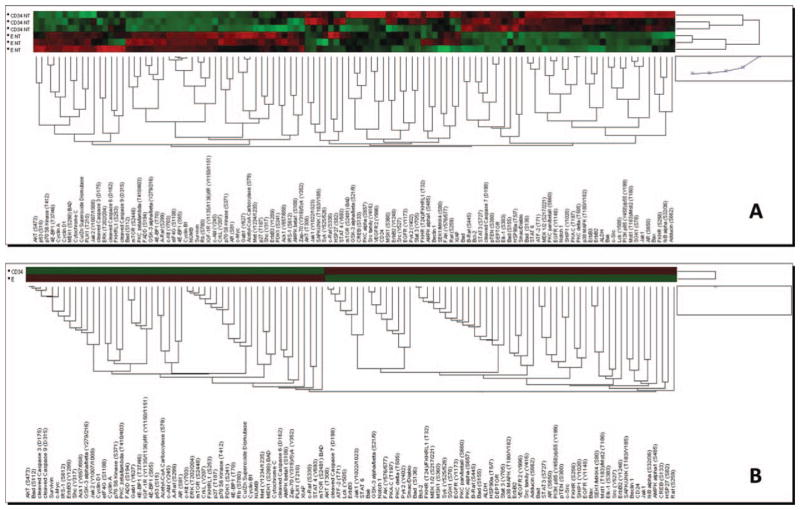
Unsupervised hierarchical clustering of cord blood-derived CD34pos hematopoietic progenitor cells versus erythroblasts at day 6 of differentiation of all the endpoints examined in reverse-phase proteomic analysis (A—separate triplicates and B—triplicate averages). Unsupervised hierarchical clustering was performed with Jump v5.1 using endpoints relative to intensity values (for technical details see [38]).
Figure 4
Figure 4
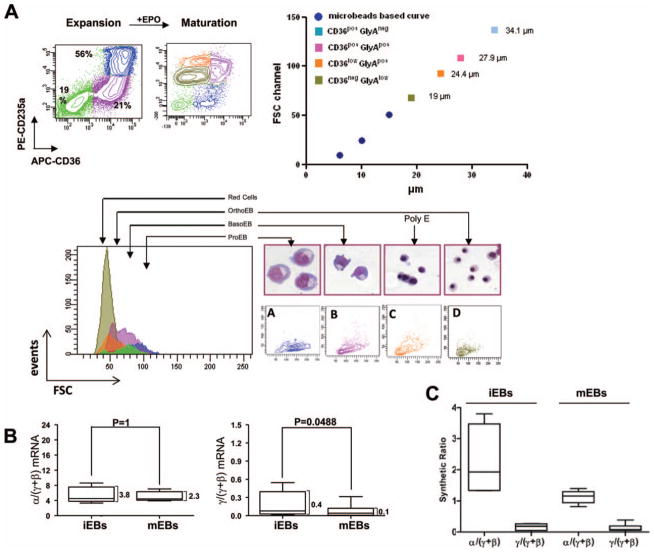
In vitro maturation of human erythroid cells. (A): Upon exposure to EPO for 4 days, human erythroblasts generated from peripheral blood mononuclear cells undergo a synchronous maturation characterized by increased expression of Glycophorin A (CD235a), loss of CD36 (the thrombospondin receptor) expression, decrease in cell size, and morphologic changes including nuclear condensation. (B): At the mRNA level, iEBs and mEBs generated in cultures express excessive α-globin mRNA (α/[γ+β] mRNA ratio >2) and high levels of γ/(γ+β) ratio. With maturation, the α/(γ+β) ratio remains unbalanced while the γ/(γ+β) ratio is significantly reduced. (C): At the protein level, with maturation, the α/(γ+β) globin chain synthetic ratio becomes approximately balanced and the γ/(γ+β) ratio is reduced. Modified and reproduced by permission from [14] and [42]. Abbreviations: EPO, erythropoietin; FSC, forward scatter; iEB, immature erythroblast; mEB, mature erythroblast.
Figure 5
Figure 5
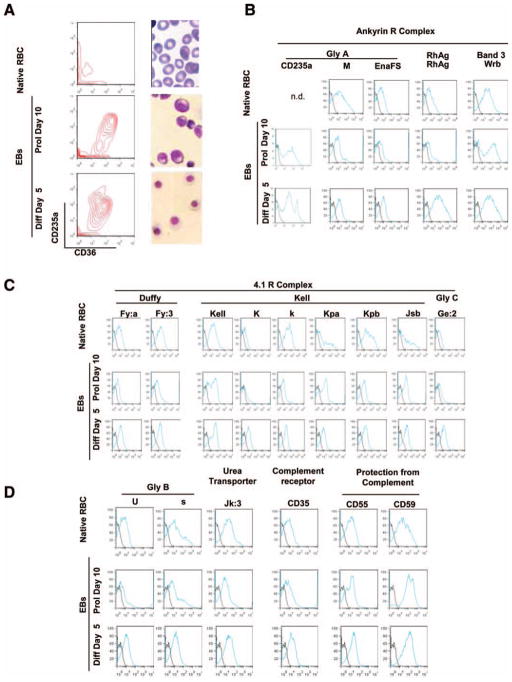
Blood group antigen expression of RBCs from the blood of an African-American donor (native RBCs) and of erythroid cells generated ex vivo from the same donor. (A): CD36/CD235a profiling and May-Grunwald staining of the native RBCs and of the erythroblasts generated in 10-day of culture (Prol day 10) and induced to mature with erythropoietin for 5 days (Diff day 5). (B): Flow cytometry analyses of the various cell types using antibodies provided by The New York Blood Center recognizing antigens present on proteins on (B) the Ankyrin R (glycophorin A [GPA, CD235a, M, and EnaFS], RhAG, and band 3 [Wrb]) and (C) the 4.1R (Duffy [Fya and Fy3], Kell [Kell prot, K/k, Kpa/Kpb, and Jsb], and glycophorin C [GPC and Ge2]) complexes, and (D) on other important membrane proteins (glycophorin B [GPB, s, and U], urea transporter [Kidd and Jk3], the complement receptor [CD35], and inhibitors of complement-mediated lysis [CD55 and CD59]) (see also [41]). Abbreviations: EB, erythroblast; RBC, red blood cell.

References

    1. Alter HJ, Klein HG. The hazards of blood transfusion in historical perspective. Blood. 2008;112:2617–2626. - PMC - PubMed
    1. Report of the US Department of Health and Human Services. The 2009 National Blood Collection and Utilization Survey Report. Washington, DC: Services, T.U.D.o.H.a.H; 2010.
    1. Ali A, Auvinen MK, Rautonen J. The aging population poses a global challenge for blood services. Transfusion. 2010;50:584–588. - PubMed
    1. Zimring JC, Welniak L, Semple JW, et al. Current problems and future directions of transfusion-induced alloimmunization: Summary of an NHLBI working group. Transfusion. 2011;51:435–441. - PMC - PubMed
    1. Papayannopoulou Th, Abkowitz J, D’Andrea A, et al. Biology of erythropoiesis, erythroid differentiation and maturation. In: Hoffman R, Benz EJ, Shattil SJ, Furie B, Cohen HJ, Silberstein LE, McGlave P, Heslop H, editors. Hematology: Basic Principles and Practice. 5. Philadelphia, PA: Elsevier; 2009. pp. 276–299.

Publication types