. 2012 Aug 17;287(34):28840-51.
doi: 10.1074/jbc.M112.359505. Epub 2012 May 29.

Down-regulation of NF-κB transcriptional activity in HIV-associated kidney disease by BRD4 inhibition

Affiliations

Down-regulation of NF-κB transcriptional activity in HIV-associated kidney disease by BRD4 inhibition

Guangtao Zhang et al. J Biol Chem. .

Erratum in

  • J Biol Chem. 2012 Nov 9;287(46):38956

Abstract

NF-κB-mediated inflammation is the major pathology in chronic kidney diseases, including HIV-associated nephropathy (HIVAN) that ultimately progresses to end stage renal disease. HIV infection in the kidney induces NF-κB activation, leading to the production of proinflammatory chemokines, cytokines, and adhesion molecules. In this study, we explored selective inhibition of NF-κB transcriptional activity by small molecule blocking NF-κB binding to the transcriptional cofactor BRD4, which is required for the assembly of the productive transcriptional complex comprising positive transcription elongation factor b and RNA polymerase II. We showed that our BET (Bromodomain and Extra-Terminal domain)-specific bromodomain inhibitor MS417, designed to block BRD4 binding to the acetylated NF-κB, effectively attenuates NF-κB transcriptional activation of proinflammatory genes in kidney cells treated with TNFα or infected by HIV. MS417 ameliorates inflammation and kidney injury in HIV-1 transgenic mice, an animal model for HIVAN. Our study suggests that BET bromodomain inhibition, targeting at the proinflammatory activity of NF-κB, represents a new therapeutic approach for treating NF-κB-mediated inflammation and kidney injury in HIVAN.


Figures
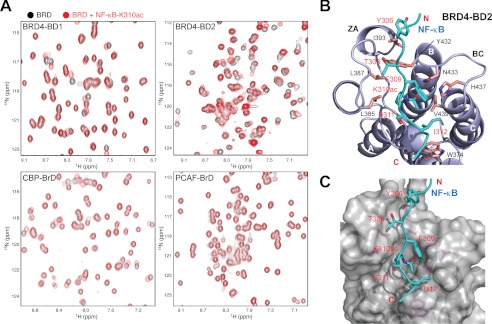
FIGURE 1.
FIGURE 1.
Structural basis of K310ac NF-κB recognition by BRD4. A, two-dimensional 1H-15N HSQC spectra of BrDs of BRD4, CBP, and PCAF in the free form (black) and in the presence of a K310ac NF-κB peptide (red). Shown are ribbon (B) and surface-filled representations (C) of the three-dimensional solution structure of the BRD4-BD2 bound to the NF-κB-K310ac peptide. Side chains of key residues involved in intermolecular interactions are highlighted and color-coded by atom types.
FIGURE 2.
FIGURE 2.
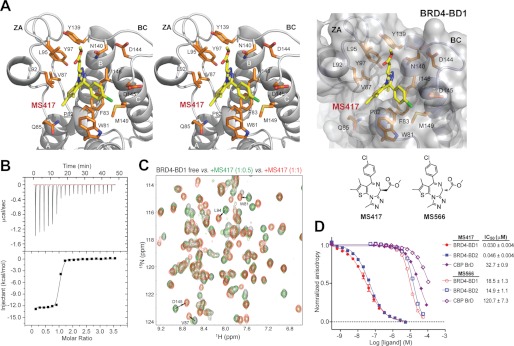
Molecular basis of MS417 binding to the BRD4 bromodomains. A, x-ray crystal structure of MS417 bound to BRD4-BD1, depicted in a stereo view (left) and surface-filled representation (right). Side chains of key protein residues involved in ligand recognition are color-coded by atom types. The chemical structures of MS417 and its enantiomer MS566 are shown. B, ITC measurement of BRD4-BD1 binding MS417. C, two-dimensional 1H-15N HSQC spectra of BRD4-BD1 in the free form (black) and in the presence of the BrDi MS417 with a protein/ligand molar ratio of 1:0.5 (green) and 1:1 (red). D, affinity measurements of MS417 or its enantiomer MS566 binding to the BrDs of BRD4, BRD3, and CBP, as assessed in a fluorescence anisotropy competition assay using an FITC-labeled MS417 (i.e. MS574) as an assay probe.
FIGURE 3.
FIGURE 3.
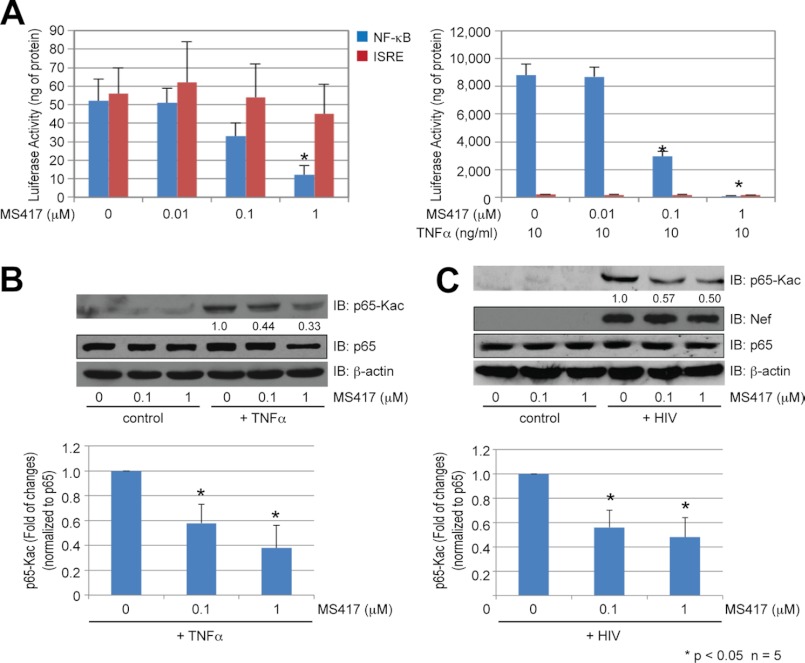
Modulation of BRD4 binding to K310ac NF-κB. A, effects of MS417 on TNFα-induced NF-κB activation in 293T cells, as measured by a NF-κB luciferase reporter assay. 293T cells were transfected with a NF-κB luciferase reporter vector for 2 days and then incubated with MS417 at the indicated doses in serum-free medium with or without TNFα for 24 h. As a negative control, the cells were also transfected with an ISRE luciferase reporter vector and treated with MS417 and TNFα in the same condition as above. The cells were harvested for determination of luciferase activity (n = 5; **, p < 0.01). B, Western blot analysis assessing effects of MS417 on acetylated p65 in 293T cells. Representative Western blots of three independent experiments are shown. C, effects of MS417 on NF-κB activation by HIV pseudovirus infection in human RTECs. RTECs were infected with HIV pseudovirus or control GFP vector for 3 days and then incubated with MS417 at the indicated doses in serum-free medium for 24 h. The cells were harvested for determination of acetylated p65 (p65-Kac), p65, and β-actin as well as HIV Nef protein by Western blot. Representative Western blots of four independent experiments are shown. The densitometric analysis of the Western blots in B and C was performed and the ratio of acetylated p65 to total p65 was calculated, *, p < 0.05; n = 4 (lower panels of Fig. 3, B and C).
FIGURE 4.
FIGURE 4.
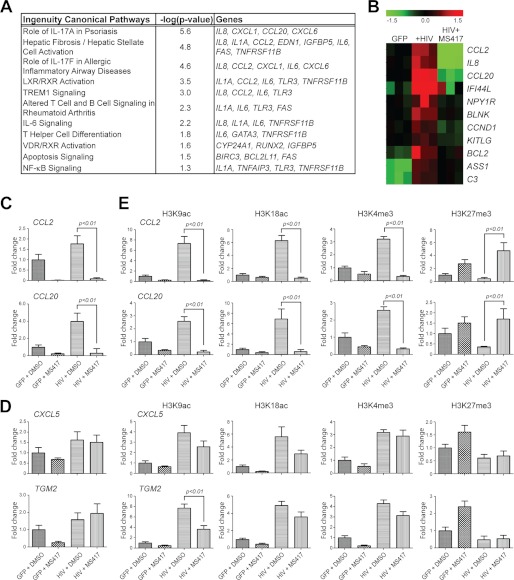
MS417 Modulation of gene transcription in HIV-infected human primary renal tubular epithelial cells. A, Ingenuity pathway analysis revealing the top gene networks enriched in the down-regulated genes by MS417 treatment in the HIV-infected human RTECs. The RTECs were infected with control GFP vector or HIV vector for 4 days and then treated with DMSO or MS417 (1.0 μm) for an additional 24 h. RNA was isolated from these cells for microarray studies. B, gene heat-map of 11 NF-κB targets that were both up-regulated by HIV infection and down-regulated by the MS417 treatment. C, MS417 inhibits NF-κB target gene activation by HIV infection in human RTECs. RTECs were infected with GFP or HIV for 72 h, and then the cells were starved for 6 h and treated with DMSO control or MS417 (1.0 μm) for an additional 24 h. The cells were harvested for real-time PCR analysis of cytokine and chemokine (n = 3; *, p < 0.01 when compared between HIV-infected cells treated with DMSO and MS417). D, some of the NF-κB target genes by HIV infection in the RTECs were not inhibited by MS417. E, chromatin immunoprecipitation analysis of the MS417-sensitive and non-sensitive genes probing changes of the corresponding histone modifications, such as H3K9ac, H3K18ac, H3K4me3, and H3K27me3, at the promoter sites of these genes (n = 3; *, p < 0.01 when compared between HIV-infected cells treated with DMSO and MS417).
FIGURE 5.
FIGURE 5.
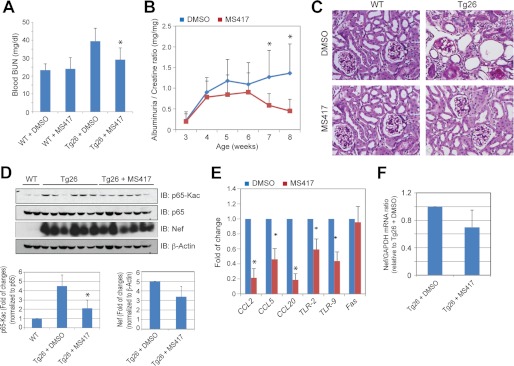
In vivo study of MS417 effects in HIV-1 transgenic mice (Tg26). A, MS417 improves renal function in Tg26 mice as measured by blood urea nitrogen (BUN) (n = 6; *, p < 0.05 as compared with DMSO-treated Tg26 mice). B, MS417 reduces proteinuria in the Tg26 mice as determined by urinary albuminuria/creatinine ratio (n = 6; *, p < 0.05 as compared with DMSO-treated Tg26 mice). C, MS417 reduces glomerulosclerosis, tubular injury, and infiltration of inflammatory cells in the kidney of Tg26 mice. Tg26 mice were treated with vehicle (0.1% DMSO) or MS417 at 0.08 mg/kg from the age of 4 weeks for a total duration of 4 weeks. The mice were sacrificed at the age of 8 weeks. The kidney sections from these mice were stained for periodic acid-Schiff, and the representative pictures from six mice in each group are shown here. D, MS417 inhibits acetylation of p65 in the kidney of the Tg26 mice. The kidney cortices from these mice were used for Western blot analysis of acetylated and total p65. The expression of HIV Nef and β-actin was also assessed by Western blot. The densitometric analysis of these Western blots is shown in the lower panels (n = 6; *, p < 0.05 as compared with DMSO-treated Tg26 mice). E, NF-κB target genes were suppressed in kidneys of the Tg26 mice treated with MS417. The kidney cortices from these mice were used for total RNA isolation and real-time PCR analysis for NF-κB target genes (n = 6; *, p < 0.05 as compared with DMSO-treated Tg26 mice). F, effects of MS417 on the expression of HIV Nef in the kidneys of Tg26 mice. All mRNA levels of the testing genes were normalized to that of GAPDH, a housekeeping gene.

References

    1. Wyatt C. M., Klotman P. E. (2007) HIV-1 and HIV-associated nephropathy 25 years later. Clin. J. Am. Soc. Nephrol. 2, Suppl. 1, S20–S24 - PubMed
    1. Atta M. G., Fine D. M., Kirk G. D., Mehta S. H., Moore R. D., Lucas G. M. (2007) Survival during renal replacement therapy among African Americans infected with HIV type 1 in urban Baltimore, Maryland. Clin. Infect. Dis. 45, 1625–1632 - PMC - PubMed
    1. Lucas G. M., Eustace J. A., Sozio S., Mentari E. K., Appiah K. A., Moore R. D. (2004) Highly active antiretroviral therapy and the incidence of HIV-1-associated nephropathy. A 12-year cohort study. AIDS 18, 541–546 - PubMed
    1. Wyatt C. M., Winston J. A., Malvestutto C. D., Fishbein D. A., Barash I., Cohen A. J., Klotman M. E., Klotman P. E. (2007) Chronic kidney disease in HIV infection. An urban epidemic. AIDS 21, 2101–2103 - PubMed
    1. D'Agati V., Suh J. I., Carbone L., Cheng J. T., Appel G. (1989) Pathology of HIV-associated nephropathy. A detailed morphologic and comparative study. Kidney Int. 35, 1358–1370 - PubMed

Publication types

MeSH terms