


Groundwater depletion and sustainability of irrigation in the US High Plains and Central Valley
- PMID: 22645352
- PMCID: PMC3386121
- DOI: 10.1073/pnas.1200311109
Groundwater depletion and sustainability of irrigation in the US High Plains and Central Valley
Abstract
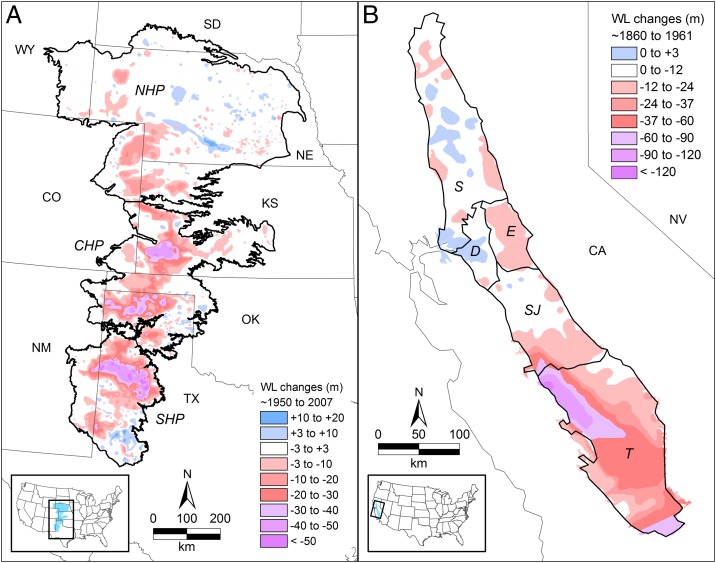
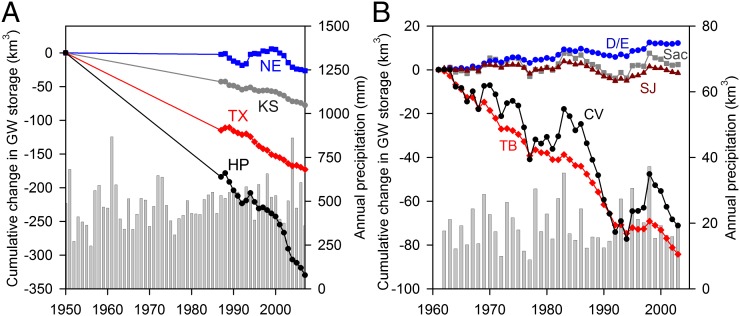
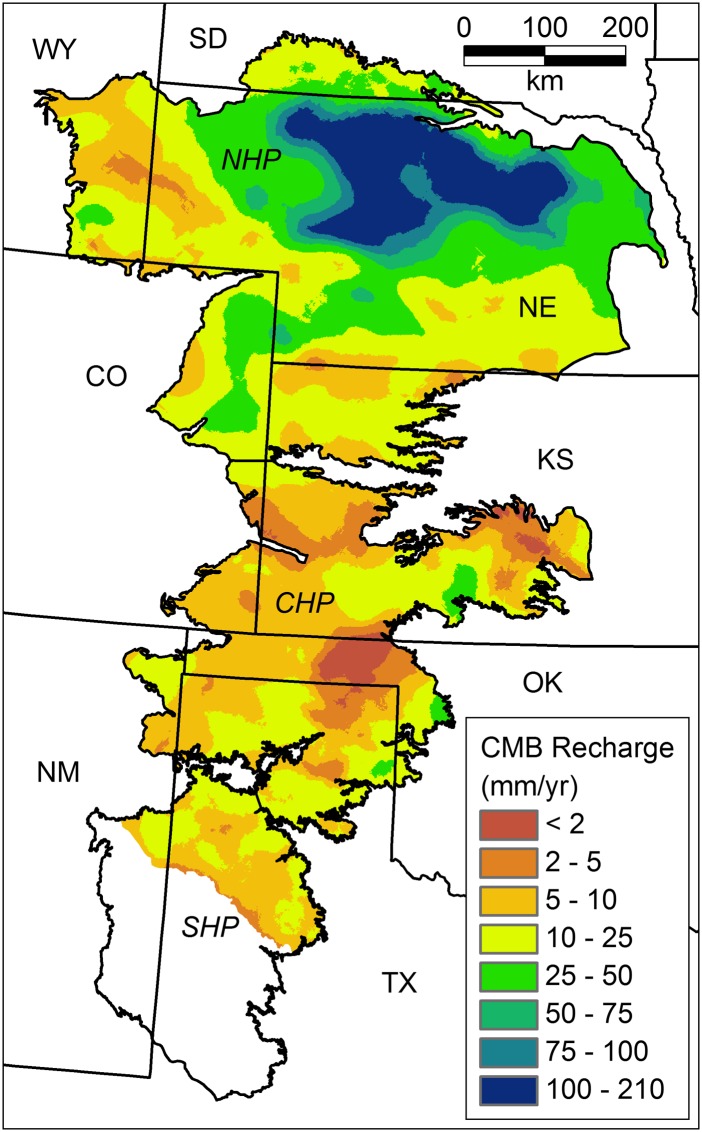
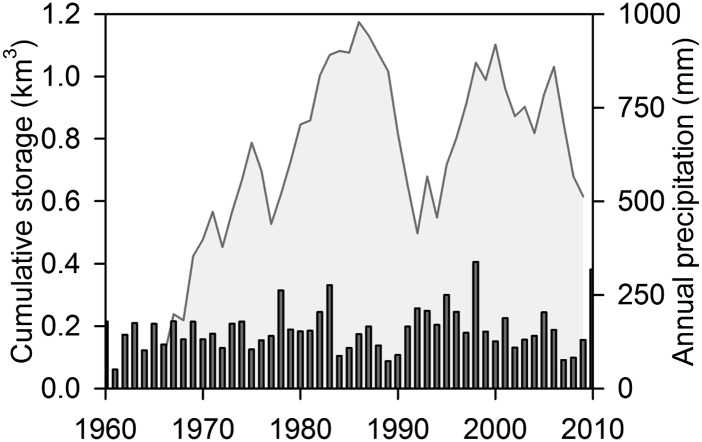
Aquifer overexploitation could significantly impact crop production in the United States because 60% of irrigation relies on groundwater. Groundwater depletion in the irrigated High Plains and California Central Valley accounts for ~50% of groundwater depletion in the United States since 1900. A newly developed High Plains recharge map shows that high recharge in the northern High Plains results in sustainable pumpage, whereas lower recharge in the central and southern High Plains has resulted in focused depletion of 330 km(3) of fossil groundwater, mostly recharged during the past 13,000 y. Depletion is highly localized with about a third of depletion occurring in 4% of the High Plains land area. Extrapolation of the current depletion rate suggests that 35% of the southern High Plains will be unable to support irrigation within the next 30 y. Reducing irrigation withdrawals could extend the lifespan of the aquifer but would not result in sustainable management of this fossil groundwater. The Central Valley is a more dynamic, engineered system, with north/south diversions of surface water since the 1950s contributing to ~7× higher recharge. However, these diversions are regulated because of impacts on endangered species. A newly developed Central Valley Hydrologic Model shows that groundwater depletion since the 1960s, totaling 80 km(3), occurs mostly in the south (Tulare Basin) and primarily during droughts. Increasing water storage through artificial recharge of excess surface water in aquifers by up to 3 km(3) shows promise for coping with droughts and improving sustainability of groundwater resources in the Central Valley.
Conflict of interest statement
The authors declare no conflict of interest.
Figures
References
-
- Shiklomanov IA. Appraisal and assessment of world water resources. Water Int. 2000;25:11–32.
-
- Molden D, editor. Water for Food, Water for Life: A Comprehensive Assessment of Water Management in Agriculture. Earthscan, London: International Water Management Institute, Colombo, Sri Lanka; 2007.
-
- Siebert S, et al. Groundwater use for irrigation—a global inventory. Hydrol Eart Syst Sci. 2010;7:3977–4021.
-
- Giordano M. Global groundwater? Issues and solutions. Annu Rev Environ Resour. 2009;34:153–178.
LinkOut - more resources
Full Text Sources
Miscellaneous
