


doi: 10.1128/JVI.00370-12.
Epub 2012 May 30.
A specific domain of the Chikungunya virus E2 protein regulates particle formation in human cells: implications for alphavirus vaccine design
Affiliations
- PMID: 22647698
- PMCID: PMC3421714
- DOI: 10.1128/JVI.00370-12
Item in Clipboard
A specific domain of the Chikungunya virus E2 protein regulates particle formation in human cells: implications for alphavirus vaccine design
J Virol.
2012 Aug.
Abstract
Virus-like particles (VLPs) can be generated from Chikungunya virus (CHIKV), but different strains yield variable quantities of particles. Here, we define the genetic basis for these differences and show that amino acid 234 in E2 substantially affects VLP production. This site is located within the acid-sensitive region (ASR) known to initiate a major conformational change in E1/E2. Selected other mutations in the ASR, or changes in pH, also increased VLP yield. These results demonstrate that the ASR of E2 plays an important role in regulating particle generation.
Figures
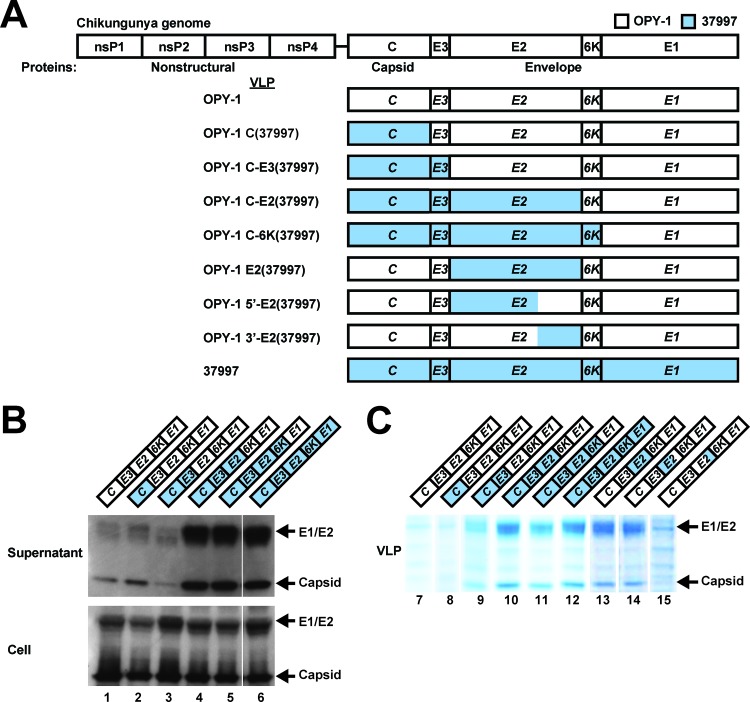
Characterization of chimeric CHIKV VLPs. (A) Schematic representation of the CHIKV genome and the chimeric CHIKV capsid-envelope (C–E) expression vectors used for VLP production from strains 37997 (blue) and OPY-1 (white). The CHIKV genome consists of the nonstructural polyproteins nsP1, nsP2, nsP3, and nsP4 and the structural polyproteins capsid (C) and envelope (E; E3, E2, 6K, and E1) (top). (B) Expression of chimeric VLP vectors in 293F cells. 293F cells (4.5 × 10⁷) were transfected with the 293fectin transfection reagent and 30 μg of each VLP plasmid as previously described (1). Western blotting was performed on the supernatant directly without purification of particles (top) or cell lysate fractions (bottom) 48 h after transfection using antisera reactive with CHIKV as a primary antibody and goat anti-mouse immunoglobulins linked to horseradish peroxidase as a secondary antibody. The levels of expression of capsid and E1/E2 from all of the chimeric VLPs in cell lysates were within 1.1-fold of each other. (C) VLP yield from chimeric expression vectors. VLPs from supernatants of the indicated transfected 293F cells were purified using OptiPrep buoyant density gradient centrifugation as previously described (1).
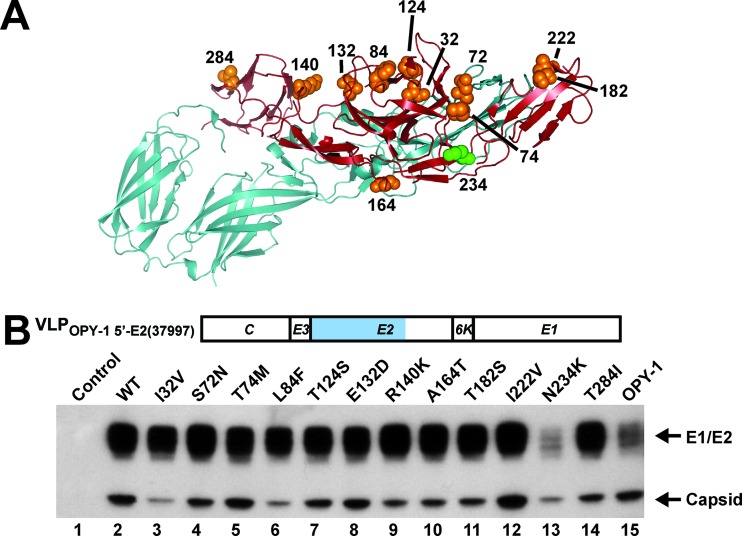
Structural models for the CHIKV OPY-1 E1/E2 complex compared to the CHIKV E2 37997 sequence, and effect of the single amino acid mutation N234K on CHIKV VLP production. (A) Location and structural orientation of relevant amino acid differences between CHIKV E1/E2 in the OPY-1 and 37997 strains. The CHIKV E1/E2 (OPY-1 strain) was modeled based on Protein Data Bank (PDB) code 3N43 and displayed using PyMOL (http://www.pymol.org ). E2 is shown in red, and E1 is shown in light blue. The green spheres indicate the E2 234 site; amino acids shown as orange spheres show the differences in amino acids between OPY-1 and 37997 in E2 aa 1 to 290. (B) Expression of mutant VLPs produced from transfected 293F cells by Western blotting. The indicated amino acid sequence from the OPY-1 strain was introduced into the NH2-terminal E2 domain of chimeric VLPOPY-1 5′-E2 (37997): lane 1, control; 2, VLPOPY-1 5′-E2 (37997) (wild type [WT]); 3, I32V; 4, S72N; 5, T74M; 6, L84F; 7, T124S; 8, E132D; 9, R140K; 10, A164T; 11, T182S; 12, I222V; 13, N234K; 14, T284I; 15, VLPOPY-1. The supernatants harvested were analyzed by Western blotting as described in the legend to Fig. 1B. The yields of the mutant VLPs were between 0.9- and 1.1-fold (lane 2 versus lanes 3 to 12 and 14).
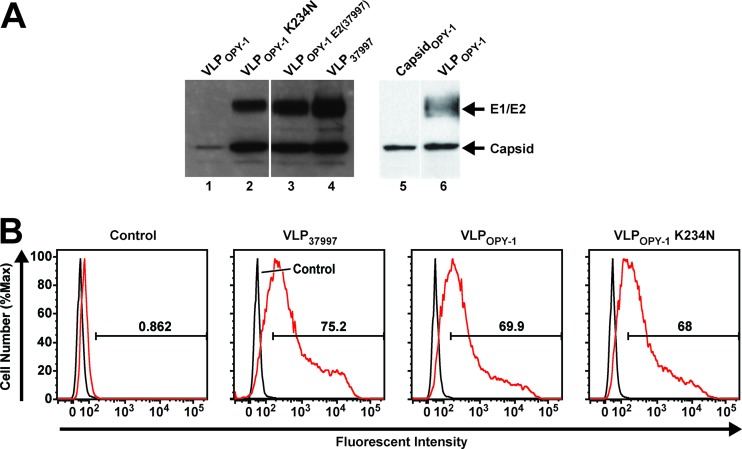
Effect of a single amino acid mutation in E2 on CHIKV OPY-1 VLP production. (A) Expression of E2 mutants (left) and capsid (right) in transfected 293F cells by Western blotting. The VLP expression vectors with the indicated amino acid sequences from the 37997 strain were substituted into the E2 region of VLPOPY-1 or the OPY-1 capsid expression vector (aa 1 to 261) and were transfected as follows: lane 1, VLPOPY-1; 2, VLPOPY-1 K234N; 3, VLPOPY-1 E2(37997); 4, VLP37997; 5, capsidOPY-1; 6, VLPOPY-1. Supernatants were harvested 72 h after transfection and analyzed by Western blotting as described in the legend to Fig. 1B. (B) Envelope expression on the surface membranes of the indicated transfected cells 72 h after transfection was assessed by flow cytometry with a CHIKV E2 monoclonal antibody (m10-18, red line) or a control mouse monoclonal antibody (black line) as a primary antibody and a phycoerythrin secondary antibody and an amine-reactive dye, ViViD, to exclude the dead cell population. Monoclonal antibodies against CHIKV E2 were developed from mice immunized with VLP37997 based on methods described previously (19).
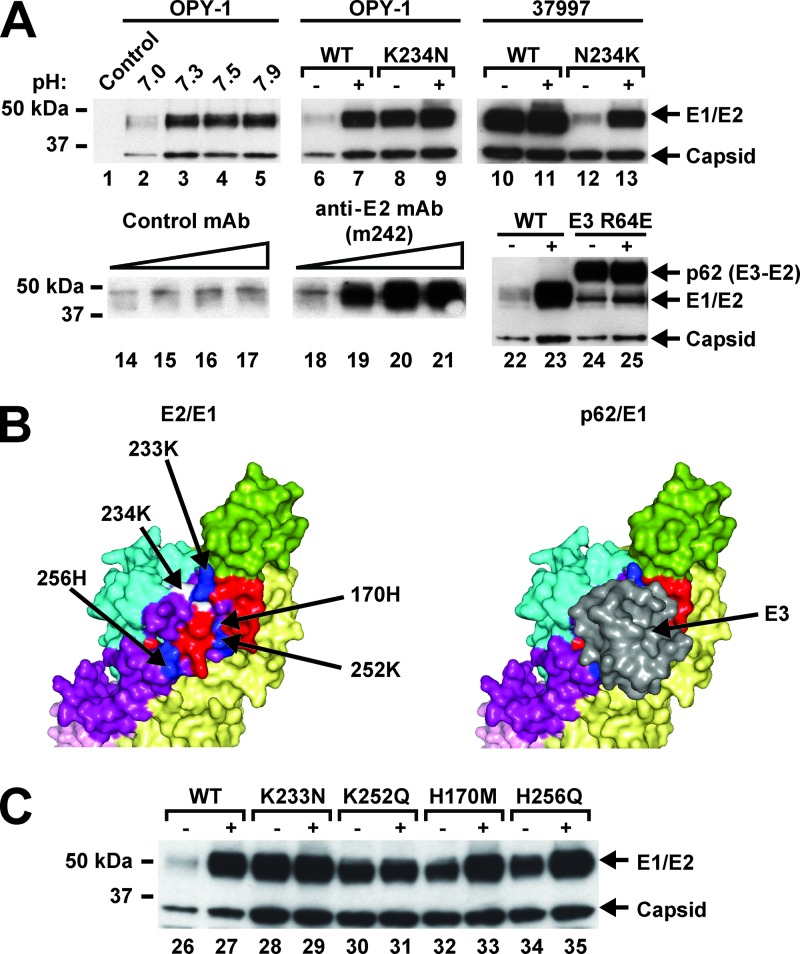
Effect of pH and amino acid mutations in the E2 ASR on VLP production. (A) Expression of VLPs in normal, basic pH buffers or adding E2 monoclonal antibody (m242) by Western blotting 48 h after transfection. At 24 h after transfection, Tris-HCl buffer at pH 7.5, 8.0, or 8.8 was added to the culture medium (final concentration, 40 mM) to change the pH to 7.3, 7.5, and 7.9, respectively (top left) or to change the pH to 7.9 (top middle and right; +). The supernatants were analyzed by Western blotting as described in the legend to Fig. 1B. The yields of the VLPOPY-1 K234N and VLP37997 were within 1.1-fold of each other at a higher pH (+) versus at a normal pH (−) (lane 8 versus lane 9 and lane 10 versus lane 11). At 24 h after transfection of the VLPOPY-1 plasmid, a mouse control antibody or a mouse anti-E2 monoclonal antibody (m242) was added (bottom left and middle, antibody final concentration was 0.16 μg/ml, 0.63 μg/ml, 2.5 μg/ml, or 10 μg/ml, respectively). Supernatants were analyzed by Western blotting with a rabbit serum immunized with VLP37997 as a primary antibody and goat anti-rabbit immunoglobulins linked to horseradish peroxidase as a secondary antibody. At 24 h after transfection of the furin cleavage site mutant VLPs (E3 R64E), the Tris-HCl buffer was added to change the pH to 7.9 (+) (bottom right). The supernatants were analyzed by Western blotting as described in the legend to Fig. 1B. The yields of the mutant VLPs (E3 R64E) were within 1.1-fold of each other at a higher pH (+) versus at a normal pH (−) (lane 24 versus 25). (B) Structural model of the E1/E2 dimer (left) and p62 (E3-E2)/E1 dimer (right) indicating the ASR of CHIKV, modified from PDB code 3N43. The E2 aa 170, 233, 252, and 256 positions in OPY-1 are shown in blue. The E2 aa 234 position in OPY-1 is shown in white. The E2 domain B is shown in green, the E2 domain A is shown in cyan, the E2 domain C is shown in pink, the E2 β-ribbon connector is shown in purple, and the E2 ASR domain (aa 231 to 258) in the E2 β-ribbon connector is shown in red. The E1 is marked in yellow. The E3 region is marked in gray. (C) Yield of VLP in normal or basic pH buffer determined by Western blotting. At 24 h after transfection of the indicated plasmids, Tris-HCl buffer was added to change the pH to 7.9 (+) as described above. The supernatants were analyzed by Western blotting as described in the legend to Fig. 1B. The yields of all the mutant VLPs were within 1.3-fold of each other at a higher pH (+) versus at a normal pH (−) (lane 28 versus lane 29, lane 30 versus lane 31, lane 32 versus lane 33, and lane 34 versus lane 35).
References
Publication types
MeSH terms
Substances
Grants and funding
LinkOut - more resources
Full Text Sources
Other Literature Sources
Medical
