Review
. 2012 Sep;105(9):813-7.
doi: 10.1093/qjmed/hcs069. Epub 2012 May 29.

Liver fibrosis: a bidirectional model of fibrogenesis and resolution

Affiliations
Review

Liver fibrosis: a bidirectional model of fibrogenesis and resolution

P Ramachandran et al. QJM. 2012 Sep.

Abstract

Liver fibrosis is the generic response to chronic injury of varying aetiologies. A number of common mechanisms link this response to the pathogenesis of fibrosis in other organs. While long thought to be relentlessly progressive, there is now excellent evidence in both human liver disease and animal models that hepatic fibrosis is potentially reversible. The liver therefore provides an excellent bidirectional model for the study of fibrogenesis and fibrosis resolution. In this article, we will review the evidence for the reversibility of liver fibrosis. We will highlight some of the mechanisms responsible for fibrogenesis and fibrosis regression, focussing on the role of hepatic myofibroblast activation and apoptosis, the importance of matrix metalloproteinases and their tissue inhibitors and the central involvement of hepatic macrophages in orchestrating this process. Finally, we will briefly discuss what renders liver fibrosis irreversible and how this accumulating knowledge base could lead to badly needed anti-fibrotic therapies in the future.


Figures
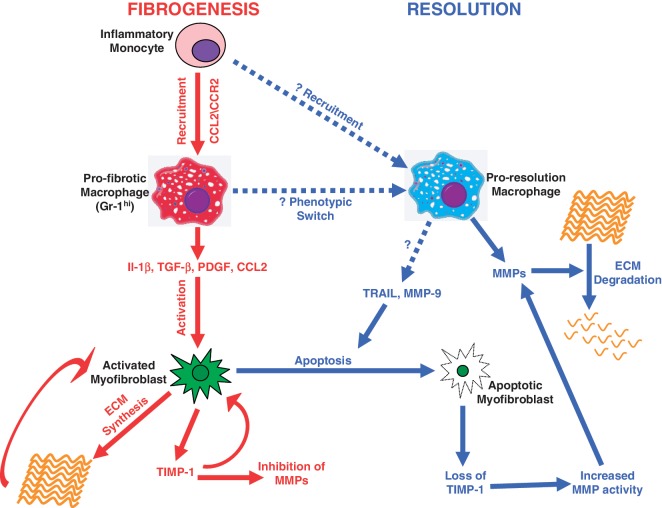
Figure 1.
Figure 1.
Macrophages as central orchestrators of hepatic fibrogenesis and fibrosis resolution. During fibrogenesis, inflammatory monocytes are recruited to the inflamed liver via Chemokine (C–C motif) ligand 2 (CCL2) and chemokine (C–C motif) receptor 2 (CCR2) interactions, forming the pro-fibrotic macrophage population. Pro-fibrotic macrophages express mediators such as Il-1β, TGF-β, PDGF and CCL2, which promote activation of hepatic myofibroblasts. Activated myofibroblasts synthesize the ECM and TIMP-1, a potent inhibitor of MMP activity. Both TIMP-1 and ECM interactions promote persistence of the activated myofibroblast phenotype. During fibrosis resolution, there is likely to be a change in macrophage phenotype, either from a phenotypic switch of pro-fibrotic macrophages or a separate recruitment of monocytes. Pro-resolution macrophages express MMPs that promote ECM degradation. Pro-resolution macrophages can also express mediators that induce myofibroblast apoptosis, leading to a reduction in ECM synthesis, loss of TIMP-1 expression and enhanced MMP activity.

Comment on

References

    1. Wynn TA. Cellular and molecular mechanisms of fibrosis. J Pathol. 2008;214:199–210. - PMC - PubMed
    1. Eddy AA. Can renal fibrosis be reversed? Pediatr Nephrol. 2005;20:1369–75. - PubMed
    1. Mizuno S, Matsumoto K, Li MY, Nakamura T. HGF reduces advancing lung fibrosis in mice: a potential role for MMP-dependent myofibroblast apoptosis. FASEB J. 2005;19:580–2. - PubMed
    1. Tyralla K, Adamczak M, Benz K, Campean V, Gross ML, Hilgers KF, et al. High-dose enalapril treatment reverses myocardial fibrosis in experimental uremic cardiomyopathy. PLoS One. 2011;6:e15287. - PMC - PubMed
    1. Iredale JP. Models of liver fibrosis: exploring the dynamic nature of inflammation and repair in a solid organ. J Clin Invest. 2007;117:539–48. - PMC - PubMed

Substances
