


Comparison of complementary feeding strategies to meet zinc requirements of older breastfed infants
- PMID: 22648720
- PMCID: PMC3374732
- DOI: 10.3945/ajcn.112.036046
Comparison of complementary feeding strategies to meet zinc requirements of older breastfed infants
Abstract
Background: The low zinc intake from human milk at ∼6 mo of age predicts the dependence on complementary foods (CF) to meet the zinc requirements of older breastfed-only infants.
Objective: The objective of this study was to compare major variables of zinc homeostasis and zinc status in 9-mo-old breastfed infants who were randomly assigned to different complementary food regimens.
Design: Forty-five exclusively breastfed 5-mo-old infants were randomly assigned to receive commercially available pureed meats, iron-and-zinc-fortified infant cereal (IZFC), or whole-grain, iron-only-fortified infant cereal (IFC) as the first and primary CF until completion of zinc metabolic studies between 9 and 10 mo of age. A zinc stable-isotope methodology was used to measure the fractional absorption of zinc (FAZ) in human milk and CF by dual-isotope ratios in urine. Calculated variables included the dietary intake from duplicate diets and 4-d test weighing, the total absorbed zinc (TAZ) from FAZ × diet zinc, and the exchangeable zinc pool size (EZP) from isotope enrichment in urine.
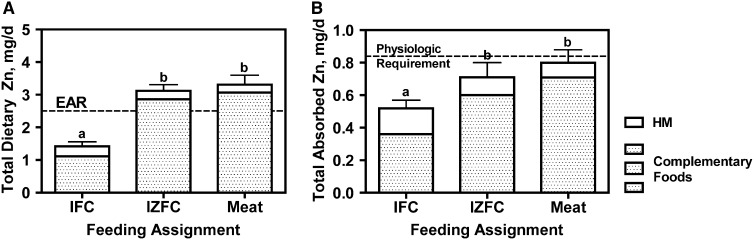
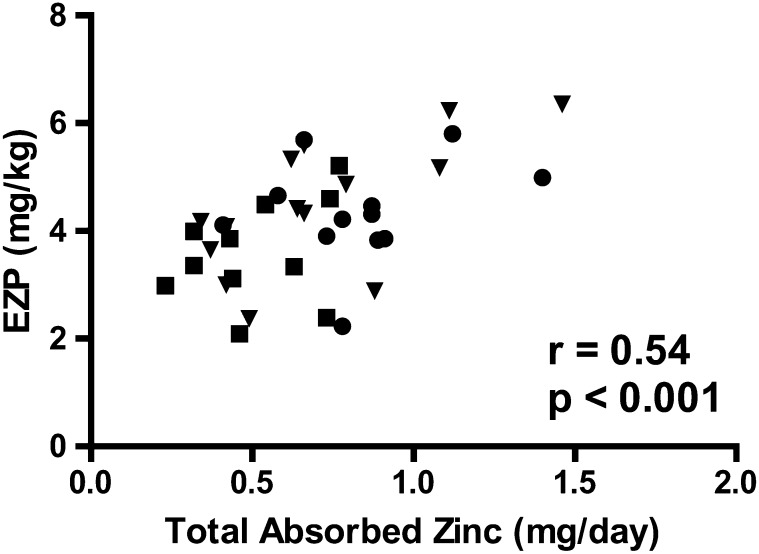
Results: Mean daily zinc intakes were significantly greater for the meat and IZFC groups than for the IFC group (P < 0.001); only intakes in meat and IZFC groups met estimated average requirements. Mean (±SEM) TAZ amounts were 0.80 ± 0.08, 0.71 ± 0.09, and 0.52 ± 0.05 mg/d for the meat, IZFC, and IFC groups, respectively (P = 0.027). Zinc from human milk contributed <25% of TAZ for all groups. The EZP correlated with both zinc intake (r = 0.43, P < 0.01) and TAZ (r = 0.54, P < 0.001).
Conclusion: Zinc requirements for older breastfed-only infants are unlikely to be met without the regular consumption of either meats or zinc-fortified foods.
Figures
References
-
- Krebs NF, Reidinger CJ, Robertson AD, Hambidge KM. Growth and intakes of energy and zinc in infants fed human milk. J Pediatr 1994;124:32–9 - PubMed
-
- Krebs NF, Reidinger CJ, Hartley S, Robertson AD, Hambidge KM. Zinc supplementation during lactation: effects on maternal status and milk zinc concentrations. Am J Clin Nutr 1995;61:1030–6 - PubMed
-
- Krebs NF, Hambidge KM. Zinc requirements and zinc intakes of breast-fed infants. Am J Clin Nutr 1986;43:288–92 - PubMed
-
- Gibson RS, Ferguson EL. Assessment of dietary zinc in a population. Am J Clin Nutr 1998;68(suppl):430S–4S - PubMed
-
- American Academy of Pediatrics Pediatric nutrition handbook. 6th ed. Elk Grove, IL: American Academy of Pediatrics, 2009
Publication types
MeSH terms
Substances
Grants and funding
LinkOut - more resources
Full Text Sources
Medical
Miscellaneous
