


Alterations of the p53 and PIK3CA/AKT/mTOR pathways in angiosarcomas: a pattern distinct from other sarcomas with complex genomics
- PMID: 22648906
- PMCID: PMC3434269
- DOI: 10.1002/cncr.27614
Alterations of the p53 and PIK3CA/AKT/mTOR pathways in angiosarcomas: a pattern distinct from other sarcomas with complex genomics
Abstract
Background: The p53 and phosphoinositide-3-kinase, catalytic, alpha polypeptide/v-akt murine thymoma viral oncogene homolog/mechanistic target of rapamycin (PIK3CA/AKT/mTOR) pathways frequently are altered in sarcoma with complex genomics, such as leiomyosarcoma (LMS) or undifferentiated pleomorphic sarcoma (UPS). The scale of genetic abnormalities in these pathways remains unknown in angiosarcoma (AS).
Methods: The authors investigated the status of critical genes involved in the p53 and PIK3CA/AKT/mTOR pathways in a series of 62 AS.
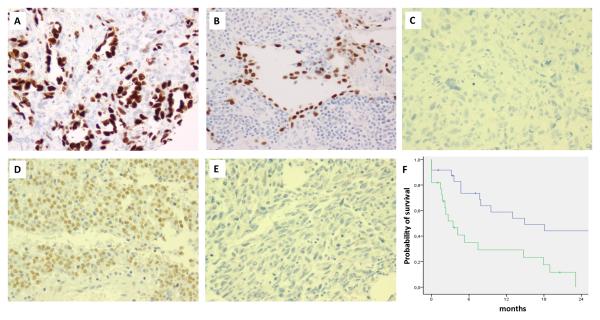
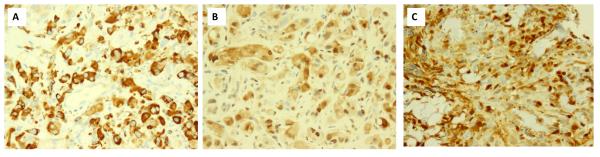
Results: The mutation and deletion rates of tumor protein 53 (TP53) were 4% and 0%, respectively. Overexpression of p53 was detected by immunohistochemistry in 49% of patients and was associated with inferior disease-free survival. Although p14 inactivation or overexpression of the human murine double minute homolog (HDM2) were frequent in LMS and UPS and could substitute for TP53 mutation or deletion, such alterations were rare in angiosarcomas. Phosphorylated ribosomal protein S6 kinase (p-S6K) and/or phosphorylated eukaryotic translation initiation factor 4E binding protein 1 (p-4eBP1) overexpression was observed in 42% of patients, suggesting frequent activation of the PIK3CA/AKT/mTOR pathway in angiosarcomas. Activation was not related to intragenic deletion of phosphatase and tensin homolog (PTEN), an aberration that is frequent in LMS and UPS but absent in angiosarcomas.
Conclusions: The current results indicated that angiosarcomas constitute a distinct subgroup among sarcomas with complex genomics. Although TP53 mutation and PTEN deletion are frequent in LMS and UPS, these aberrations are rarely involved in the pathogenesis of angiosarcoma.
Copyright © 2012 American Cancer Society.
Figures
References
-
- Fletcher CD, Unni K, Mertens F. World Health Organization Classification of Tumours Pathology and Genetics of Tumours of Soft Tissue and Bone (2002) IARC Press. G; Lyon: 2002.
-
- Fayette J, Martin E, Piperno-Neumann S, Le Cesne A, Robert C, Bonvalot S, Ranchere D, Pouillart P, Coindre JM, Blay JY. Angiosarcomas, a heterogeneous group of sarcomas with specific behavior depending on primary site: a retrospective study of 161 cases. Ann Oncol. 2007;18:2030–6. - PubMed
-
- Mandahl N, Jin YS, Heim S, Willen H, Wennerberg J, Biorklund A, Mitelman F. Trisomy 5 and loss of the Y chromosome as the sole cytogenetic anomalies in a cavernous hemangioma/angiosarcoma. Genes Chromosomes Cancer. 1990;1:315–6. - PubMed
-
- Kindblom LG, Stenman G, Angervall L. Morphological and cytogenetic studies of angiosarcoma in Stewart-Treves syndrome. Virchows Arch A Pathol Anat Histopathol. 1991;419:439–45. - PubMed
-
- Gil-Benso R, Lopez-Gines C, Soriano P, Almenar S, Vazquez C, Llombart-Bosch A. Cytogenetic study of angiosarcoma of the breast. Genes Chromosomes Cancer. 1994;10:210–2. - PubMed
Publication types
MeSH terms
Substances
Grants and funding
LinkOut - more resources
Full Text Sources
Research Materials
Miscellaneous
