


Trajectory of functional decline before and after ischemic stroke: the Northern Manhattan Study
- PMID: 22649168
- PMCID: PMC3404224
- DOI: 10.1161/STROKEAHA.112.658922
Trajectory of functional decline before and after ischemic stroke: the Northern Manhattan Study
Abstract
Background and purpose: Previous research in our cohort showed a delayed decline in functional status after first ischemic stroke. We compared the long-term trajectory of functional status before and after ischemic stroke.
Methods: The Northern Manhattan Study contains a prospective, population-based study of stroke-free individuals age ≥40 years, followed for a median of 11 years. The Barthel index (BI), a commonly used measure of activities of daily living, was assessed annually. Generalized estimating equations were used to assess functional decline over time before stroke and beginning 6 months after stroke. Follow-up was censored at the time of recurrent stroke.
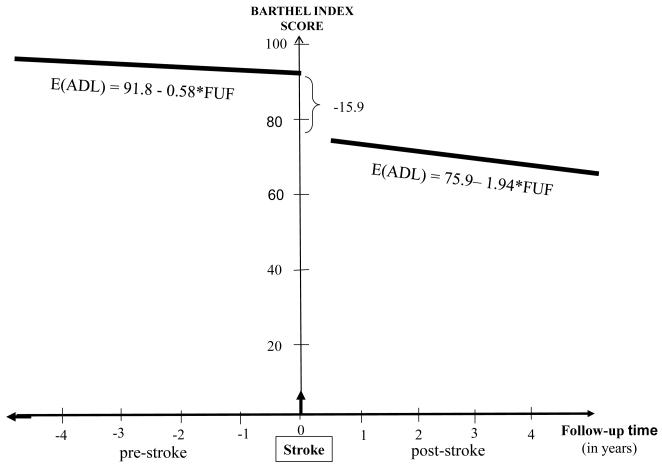
Results: Among 3298 participants, 210 participants had an ischemic stroke during follow-up and had poststroke BI assessed. Mean age (±SD) was 77±9 years, 38% were men, 52% were Hispanic, 37% had diabetes, and 31% had coronary artery disease. There was no difference in rate of functional decline over time before and after stroke (P=0.51), with a decline of 0.96 BI points per year before stroke (P<0.0001) and 1.24 BI points after stroke (P=0.001). However, when stratified by insurance status, among those with Medicaid or no insurance, in a fully adjusted model, there was a difference in slope before and after stroke (P=0.04), with a decline of 0.58 BI points per year before stroke (P=0.02) and 1.94 BI points after stroke (P=0.001).
Conclusions: In this large, prospective, population-based study with long-term follow-up, there was a significantly steeper decline in functional status after ischemic stroke compared with before stroke among those with Medicaid or no insurance, after adjusting for confounders.
Figures
References
-
- Kaplan PE. Rehabilitation of stroke. Butterworth-Heinemann; Burlington, MA: 2003.
-
- Andrews K, Brocklehurst JC, Richards B, Laycock PJ. The rate of recovery from stroke - and its measurement. Int Rehabil Med. 1981;3:155–161. - PubMed
-
- Dignan MB, Howard G, Toole JF, Becker C, McLeroy KR. Evaluation of the north carolina stroke care program. Stroke. 1986;17:382–386. - PubMed
-
- Dombovy ML, Sandok BA, Basford JR. Rehabilitation for stroke: A review. Stroke. 1986;17:363–369. - PubMed
-
- de Groot-Driessen D, van de Sande P, van Heugten C. Speed of finger tapping as a predictor of functional outcome after unilateral stroke. Arch Phys Med Rehabil. 2006;87:40–44. - PubMed
Publication types
MeSH terms
Grants and funding
LinkOut - more resources
Full Text Sources
Medical
