


Pareidolias: complex visual illusions in dementia with Lewy bodies
- PMID: 22649179
- PMCID: PMC3407420
- DOI: 10.1093/brain/aws126
Pareidolias: complex visual illusions in dementia with Lewy bodies
Abstract
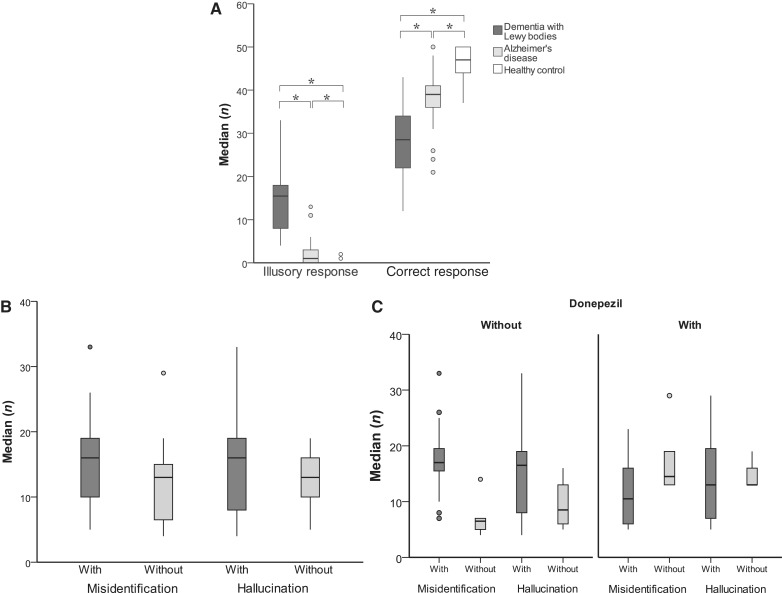
Patients rarely experience visual hallucinations while being observed by clinicians. Therefore, instruments to detect visual hallucinations directly from patients are needed. Pareidolias, which are complex visual illusions involving ambiguous forms that are perceived as meaningful objects, are analogous to visual hallucinations and have the potential to be a surrogate indicator of visual hallucinations. In this study, we explored the clinical utility of a newly developed instrument for evoking pareidolic illusions, the Pareidolia test, in patients with dementia with Lewy bodies-one of the most common causes of visual hallucinations in the elderly. Thirty-four patients with dementia with Lewy bodies, 34 patients with Alzheimer's disease and 26 healthy controls were given the Pareidolia test. Patients with dementia with Lewy bodies produced a much greater number of pareidolic illusions compared with those with Alzheimer's disease or controls. A receiver operating characteristic analysis demonstrated that the number of pareidolias differentiated dementia with Lewy bodies from Alzheimer's disease with a sensitivity of 100% and a specificity of 88%. Full-length figures and faces of people and animals accounted for >80% of the contents of pareidolias. Pareidolias were observed in patients with dementia with Lewy bodies who had visual hallucinations as well as those who did not have visual hallucinations, suggesting that pareidolias do not reflect visual hallucinations themselves but may reflect susceptibility to visual hallucinations. A sub-analysis of patients with dementia with Lewy bodies who were or were not treated with donepzil demonstrated that the numbers of pareidolias were correlated with visuoperceptual abilities in the former and with indices of hallucinations and delusional misidentifications in the latter. Arousal and attentional deficits mediated by abnormal cholinergic mechanisms and visuoperceptual dysfunctions are likely to contribute to the development of visual hallucinations and pareidolias in dementia with Lewy bodies.
Figures

References
-
- Adolphs R, Denburg NL, Tranel D. The amygdala’s role in long-term declarative memory for gist and detail. Behav Neurosci. 2001;115:983–92. - PubMed
-
- Ballard C, McKeith I, Harrison R, O’Brien J, Thompson P, Lowery K, et al. A detailed phenomenological comparison of complex visual hallucinations in dementia with Lewy bodies and Alzheimer’s disease. Int Psychogeriatr. 1997;9:381–8. - PubMed
-
- Benke T. Peduncular hallucinosis: a syndrome of impaired reality monitoring. J Neurol. 2006;253:1561–71. - PubMed
-
- Bonanni L, Thomas A, Tiraboschi P, Perfetti B, Varanese S, Onofrj M. EEG comparisons in early Alzheimer’s disease, dementia with Lewy bodies and Parkinson’s disease with dementia patients with a 2-year follow-up. Brain. 2008;131:690–705. - PubMed
Publication types
MeSH terms
LinkOut - more resources
Full Text Sources
Other Literature Sources
Medical
