


Greater whole-grain intake is associated with lower risk of type 2 diabetes, cardiovascular disease, and weight gain
- PMID: 22649266
- PMCID: PMC6498460
- DOI: 10.3945/jn.111.155325
Greater whole-grain intake is associated with lower risk of type 2 diabetes, cardiovascular disease, and weight gain
Erratum in
- J Nutr. 2013 Sep;143(9):1524
Abstract
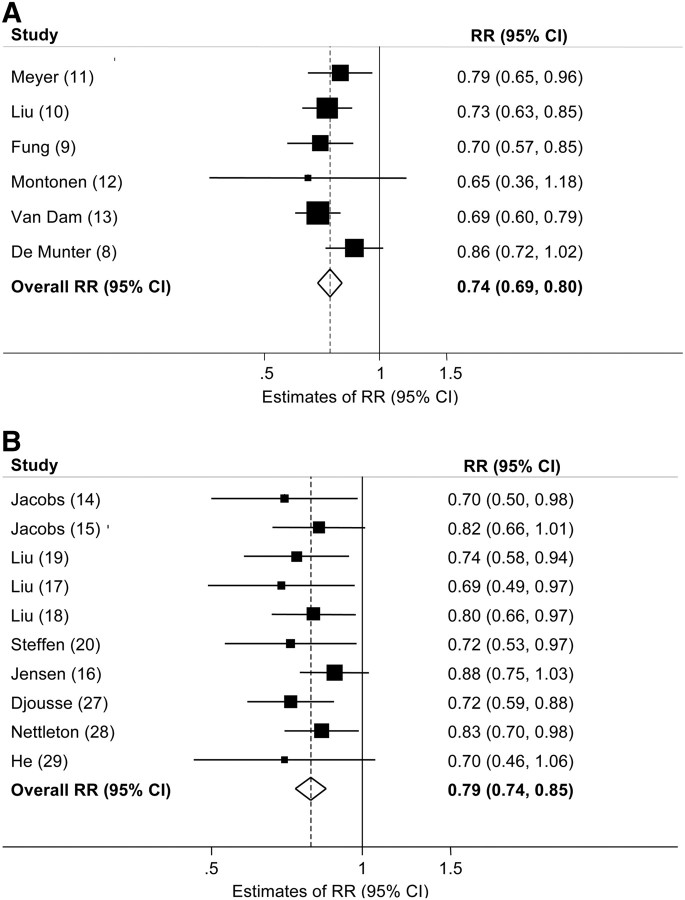
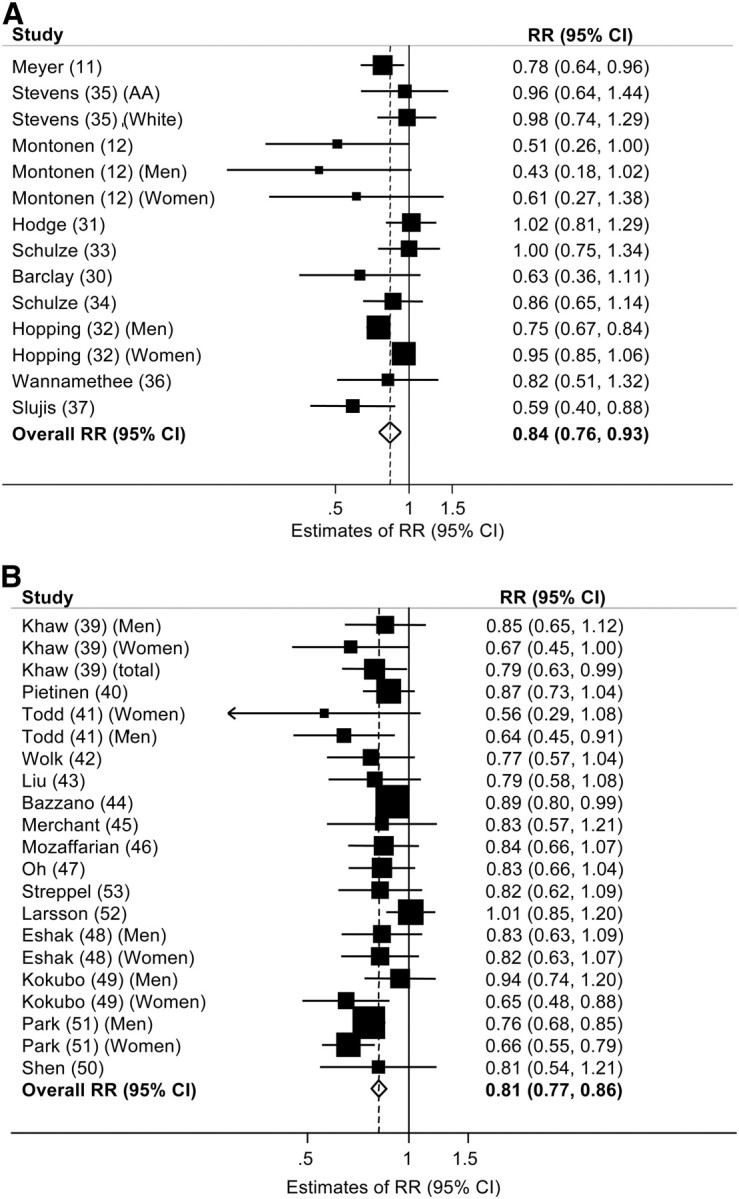
Whole-grain and high fiber intakes are routinely recommended for prevention of vascular diseases; however, there are no comprehensive and quantitative assessments of available data in humans. The aim of this study was to systematically examine longitudinal studies investigating whole-grain and fiber intake in relation to risk of type 2 diabetes (T2D), cardiovascular disease (CVD), weight gain, and metabolic risk factors. We identified 45 prospective cohort studies and 21 randomized-controlled trials (RCT) between 1966 and February 2012 by searching the Cumulative Index to Nursing and Allied Health Literature, Cochrane, Elsevier Medical Database, and PubMed. Study characteristics, whole-grain and dietary fiber intakes, and risk estimates were extracted using a standardized protocol. Using random effects models, we found that compared with never/rare consumers of whole grains, those consuming 48-80 g whole grain/d (3-5 serving/d) had an ~26% lower risk of T2D [RR = 0.74 (95% CI: 0.69, 0.80)], ~21% lower risk of CVD [RR = 0.79 (95% CI: 0.74, 0.85)], and consistently less weight gain during 8-13 y (1.27 vs 1.64 kg; P = 0.001). Among RCT, weighted mean differences in post-intervention circulating concentrations of fasting glucose and total and LDL-cholesterol comparing whole-grain intervention groups with controls indicated significantly lower concentrations after whole-grain interventions [differences in fasting glucose: -0.93 mmol/L (95% CI: -1.65, -0.21), total cholesterol: -0.83 mmol/L (-1.23, -0.42); and LDL-cholesterol: -0.82 mmol/L (-1.31, -0.33)]. [corrected] Findings from this meta-analysis provide evidence to support beneficial effects of whole-grain intake on vascular disease prevention. Potential mechanisms responsible for whole grains' effects on metabolic intermediates require further investigation in large intervention trials.
Figures

Comment in
-
Do whole grain cereals really reduce LDL-cholesterol by 0.72 mmol/L?J Nutr. 2013 Sep;143(9):1521-2. doi: 10.3945/jn.113.177139. J Nutr. 2013. PMID: 23964016 No abstract available.
-
Reply to Wolever.J Nutr. 2013 Sep;143(9):1522-3. doi: 10.3945/jn.113.179267. J Nutr. 2013. PMID: 24137670 No abstract available.
References
-
- WHO Diet, nutrition and the prevention of chronic diseases: report of a joint WHO/FAO expert consultation. Geneva: WHO Technical Report Series; 2002. p. 916.
-
- Dietary Guidelines for Americans 2010. Washington, DC: U.S. Government Printing; 2010.
-
- Bantle JP, Wylie-Rosett J, Albright AL, Apovian CM, Clark NG, Franz MJ, Hoogwerf BJ, Lichtenstein AH, Mayer-Davis E, Mooradian AD, et al. Nutrition recommendations and interventions for diabetes: a position statement of the American Diabetes Association. Diabetes Care. 2008;31Suppl 1:S61–78. - PubMed
-
- Mann JI, De Leeuw I, Hermansen K, Karamanos B, Karlstrom B, Katsilambros N, Riccardi G, Rivellese AA, Rizkalla S, Slama G, et al. Evidence-based nutritional approaches to the treatment and prevention of diabetes mellitus. Nutr Metab Cardiovasc Dis. 2004;14:373–94. - PubMed
-
- Bazzano LA, Song Y, Bubes V, Good CK, Manson JE, Liu S. Dietary intake of whole and refined grain breakfast cereals and weight gain in men. Obes Res. 2005;13:1952–60. - PubMed
