


Oxidative stress and heart failure in altered thyroid States
- PMID: 22649319
- PMCID: PMC3354657
- DOI: 10.1100/2012/741861
Oxidative stress and heart failure in altered thyroid States
Abstract
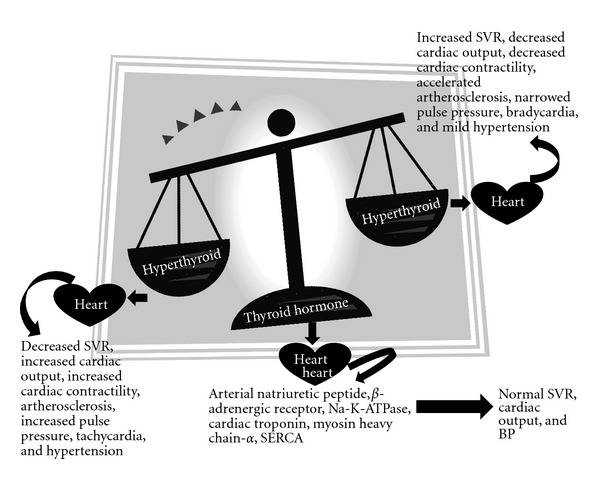
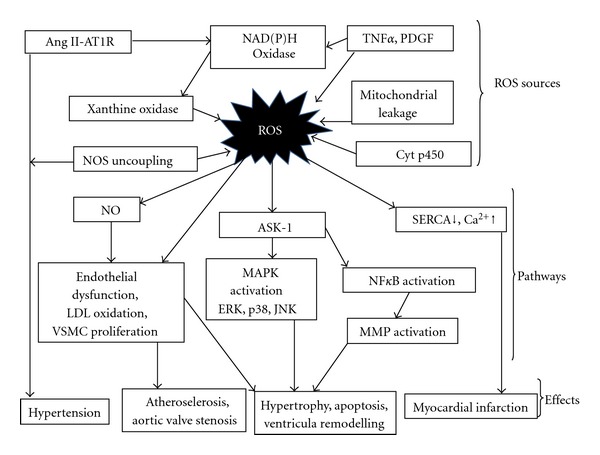
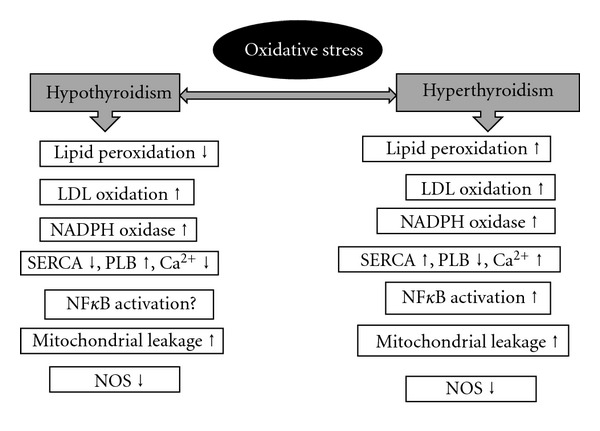
Increased or reduced action of thyroid hormone on certain molecular pathways in the heart and vasculature causes relevant cardiovascular derangements. It is well established that hyperthyroidism induces a hyperdynamic cardiovascular state, which is associated with a faster heart rate, enhanced left ventricular systolic and diastolic function whereas hypothyroidism is characterized by the opposite changes. Hyperthyroidism and hypothyroidism represent opposite clinical conditions, albeit not mirror images. Recent experimental and clinical studies have suggested the involvement of ROS tissue damage under altered thyroid status. Altered-thyroid state-linked changes in heart modify their susceptibility to oxidants and the extent of the oxidative damage they suffer following oxidative challenge. Chronic increase in the cellular levels of ROS can lead to a catastrophic cycle of DNA damage, mitochondrial dysfunction, further ROS generation and cellular injury. Thus, these cellular events might play an important role in the development and progression of myocardial remodeling and heart failure in altered thyroid states (hypo- and hyper-thyroidism). The present review aims at elucidating the various signaling pathways mediated via ROS and their modulation under altered thyroid state and the possibility of antioxidant therapy.
Figures
References
-
- Klein I, Ojamaa K. Editorial: thyroid hormone—targeting the heart. Endocrinology. 2001;142(1):11–12. - PubMed
-
- Fernandez V, Barrientos X, Kipreos K. Superoxide radical generation, NADPH oxidase activity, and cytochrome P-450 content of rat liver microsomal fractions in an experimental hyperthyroid state: relation to lipid peroxidation. Endocrinology. 1985;117(2):496–501. - PubMed
-
- Asayama K, Dobashi K, Hayashibe H, Megata Y, Kato K. Lipid peroxidation and free radical scavengers in thyroid dysfunction in the rat: a possible mechanism of injury to heart and skeletal muscle in hyperthyroidism. Endocrinology. 1987;121(6):2112–2118. - PubMed
-
- Halliwell B, Gutteridge JMC. Free Radicals in Biology and Medicine. 3rd edition. New York, NY, USA: Oxford University Press; 2001.
Publication types
MeSH terms
Substances
LinkOut - more resources
Full Text Sources
Medical
