


Current Challenges in Prostate Cancer Management and the Rationale behind Targeted Focal Therapy
- PMID: 22649447
- PMCID: PMC3357537
- DOI: 10.1155/2012/862639
Current Challenges in Prostate Cancer Management and the Rationale behind Targeted Focal Therapy
Abstract
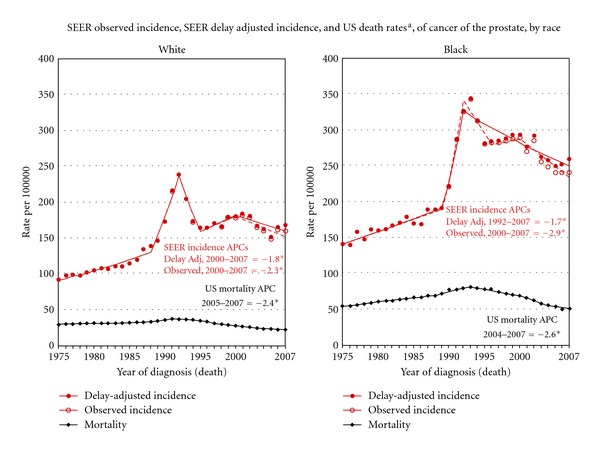
Among men, prostate cancer has a high prevalence, with relatively lower cancer-specific mortality risk compared to lung and colon cancer. Prostate-specific antigen (PSA) screening has increased prostate cancer awareness since its implementation as a screening tool almost 25 years ago, but, due to the largely indolent course of this disease and the unspecific nature of the PSA test, increased incidence has largely been associated with cancers that would not go on to cause death (clinically insignificant), leading to an overdiagnosis challenge and an ensuing overtreatment consequences. The overtreatment problem is exacerbated by the high risk of side effects that current treatment techniques have, putting patients' quality of life at risk with little or no survival benefit. The goals of this paper are to evaluate the rise, prevalence, and impact of the overdiagnosis and ensuing overtreatment problems, as well as highlight potential solutions. In this effort, a review of major epidemiological and screening studies, cancer statistics from the advent of prostate-specific antigen screening to the present, and reports on patient concerns and treatment outcomes was conducted to present the dominant factors that underlie current challenges in prostate cancer treatment and illuminate potential solutions.
Figures
References
-
- Jemal A, Siegel R, Xu J, Ward E. Cancer statistics, 2010. CA Cancer Journal for Clinicians. 2010;60(5):277–300. - PubMed
-
- Siegel R, Ward E, Brawley O, Jemal A. Cancer statistics, 2011. CA Cancer Journal for Clinicians. 2011;61(4):212–236. - PubMed
-
- Howlader N, Noone AM, Krapcho M, Neyman N, Aminou R, et al. SEER Cancer Statistics Review, 1975–2008. Bethesda, Md, USA: National Cancer Institute; 2011, http://seer.cancer.gov/csr/1975_2008/
-
- American Cancer Society. Cancer Facts and Figures. Atlanta, Ga, USA: American Cancer Society; 2010, http://www.cancer.org/Research/CancerFactsFigures/CancerFactsFigures/can....
LinkOut - more resources
Full Text Sources
Research Materials
Miscellaneous
