Comparative Study
. 2012;7(5):e37955.
doi: 10.1371/journal.pone.0037955. Epub 2012 May 23.

Propentofylline targets TROY, a novel microglial signaling pathway

Affiliations
Comparative Study

Propentofylline targets TROY, a novel microglial signaling pathway

Valerie L Jacobs et al. PLoS One. 2012.

Erratum in

  • PLoS One. 2013;8(1). doi:10.1371/annotation/d8f0ef0f-414e-49aa-92a8-fd8d838b611b

Abstract

Glioblastoma multiforme (GBM) is the most common and aggressive primary brain cancer, with a median survival of less than 2 years after diagnosis with current available therapies. The tumor microenvironment serves a critical role in tumor invasion and progression, with microglia as a critical player. Our laboratory has previously demonstrated that propentofylline, an atypical methylxanthine with central nervous system glial modulating and anti-inflammatory actions, significantly decreases tumor growth in a GBM rodent model by preferentially targeting microglia. In the present study, we used the CNS-1 rat glioma model to elucidate the mechanisms of propentofylline. Here we demonstrate that propentofylline targets TROY, a novel signaling molecule up-regulated in infiltrating microglia, and not macrophages, in response to CNS-1 cells. We identify Pyk2, Rac1 and pJNK as the downstream signaling molecules of TROY through western blot analysis and siRNA transfection. We demonstrate that inhibition of TROY expression in microglia by siRNA transfection significantly inhibits microglial migration towards CNS-1 cells similar to 10 µM propentofylline treatment. These results identify TROY as a novel molecule expressed in microglia, involved in their migration and targeted by propentofylline. Furthermore, these results describe a signaling molecule that is differentially expressed between microglia and macrophages in the tumor microenvironment.


Conflict of interest statement

Competing Interests: The authors have declared that no competing interests exist.

Figures

Figure 1
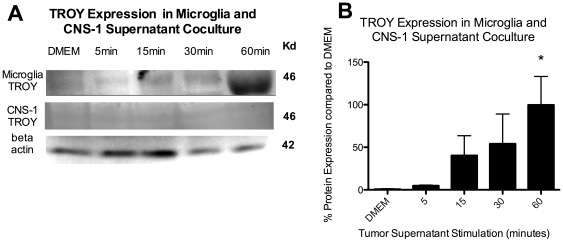
Figure 1. TROY is expressed in microglia in response to CNS-1 tumor stimulation.
(A) TROY western blot of microglia cultured with CNS-1 conditioned media over time. (B) A graphical representation of differential TROY expression in microglia cultured with CNS-1 conditioned media over time (* = p<0.05). Graph is representative of three western blots from three replicates.
Figure 2
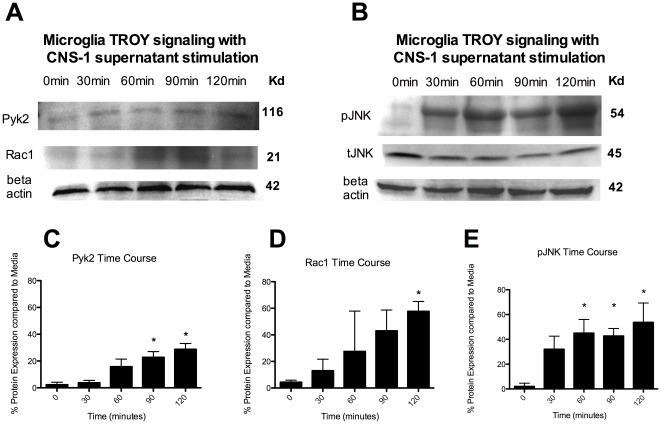
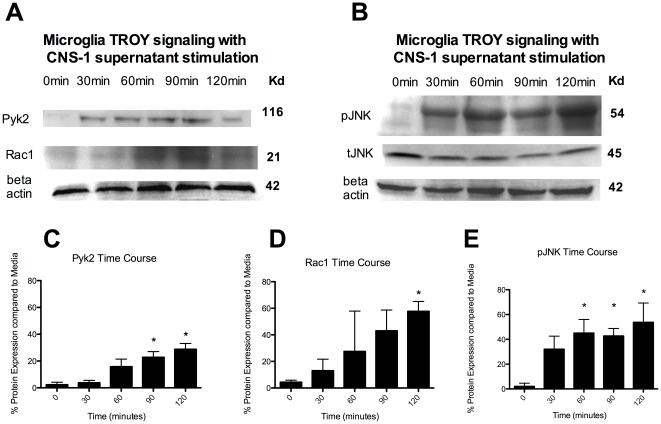
Figure 2. Microglia increase Pyk2, Rac1 and pJNK expression in response to CNS-1 conditioned media.
(A) Pyk2 and Rac1 western blot of microglia cultured with CNS-1 conditioned media over time. (B) pJNK and tJNK western blot of microglia cultured with CNS-1 conditioned media over time. (C) A graphical representation of differential pyk2 expression in microglia cultured with CNS-1 conditioned media over time (* = p<0.05). (D) A graphical representation of differential Rac1 expression in microglia cultured with CNS-1 conditioned media over time (* = p<0.05). (E) A graphical representation of differential pJNK expression in microglia cultured with CNS-1 conditioned media over time (* = p<0.05). Graphs are representative of three western blots from three replicates.
Figure 3
Figure 3. Propentofylline decreases TROY expression in microglia.
(A) TROY western blot of microglia cultured with CNS-1 conditioned media and treated with PPF. (B) A graphical representation of differential TROY expression microglia cultured with CNS-1 conditioned media and treated with PPF (* = p<0.05). Graph is representative of three western blots from three replicates.
Figure 4
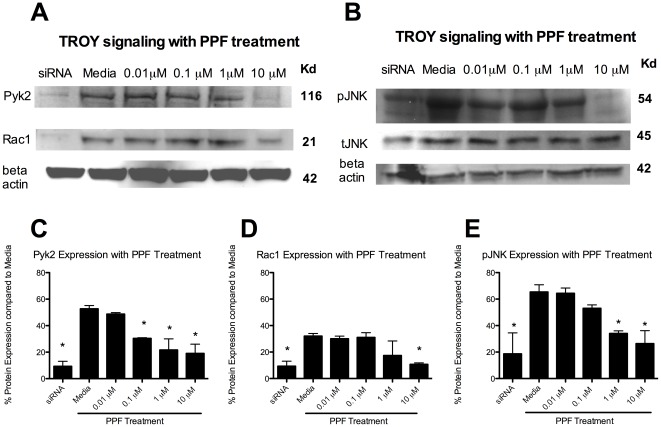
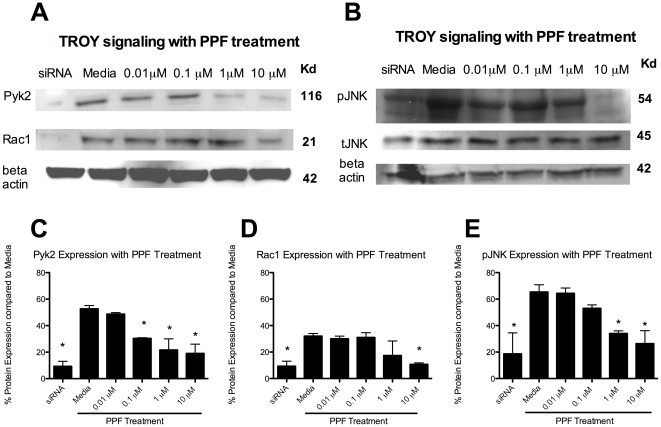
Figure 4. Propentofylline decreases Pyk2, Rac1 and pJNK.
(A) Pyk2, Rac1 and pJNK western blot of microglia cultured with CNS-1 conditioned media and treated with PPF. (B) pJNK and tJNK western blot of microglia cultured with CNS-1 conditioned media and treated with PPF. (C) A graphical representation of differential pyk2 expression in microglia cultured with CNS-1 conditioned media and treated with PPF (* = p<0.05). (D) A graphical representation of differential Rac1 expression in microglia cultured with CNS-1 conditioned media and treated with PPF (* = p<0.05). (E) A graphical representation of differential pJNK expression in microglia cultured with CNS-1 conditioned media and treated with PPF (* = p<0.05). Graphs are representative of three western blots from three replicates.
Figure 5
Figure 5. TROY knockdown results in a decrease of microglial migration towards CNS-1 tumor cells.
(A) Western blot demonstrating decreased TROY expression in microglia cultured with CNS-1 conditioned media and treated with TROY siRNA. (B) Microglia were treated with TROY siRNA, and then migrated towards CNS-1 cells. Migration of microglia in response to CNS-1 cells is significantly decreased compared to media (* = p<0.05).
Figure 6
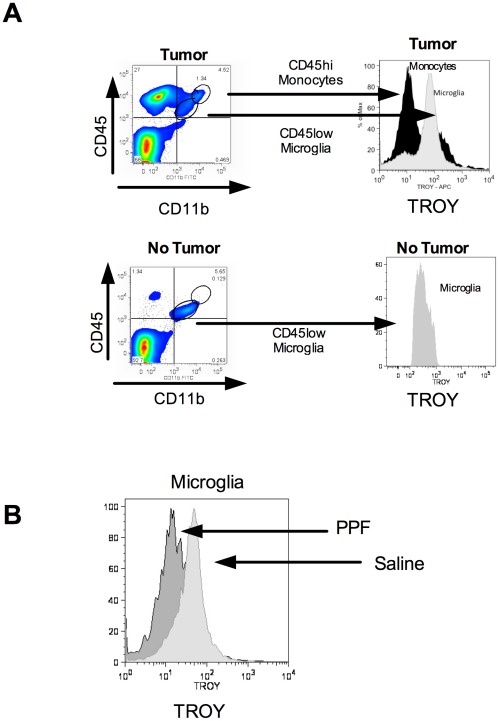
Figure 6. TROY is expressed in tumor infiltrating microglia, not macrophages.
(A) Lewis rats were implanted with 3×10⁵ CNS-1 cells. Tumors were collected on day 10 from tumor bearing rats and untreated rats, and then stained for microglia (CD45+lo, CDllb+), macrophages (CD45+hi, CDllb+) and TROY. Gating is shown in figure, histogram is representative of 6 rats/group. (B) Lewis rats were implanted with CNS-1 cells and then treated with 50 mg/kg PPF or saline on day 8 for 2 days. Tumors were collected and stained for microglia (CD45+lo, CDllb+), macrophages (CD45+hi, CDllb+) and TROY. Histogram is representative of 3 rats/group.

References

    1. DeAngelis LM. Chemotherapy for brain tumors–a new beginning. N Engl J Med. 2005;352:1036–1038. - PubMed
    1. Ohgaki H, Kleihues P. Population-based studies on incidence, survival rates, and genetic alterations in astrocytic and oligodendroglial gliomas. J Neuropathol Exp Neurol. 2005;64:479–489. - PubMed
    1. Roggendorf W, Strupp S, Paulus W. Distribution and characterization of microglia/macrophages in human brain tumors. Acta Neuropathol. 1996;92:288–293. - PubMed
    1. Yang I, Han SJ, Kaur G, Crane C, Parsa AT. The role of microglia in central nervous system immunity and glioma immunology. J Clin Neurosci. 2010;17:6–10. - PMC - PubMed
    1. Tuettenberg J, Grobholz R, Seiz M, Brockmann MA, Lohr F, et al. Recurrence pattern in glioblastoma multiforme patients treated with anti-angiogenic chemotherapy. J Cancer Res Clin Oncol. 2009;135:1239–1244. - PMC - PubMed

Publication types

MeSH terms