


Macrolide-resistant Mycoplasma pneumoniae in adolescents with community-acquired pneumonia
- PMID: 22650321
- PMCID: PMC3478186
- DOI: 10.1186/1471-2334-12-126
Macrolide-resistant Mycoplasma pneumoniae in adolescents with community-acquired pneumonia
Abstract
Background: Although the prevalence of macrolide-resistant Mycoplasma pneumoniae isolates in Japanese pediatric patients has increased rapidly, there have been no reports concerning macrolide-resistant M. pneumoniae infection in adolescents aged 16 to 19 years old. The purpose of this study was to clarify the prevalence and clinical characteristics of macrolide-resistant M. pneumoniae in adolescent patients with community-acquired pneumonia.
Methods: A total of 99 cases with M. pneumoniae pneumonia confirmed by polymerase chain reaction (PCR) and culture were analyzed. Forty-five cases were pediatric patients less than 16 years old, 26 cases were 16 to 19-year-old adolescent patients and 28 cases were adult patients. Primers for domain V of 23S rRNA were used and DNA sequences of the PCR products were compared with the sequence of an M. pneumoniae reference strain.
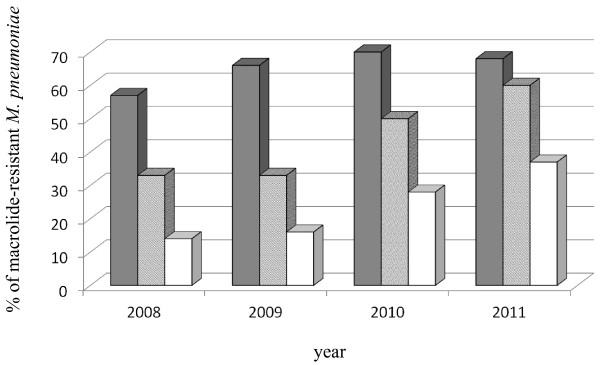
Results: Thirty of 45 pediatric patients (66%), 12 of 26 adolescent patients (46%) and seven of 28 adult patients (25%) with M. pneumoniae pneumonia were found to be infected with macrolide-resistant M. pneumoniae (MR patients). Although the prevalence of resistant strains was similar in pediatric patients between 2008 and 2011, an increase in the prevalence of resistant strains was observed in adolescent patients. Among 30 pediatric MR patients, 26 had an A-to-G transition at position 2063 (A2063G) and four had an A-to-G transition at position 2064 (A2064G). In 12 adolescent MR patients, 10 showed an A2063G transition and two showed an A2064G transition, and in seven adult MR patients, six showed an A2063G transition and one showed an A2064G transition.
Conclusions: The prevalence of macrolide-resistant M. pneumoniae is high among adolescent patients as well as pediatric patients less than 16-years old. To prevent outbreaks of M. pneumoniae infection, especially macrolide-resistant M. pneumoniae, in closed populations including among families, in schools and in university students, physicians should pay close attention to macrolide-resistant M. pneumoniae.
Figures
References
-
- The committee for the Japanese Respiratory Society guidelines in management of respiratory infections. The Japanese Respiratory Society guideline for the management of community-acquired pneumonia in adults. Respirology. 2006;11(Suppl 3):79–133. - PubMed
-
- National Institute of Health. Infectious Disease Surveillance Center. Mycoplasma pneumoniae pneumonia. 2000. http://idsc.nih.go.jp/idwr/kanja/weeklygraph/18myco.html
-
- Rasmussen JN, Voldstedlund M, Andersen RL, Ellermann-Eriksen S, Jensen TG, Johansen HK, Kolmos B, Molvadgaard M, Nielsen SS, Olsen E, Schonning K, Uldum SA. Increased incidence ofMycoplasma pneumoniaeinfections detected by laboratory-based surveillance in Denmark in 2010. Euro Surveill. 2010;15:45. - PubMed
-
- Chalker V, Stocki T, Mentasti M, Fleming D, Harrison T. Increased incidence ofMycoplasma pneumoniaeinfection in England and Wales in 2010: multiocus variable number tandem repeat analysis typing and macrolide susceptibility. Euro Surveill. 2011;16:19. - PubMed
Publication types
MeSH terms
Substances
LinkOut - more resources
Full Text Sources
Medical
