. 2012 May 31;10(1):14.
doi: 10.1186/1546-0096-10-14.

The assessment of the spondyloarthritis international society concept and criteria for the classification of axial spondyloarthritis and peripheral spondyloarthritis: A critical appraisal for the pediatric rheumatologist

Affiliations

The assessment of the spondyloarthritis international society concept and criteria for the classification of axial spondyloarthritis and peripheral spondyloarthritis: A critical appraisal for the pediatric rheumatologist

Ruben Burgos-Vargas. Pediatr Rheumatol Online J. .

Abstract

This review refers to the origin and current state of the assessment of the SpondyloArthritis International Society (ASAS) criteria for the classification of axial and peripheral spondyloarthritis (SpA) and the possible implications in the pediatric population. The ASAS criteria evolved from the idea that the earlier the recognition of patients with ankylosing spondylitis, the better the efficacy of tumor necrosis factor blockers. Strategies included the development of new concepts, definitions, and techniques for the study of clinical signs and symptoms. Of relevance, the new definition of inflammatory back pain (IBP) and the introduction of sacroiliitis by magnetic resonance imaging represented the most important advance in the early identification of AS in the "pre-radiographic stage" of the disease. AS is considered in this paper as a disease continuum with symptoms depending on age at onset. The application of those specific strategies in children and adolescents with SpA seems limited because the most important manifestation in the early stage of disease is not IBP, but peripheral arthritis and enthesitis. In this instance, the logical approach to juvenile onset SpA according to ASAS criteria should not be through the axial criteria but rather the peripheral set of criteria.


Figures
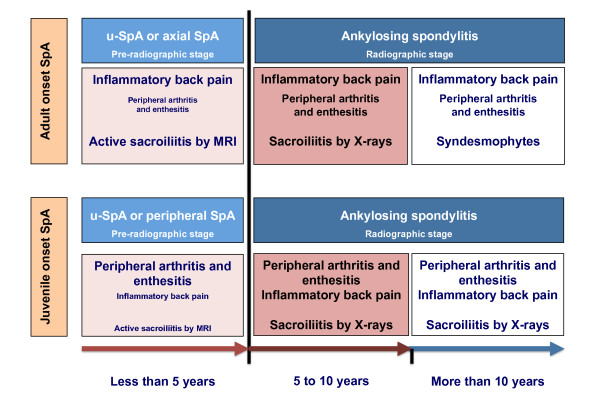
Figure 1
Figure 1
The modified schematic representation of Rudwaleit’s scheme[49]on the transition of undifferentiated juvenile-onset spondyloarthritis (u-SpA) to ankylosing spondylitis (AS) in the context of axial and peripheral SpA. Note: In this model, we present the idea that axial SpA is mostly representative of adult-onset patients (upper panel) whereas the subset that could mostly be adapted to children and adolescents with juvenile-onset SpA is that of peripheral SpA (lower panel). Time to transition is an estimation based on scarce published reports. Note that during the interval between disease onset and the 5th year of symptoms, the most frequent and characteristic symptoms and signs in juvenile-onset SpA are peripheral arthritis and enthesitis and not inflammatory back pain (small fonts; IBP). In contrast, IBP, and not peripheral symptoms, (small fonts) is the most important characteristic in adult patients. Beyond the 5th year of disease, the proportion of patients with both juvenile and adult onset SpA fulfilling the modified New York criteria for AS [3] increases to reach a maximum around 10 years after onset. Imaging of the sacroiliac joints, particularly the early inflammatory stage by magnetic resonance imaging (MRI) is essential in the study of adult patients with IBP. This approach does not seem the logical in the study of juvenile-onset SpA since IBP occurs in less than 15% in the initial years of disease. While the demonstration of edema in the sacroiliac joints by MRI has therapeutic implications in adult-onset SpA –the earliest the treatment, the better the response, the indications for early treatment of children and adolescents with SpA with tumor necrosis factor (TNF) blockers could mostly rely on peripheral symptoms. Regarding the ostechondral proliferative stage of spinal involvement, it is only probable that in juvenile-onset patient this stage takes a long time to develop, perhaps similar to that seen in adults.
Figure 2
Figure 2
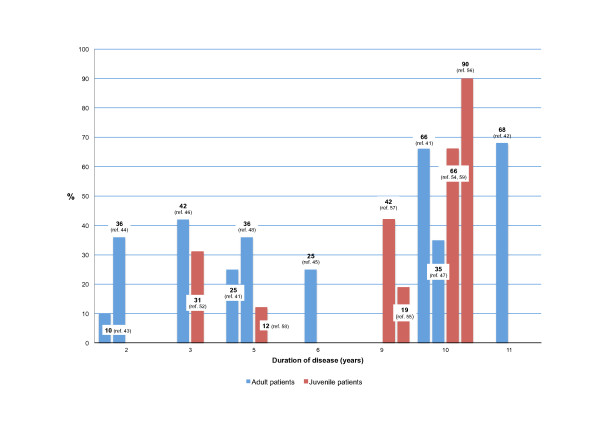
Percentage of adult and juvenile onset patients with undifferentiated SpA (u-SpA) progressing to ankylosing spondylitis (AS) throughout the course of the disease as reported in retrospective studies. Note: Variations are probably related to the characteristics of the population included in the study, entry criteria, and the type of assessments carried out. Interestingly, most references related to adult-onset patients include a moderately high proportion of patients with peripheral arthritis in combination or not with axial symptoms. Most studies consider AS the outcome measure, but some others referred to other parameters, for example radiographic sacroiliitis.
Figure 3
Figure 3
TNF blocker effect on sacrolliitis. Short Tau (t) (inversion time) Inversion Recovery (STIR) magnetic resonance (MR) imaging of the sacroiliac joints of a 16-year-old boy a 3-month history of gluteal pain and a 3-year history of peripheral arthritis and enthesitis before (A) and 14 weeks after 5 mg/kg infliximab treatment at baseline and weeks 2 and 6. In (A), there is ample edema of the iliac bone and sacrum (line) and part of the sacrum inferior quadrant on the opposite side (arrow) that cleared-up after treatment (B).
Figure 4
Figure 4
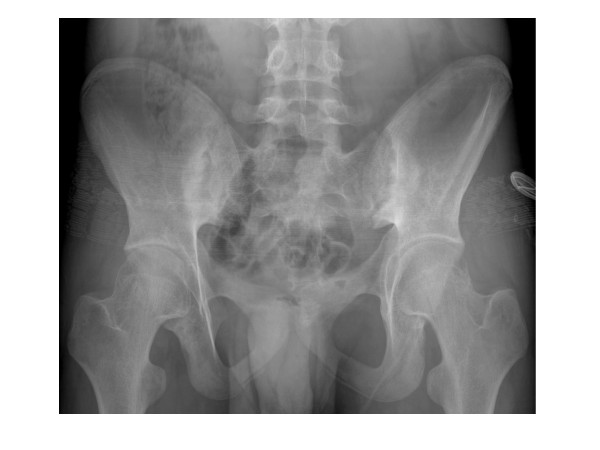
Grade 3 bilateral sacroiliitis in a 14-year-old boy with 6 years disease duration. There is subchondral sclerosis of the iliac bone, joint surface irregularities, which include some erosions on both sides, and joint space narrowing of the hips (From Burgos-Vargas, R. 2006, The juvenile-onset spondyloarthritides. In: Weisman MH, van der Heijde D, Reveille JD. Ankylosing spondylitis and the Spondyloarthropathies. Mosby. Philadelphia. pp 94–106).
Figure 5
Figure 5
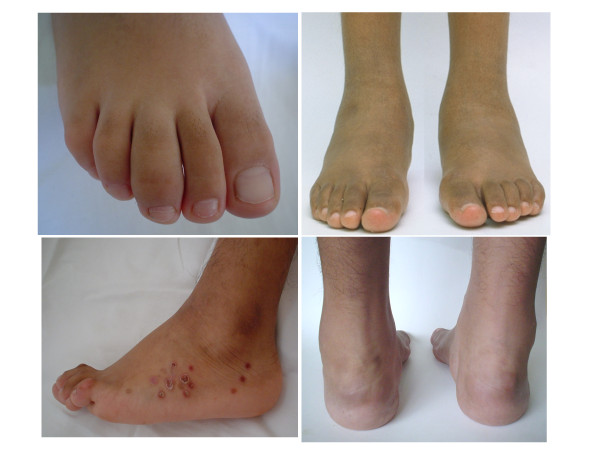
Involvement of the feet in patients with SpA. A. Dactylitis of the third digit in a 12-year-old boy with undifferentiated SpA. B. Diffuse swelling of the tarsal region of a 11- year-old boy with juvenile-onset AS. C. Tarsal swelling, hyperextension of the digits, and keratoderma blenorrhagica spots in a 16-year-old boy with chronic reactive arthritis. D. Diffuse swelling of the posterior aspect of feet including the ankles, Achilles, peroneal and tibial posterior tendons in a 12 year-old-boy with undifferentiated SpA (Modified from Burgos-Vargas R, Vázquez-Mellado J. Reactive arthritides. In: Cassidy JT, Petty RE (eds): Textbook of Pediatric Rheumatology. 5th Edition. Philadelphia. Elsevier Saunders. 2005:604–612 and Burgos-Vargas, R. 2006, The juvenile-onset spondyloarthritides. In: Weisman MH, van der Heijde D, Reveille JD. Ankylosing spondylitis and the Spondyloarthropathies. Mosby. Philadelphia. pp 94–106).
Figure 6
Figure 6
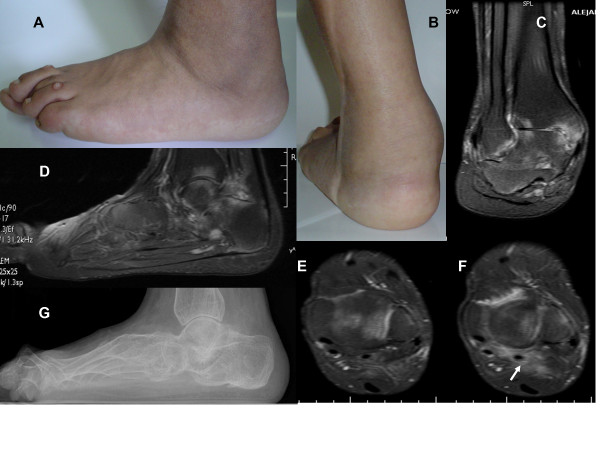
Composite images of ankylosing tarsitis in a 16-year-old boy with AS of 9 year’s disease duration and complete ankylosis of the tarsal bones and grade 2 bilateral sacroiliitis. A and B. Flat foot and swelling around the ankle. C, D, E, and F. T2-weighted-fat suppressed MR imaging showing edema in various tarsal bones, joint spaces (C and D), and soft tissues (E and F) surrounding the tendons of the posterior aspect of the foot on the coronal view (arrows) fat. G. Complete ankylosis of the tarsal bones and an enthesophyte at the plantar fascia attachment (modified from: Burgos-Vargas R. A case of childhood-onset ankylosing spondylitis: diagnosis and treatment. Nat Clin Pract Rheumatol 2009;5:52–7).

References

    1. Braun J, Sieper J. Ankylosing spondylitis. Lancet. 2007;369(9570):1379–1390. doi: 10.1016/S0140-6736(07)60635-7. - DOI - PubMed
    1. Weisman MH, Reveille JD, van der Heijde D. Ankylosing Spondylitis and the Spondyloarthropathies: A Companion to Rheumatology. 1. Mosby, Philadelphia; 2006.
    1. van der Linden S, Valkenburg HA, Cats A. Evaluation of diagnostic criteria for ankylosing spondylitis. A proposal for modification of the New York criteria. Arthritis Rheum. 1984;27(4):361–368. doi: 10.1002/art.1780270401. - DOI - PubMed
    1. Kobelt G, Andlin-Sobocki P, Maksymowych WP. Costs and quality of life of patients with ankylosing spondylitis in Canada. J Rheumatol. 2006;33(2):289–295. - PubMed
    1. Ariza-Ariza R, Hernandez-Cruz B, Navarro-Sarabia F. Physical function and health-related quality of life of Spanish patients with ankylosing spondylitis. Arthritis Rheum. 2003;49(4):483–487. doi: 10.1002/art.11197. - DOI - PubMed