Review
doi: 10.2741/s347.
Developmental regulation of decidual cell polyploidy at the site of implantation
Affiliations
- PMID: 22652887
- PMCID: PMC4269479
- DOI: 10.2741/s347
Item in Clipboard
Review
Developmental regulation of decidual cell polyploidy at the site of implantation
Front Biosci (Schol Ed).
.
Abstract
Polyploidy has been reported in several animal cells, as well as within humans; however the mechanism of developmental regulation of this process remains poorly understood. Polyploidy occurs in normal biologic processes as well as in pathologic states. Decidual polyploid cells are terminally differentiated cells with a critical role in continued uterine development during embryo implantation and growth. Here we review the mechanisms involved in polyploidy cell formation in normal developmental processes, with focus on known regulatory aspects in decidual cells.
Figures
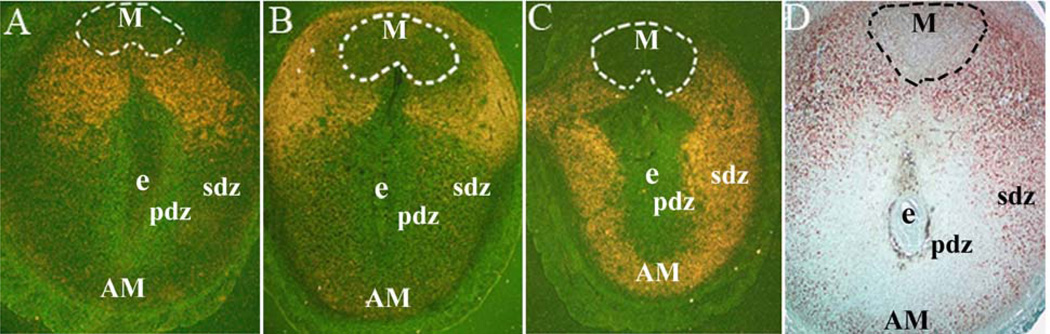
Regional distribution of expression for up-regulated polyploidy genes during decidualization at the site of implantation. In situ hybridization: Expression of Nox4 (A), Nsbp1 (B), and Tdo2 (C) genes at the embryo implantation sites on day 7 of pregnancy. Dark-field photomicrographs of representative cross-sections hybridized with antisense probes are shown at 40X. Immunohistochemical analysis: Localization of CyclinD3 (D) at the embryo implantation sites on day 8. M, mesometrial pole; AM, anti-mesometrial pole; e, embryo; pdz, primary decidual zone; sdz, secondary decidual zone. (Reproduced with permission from, ref# 49).
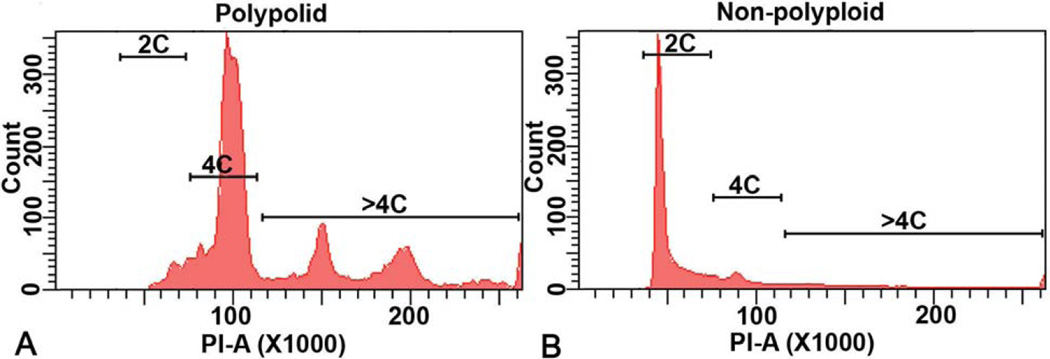
Analysis of polyploid and non-polyploid cells. Deciduomal cells collected on day 7 of pseudopregnancy. Flow cytometric analyses of the DNA content for a representative polyploid (A) and non-polyploid (B) population are shown. Note: The polyploid fractions are enriched with DNA content > 4N, while the non-polyploid fractions are primarily devoid of cells with DNA content > 4N. (Reproduced with permission from, ref# 49).
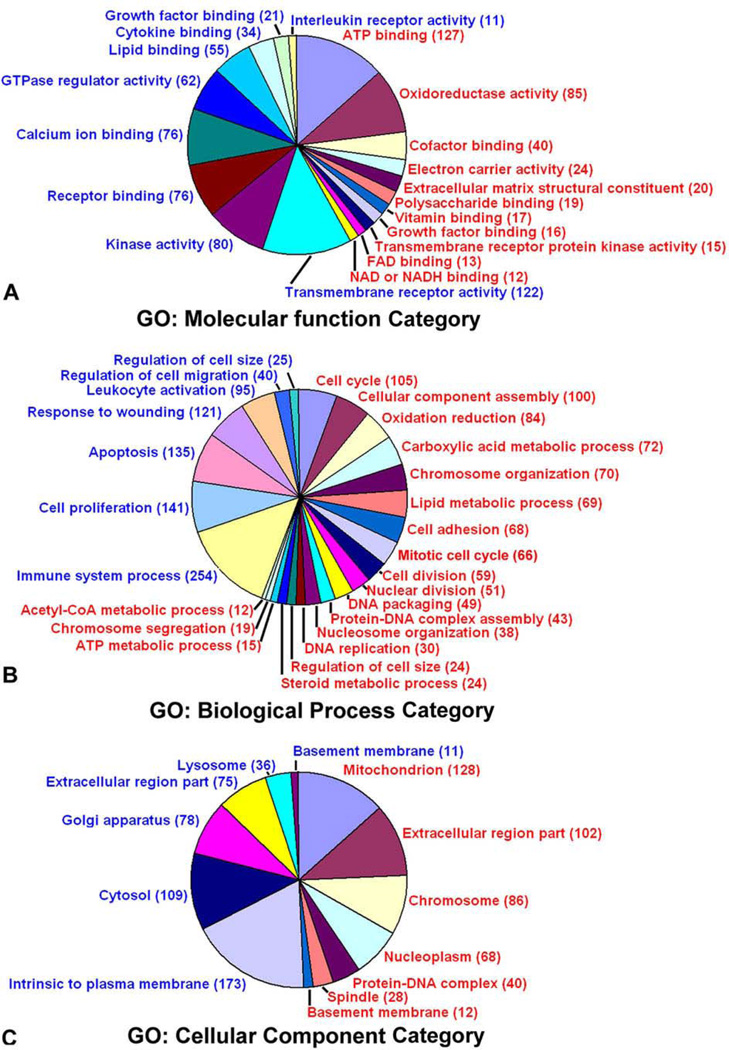
Functional categorization of differentially expressed genes in the polyploid decidual cells. The up-regulated (red) and down-regulated (blue) genes are defined by the gene ontology (GO) terms: molecular function, biological processes, and cellular component categories. The number within the parenthesis represents the total genes modulated under a category. (Reproduced with permission from, ref# 49).
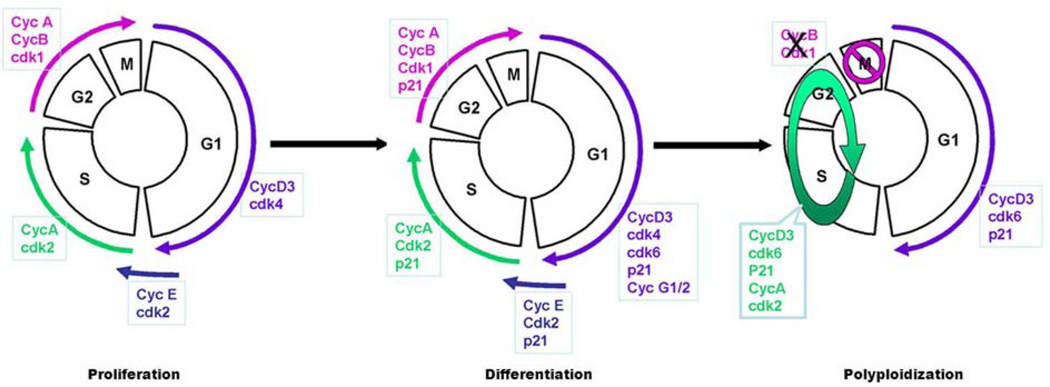
A proposed model for stromal cell proliferation, differentiation, and polyploidization. (Reproduced with permission from, ref# 6).
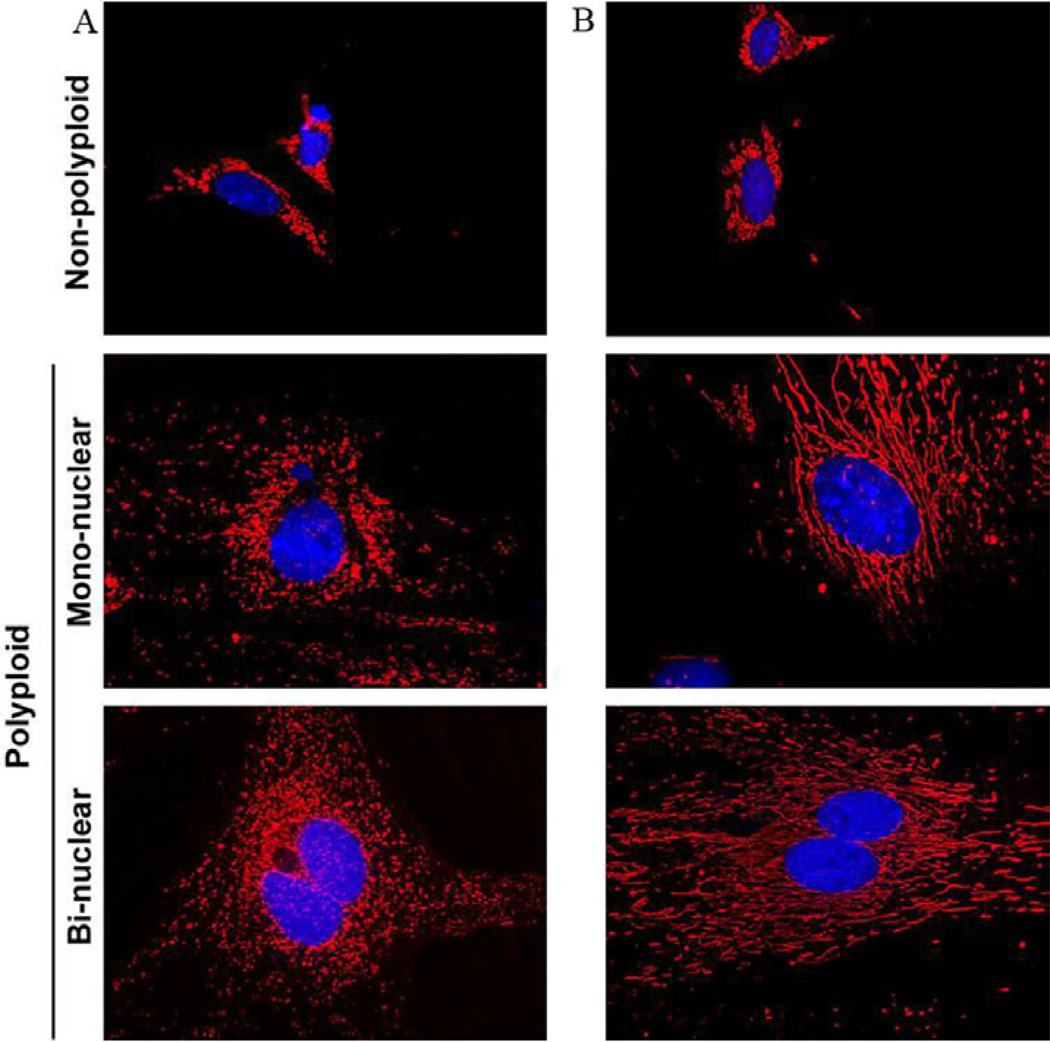
Analysis of mitochondria in relation to decidual cell polyploidy. Mitochondrial mass analysis by confocal microscopy. (A) Pure polyploid and non-polyploid decidual cells isolated from day 7 deciduomal tissues. (B) Day 4 uterine stromal cells in culture were used to induce decidualization in vitro. Polyploid and non-polyploid cells were collected on day-5 following the induction of decidualization. Both cell populations derived in vivo and in vitro were cyto-spun onto slides and analyzed by staining with Mitotracker Red. (Reproduced with permission from, ref# 49).
References
-
- Psychoyos A. Hormonal control of ovoimplantation. Vitam Horm. 1973;31:201–256. - PubMed
-
- Wang H, Dey SK. Roadmap to embryo implantation: clues from mouse models. Nat Rev Genet. 2006;7:185–199. - PubMed
-
- Dey SK, Lim H, Das SK, Reese J, Paria BC, Daikoku T, Wang H. Molecular cues to implantation. Endocr Rev. 2004;25:341–373. - PubMed
Publication types
MeSH terms
Grants and funding
LinkOut - more resources
Full Text Sources