


In-lab three-dimensional printing: an inexpensive tool for experimentation and visualization for the field of organogenesis
- PMID: 22652907
- PMCID: PMC3399707
- DOI: 10.4161/org.20173
In-lab three-dimensional printing: an inexpensive tool for experimentation and visualization for the field of organogenesis
Abstract
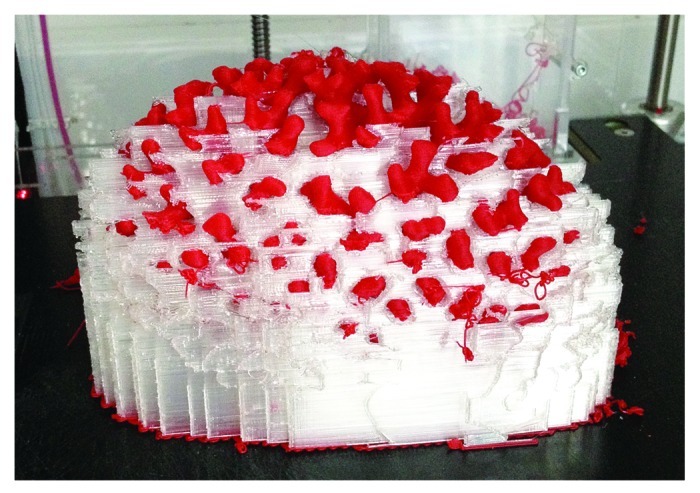
The development of the microscope in 1590 by Zacharias Janssenby and Hans Lippershey gave the world a new way of visualizing details of morphogenesis and development. More recent improvements in this technology including confocal microscopy, scanning electron microscopy (SEM) and optical projection tomography (OPT) have enhanced the quality of the resultant image. These technologies also allow a representation to be made of a developing tissue's three-dimensional (3-D) form. With all these techniques however, the image is delivered on a flat two-dimensional (2-D) screen. 3-D printing represents an exciting potential to reproduce the image not simply on a flat screen, but in a physical, palpable three-dimensional structure. Here we explore the scope that this holds for exploring and interacting with the structure of a developing organ in an entirely novel way. As well as being useful for visualization, 3-D printers are capable of rapidly and cost-effectively producing custom-made structures for use within the laboratory. We here describe the advantages of producing hardware for a tissue culture system using an inexpensive in-lab printer.
Figures



References
-
- Happé H, de Heer E, Peters DJ. Polycystic kidney disease: the complexity of planar cell polarity and signaling during tissue regeneration and cyst formation. Biochim Biophys Acta. 2011;1812:1249–55. - PubMed
-
- Hopwood N. Embryos in wax: models from the Ziegler studio. Bern: Whipple Museum for the History of Science, 2002.
Publication types
MeSH terms
Grants and funding
LinkOut - more resources
Full Text Sources
Other Literature Sources
Research Materials
Miscellaneous
