


Etiology and seasonality of viral respiratory infections in rural Honduran children
- PMID: 22653487
- PMCID: PMC3473163
- DOI: 10.1097/INF.0b013e31826052eb
Etiology and seasonality of viral respiratory infections in rural Honduran children
Abstract
Background: Limited data are available in Honduras that describe the etiology and seasonality of respiratory infections, especially in rural outpatient settings. Better data may lead to improved therapeutic and preventive strategies. The goal of our study was to determine the viral etiology and seasonality of acute respiratory infections in a rural Honduran population of children.
Methods: Prospective clinic surveillance was conducted to identify children < 5 years of age presenting with respiratory symptoms of < 5 days duration. We obtained data on age, sex, medical history, breastfeeding history, symptoms, risk factors, household setting, temperature, respiratory rate and chest examination findings. To assess the association between specific viruses and weather, regional meteorological data were collected. Nasopharyngeal samples were tested for 16 respiratory viruses using a multiplex polymerase chain reaction panel.
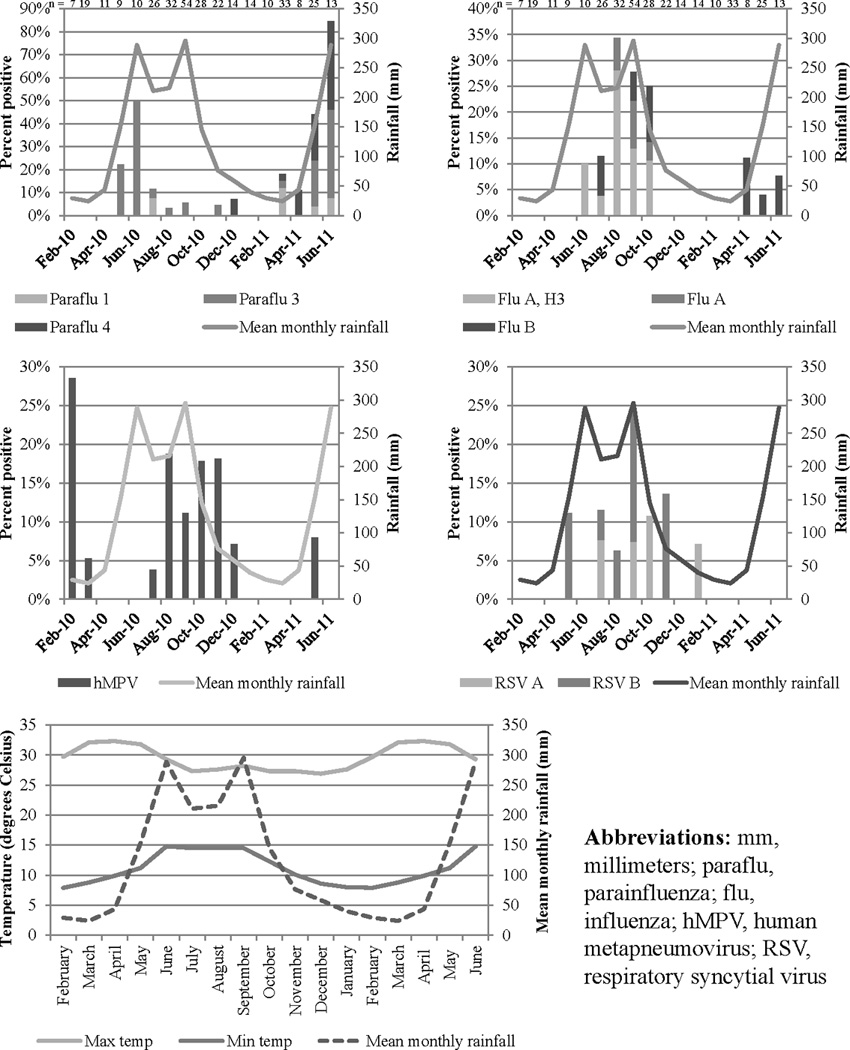
Results: From February 2010 through June 2011, 345 children < 5 years of age were enrolled; 17%, 23%, 30% and 31% were <6, 6-11, 12-23 and 24-60 months old, respectively. Including all clinics in the region, 44.5% of patients < 5 years of age with documented respiratory diagnoses were enrolled. At least 1 virus was identified in 75.4% children, of which 7.5% were coinfections; 13.3% were positive for parainfluenza, 11.9% for influenza, 8.1% for human metapneumovirus and 7.5% for respiratory syncytial virus. Rainfall correlated with parainfluenza (P < 0.0001), influenza (P < 0.0001), human metapneumovirus (P = 0.0182) and respiratory syncytial virus (P < 0.0001).
Conclusions: These results suggest that the spectrum of viruses in ill, rural, Honduran children is similar to that in North and Central America, although the seasonality is typical of some tropical regions.
Conflict of interest statement
Figures
References
-
- Black RE, Cousens S, Johnson HL, et al. Global, regional, and national causes of child mortality in 2008: a systematic analysis. Lancet. 2010 Jun 5;375(9730):1969–1987. - PubMed
-
- Juven T, Mertsola J, Waris M, et al. Etiology of community-acquired pneumonia in 254 hospitalized children. The Pediatric infectious disease journal. 2000 Apr;19(4):293–298. - PubMed
-
- Tajima T, Nakayama E, Kondo Y, et al. Etiology and clinical study of community-acquired pneumonia in 157 hospitalized children. J Infect Chemother. 2006 Dec;12(6):372–379. - PubMed
-
- Bonzel L, Tenenbaum T, Schroten H, Schildgen O, Schweitzer-Krantz S, Adams O. Frequent detection of viral coinfection in children hospitalized with acute respiratory tract infection using a real-time polymerase chain reaction. The Pediatric infectious disease journal. 2008 Jul;27(7):589–594. - PubMed
Publication types
MeSH terms
Grants and funding
LinkOut - more resources
Full Text Sources
Medical
