. 2011 Jun;37(3):361-73.
doi: 10.1007/s10867-010-9212-6. Epub 2011 Jan 11.

Ion concentration dynamics as a mechanism for neuronal bursting

Affiliations

Ion concentration dynamics as a mechanism for neuronal bursting

Ernest Barreto et al. J Biol Phys. 2011 Jun.

Abstract

We describe a simple conductance-based model neuron that includes intra- and extracellular ion concentration dynamics and show that this model exhibits periodic bursting. The bursting arises as the fast-spiking behavior of the neuron is modulated by the slow oscillatory behavior in the ion concentration variables and vice versa. By separating these time scales and studying the bifurcation structure of the neuron, we catalog several qualitatively different bursting profiles that are strikingly similar to those seen in experimental preparations. Our work suggests that ion concentration dynamics may play an important role in modulating neuronal excitability in real biological systems.

Keywords: Burst; Epilepsy; Ion concentration; Neuron; Potassium; Seizure; Sodium.


Figures

Fig. 1
Fig. 1
Bifurcation diagrams describing the neuron’s asymptotic behavior with fixed ion concentrations. In a [Na]i = 10 mM. The detailed structure in the upper part of b is shown in Fig. 5
Fig. 2
Fig. 2
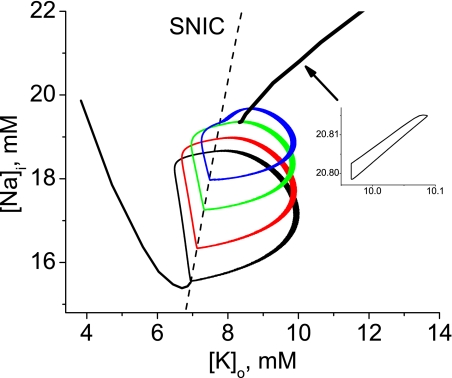
Asymptotic behavior of the ion concentrations as kbath (in millimolar) is varied. The curve on the left denotes stable equilibria and corresponds to kbath ranging from 4.0 to 7.615. Projections of limit cycles (loops) are shown for kbath = 7.62, 8.0, 8.5, and 8.95 mM; the thickness of the loops on the right reflect small, fast ion concentration fluctuations due to spiking behavior. The curve on the upper right, for kbath ranging from 8.8 to 15.0, denotes small-amplitude loops that correspond to tonic spiking (see inset)
Fig. 3
Fig. 3
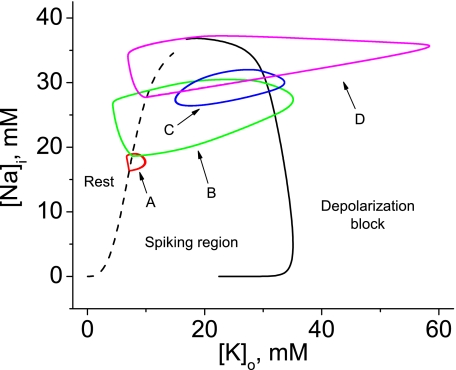
Loops AD represent the time evolution of the ion concentrations as the system exhibits limit cycle behavior. The loops are traversed in a counterclockwise manner. The dashed and solid lines are the SNIC and Hopf bifurcation curves, respectively
Fig. 4
Fig. 4
Four qualitatively different bursting patterns corresponding to the four loops shown in Fig. 3. In the lower panels, solid curves represent [K]o (left vertical axes) and dashed curves represent [Na]i (right vertical axes). The event in d recurs with a period of approximately 16.5 s, but for clarity, only a portion of one such event is shown
Fig. 5
Fig. 5
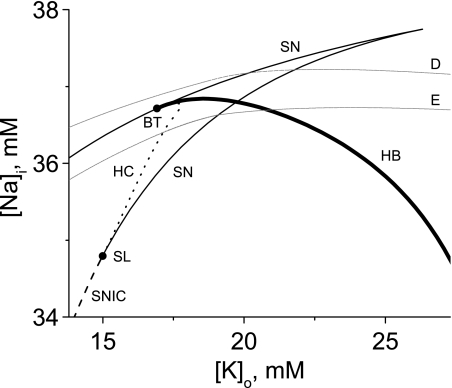
Magnification of the upper portion of Fig. 1b. D and E are portions of ion concentration limit cycles as described in the text. SN saddle-node, BT Bogdanov–Takens, HC homoclinic, HB Hopf, SL saddle-node loop, SNIC saddle-node infinite period
Fig. 6
Fig. 6
Diagrams clarifying the burst termination behavior corresponding to ion concentration loops D and E of Fig. 5. Insets show complete burst time traces of the membrane voltage. In d, [Na]i = 37.2 mM; in e, [Na]i = 36.6 mM

References

    1. Hodgkin AL, Huxley AF. A quantitative description of membrane current and its application to conduction and excitation in nerve. J. Physiol. 1952;117(4):500–544. - PMC - PubMed
    1. Frankenhaeuser B, Hodgkin AL. The after-effects of impulses in the giant nerve fibres of Loligo. J. Physiol. 1956;131:341–376. - PMC - PubMed
    1. Grafstein B. Mechanism of spreading cortical depression. J. Neurophysiol. 1956;19:154–171. - PubMed
    1. Green JD. The hippocampus. Phys. Rev. 1964;44:561–608. - PubMed
    1. Fertziger AP, Ranck JB., Jr Potassium accumulation in interstitial space during epileptiform seizures. Exp. Neurol. 1970;26:571–585. doi: 10.1016/0014-4886(70)90150-0. - DOI - PubMed

LinkOut - more resources