


doi: 10.1055/s-0031-1280660.
Radiofrequency ablation complicated by skin burn
- PMID: 22654258
- PMCID: PMC3193320
- DOI: 10.1055/s-0031-1280660
Item in Clipboard
Radiofrequency ablation complicated by skin burn
Semin Intervent Radiol.
2011 Jun.
Abstract
Radiofrequency (RF) ablation has been increasingly utilized as a minimally invasive treatment for primary and metastatic liver tumors, as well as tumors in the kidneys, bones, and adrenal glands. The development of high-current RF ablation has subsequently led to an increased risk of thermal skin injuries at the grounding pad site. The incidence of skin burns in recent studies ranges from 0.1-3.2% for severe skin burns (second-/third-degree), and from 5-33% for first-degree burns.(1-3).
Keywords: Colorectal cancer; complications; radiofrequency ablation.
Figures
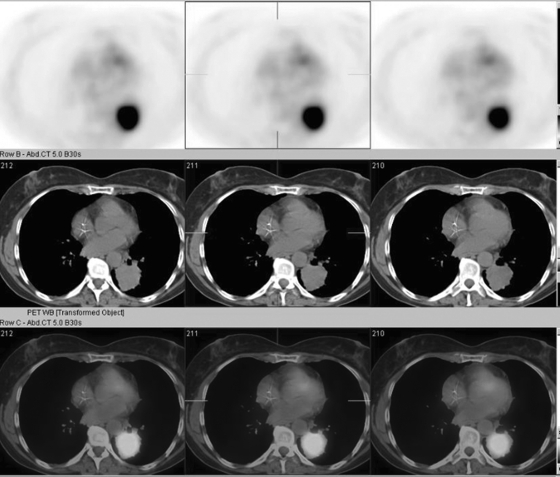
Positron emission tomography–computed tomography (PET–CT) demonstrates a hypermetabolic mass within the left lower lobe.
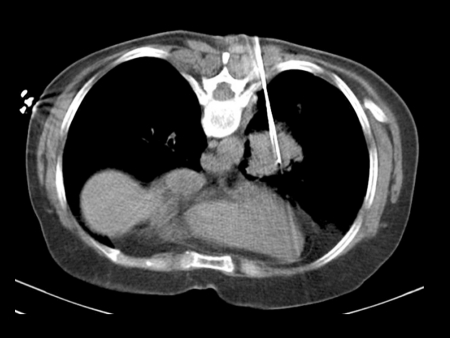
Axial prone noncontrast computed tomography demonstrates appropriate electrode positioning within the mass.
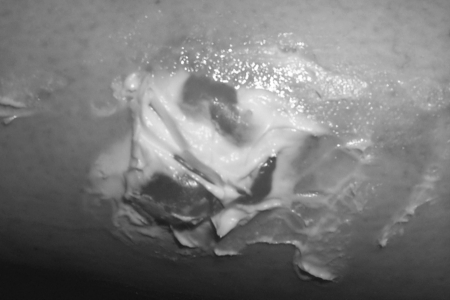
Large flaccid bulla with surrounding pink inflammation and topical silver sulfadiazine ointment at day 1.
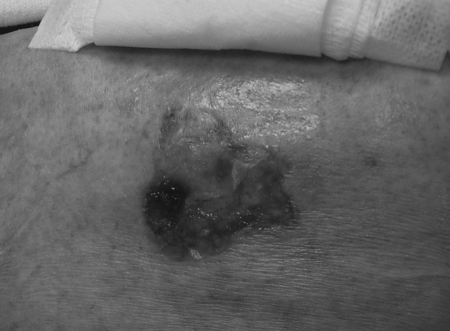
Superficial erosions with adherent denuded epidermis and hemorrhagic crust at day 60.
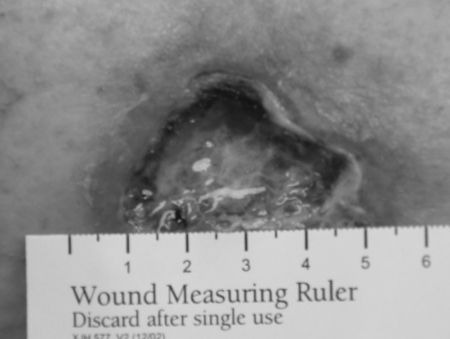
Full thickness ulceration with pink undermined borders and visible subcutaneous tissue at the base on day 90.
References
-
- Mulier S, Mulier P, Ni Y, et al. Complications of radiofrequency coagulation of liver tumours. Br J Surg. 2002;89(10):1206–1222. - PubMed
-
- Rhim H. Complications of radiofrequency ablation in hepatocellular carcinoma. Abdom Imaging. 2005;30(4):409–418. - PubMed
-
- Steinke K, Gananadha S, King J, Zhao J, Morris D L. Dispersive pad site burns with modern radiofrequency ablation equipment. Surg Laparosc Endosc Percutan Tech. 2003;13(6):366–371. - PubMed
-
- Goldberg S N, Solbiati L, Halpern E F, Gazelle G S. Variables affecting proper system grounding for radiofrequency ablation in an animal model. J Vasc Interv Radiol. 2000;11(8):1069–1075. - PubMed
-
- Thiagalingam A, Pouliopoulos J M, Barry M A, et al. A thermochromic dispersive electrode can measure the underlying skin temperature and prevent burns during radiofrequency ablation. J Cardiovasc Electrophysiol. 2005;16(7):781–788. - PubMed
