


Hashimoto's Thyroiditis: From Genes to the Disease
- PMID: 22654557
- PMCID: PMC3271310
- DOI: 10.2174/138920211798120763
Hashimoto's Thyroiditis: From Genes to the Disease
Abstract
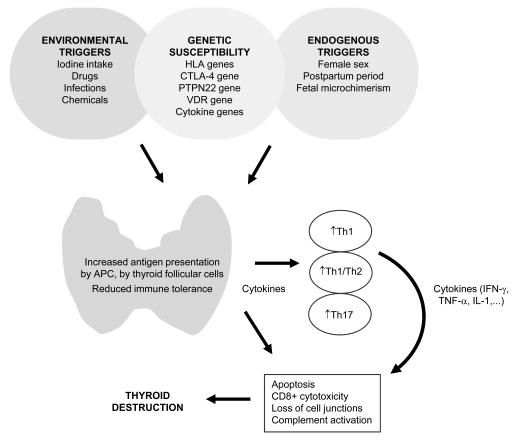
Hashimoto's thyroiditis (HT) is the most prevalent autoimmune thyroid disorder. Intrathyroidal lymphocytic infiltration is followed by a gradual destruction of the thyroid gland which may lead to subclinical or overt hypothyroidism. Biochemical markers of the disease are thyroid peroxidase and/or thyroglobulin autoantibodies in the serum which are present with a higher prevalence in females than in males and increase with age. Although exact mechanisms of aetiology and pathogenesis of the disorder are not completely understood, a strong genetic susceptibility to the disease has been confirmed predominantly by family and twin studies. Several genes were shown to be associated with the disease occurrence, progression, and severity. Genes for human leukocyte antigen, cytotoxic T lymphocyte antigen-4, protein tyrosine phosphatase nonreceptor-type 22, thyroglobulin, vitamin D receptor, and cytokines are considered to be of utmost importance. Amongst endogenous factors for the disease development, the attention is focused predominantly on female sex, pregnancy with postpartum period and fetal microchimerism. Environmental factors influencing HT development are iodine intake, drugs, infections and different chemicals. Disturbed self-tolerance accompanied by the increased antigen presentation is a prerequisite for the HT occurrence, whereas proper interaction of thyroid cells, antigen presenting cells, and T cells are necessary for the initiation of thyroid autoimmunity. Secreted cytokines lead predominantly to T-helper type 1 (Th1) response as well as to Th 17 response which has only recently been implicated. Final outcome of HT is thyroid destruction which is mostly a consequence of the apoptotic processes combined with T-cell mediated cytotoxicity.
Keywords: Endogenous factors; Hashimoto’s thyroiditis; environmental factors; genetic susceptibility; self-tolerance; thyroid destruction..
Figures
References
-
- Zaletel K. Determinants of thyroid autoantibody production in Hashimoto's thyroiditis. Expert Rev. Clin. Immunol. 2007;3:217–223. - PubMed
-
- Hocevar M, Auersperg M, Stanovnik L. The dynamics of serum thyroglobulin elimination from the body after thyroid surgery. Eur. J. Surg. Oncol. 1997;23:208–210. - PubMed
-
- McLachlan SM, Rapoport B. Why measure thyroglobulin autoantibodies rather than thyroid peroxidase autoantibodies? Thyroid. 2004;14:510–520. - PubMed
-
- Di Tomaso L, Battista S, Annarita D, Sciarra A, Morenghi E, Roncalli M. Cracking spaces in Hashimoto thyroiditis are lymphatic and prelymphatic vessels. Am. J. Surg. Pathol. 2010;34:1857–1861. - PubMed
LinkOut - more resources
Full Text Sources