. 2011 Dec;9(4):674-84.
doi: 10.2174/157015911798376181.

Alzheimer's disease: pathological mechanisms and recent insights

Affiliations

Alzheimer's disease: pathological mechanisms and recent insights

Dana M Niedowicz et al. Curr Neuropharmacol. 2011 Dec.

Abstract

Amyloidopathies cause neurodegeneration in a substantial portion of the elderly population. Improvements in long term health care have made elderly individuals a large and growing demographic group, marking these diseases as a major public health concern. Alzheimer's Disease (AD) is the most studied form of neurodegenerative amyloidopathy. Although our understanding of AD is far from complete, several decades of research have advanced our knowledge to the point where it is conceivable that some form of disease modifying therapy may be available in the near future. These advances have been built on a strong mechanistic understanding of the disease from its underlying genetics, molecular biology and clinical pathology. Insights derived from the study of other neurodegenerative diseases, such as some forms of frontotemporal dementia, have been critical to this process. This knowledge has allowed researchers to construct animal models of the disease process that have paved the way towards the development of therapeutics. However, what was once thought to be a straightforward problem has evolved into a series of disappointing outcomes. Examination of pathways common to all neurodegenerative diseases, including the cellular mechanisms that clear misfolded proteins and their regulation, may be the best way to move forward.

Keywords: Amyloid; Tau.; amyloid-β peptide; amyloid-β precursor protein; neurodegeneration; protein misfolding; proteinopathies.


Figures
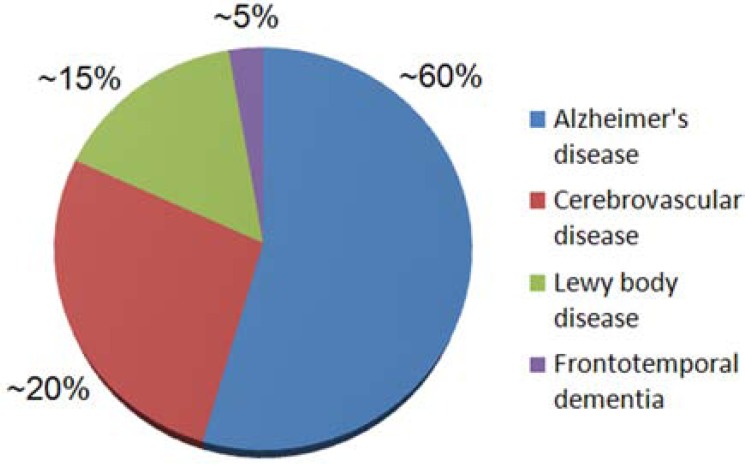
Fig. (1)
Fig. (1)
Distribution of the Major Age-Related Neurodegenerative Diseases. There are several different brain diseases that contribute substantially to cognitive impairment in the elderly. The weighted contributions shown on this pie chart are approximate and represent data collected from five different U.S. studies [8, 108-111]. Some other diseases that adversely affect cognition (including hippocampal sclerosis) affect many persons but are not discussed in this review. There is variation between studies due to population differences (e.g., mean age) and methodology. Thus, we have simplified these data for illustration. Note that AD accounts for more than one-half of cognitive impairment among American aged persons. In the “oldest old” (85+), some impact from cerebrovascular pathology is almost universal, and it is normal for the brains of individuals over the age of 80 to harbor more than one type of pathology.
Fig. (2)
Fig. (2)
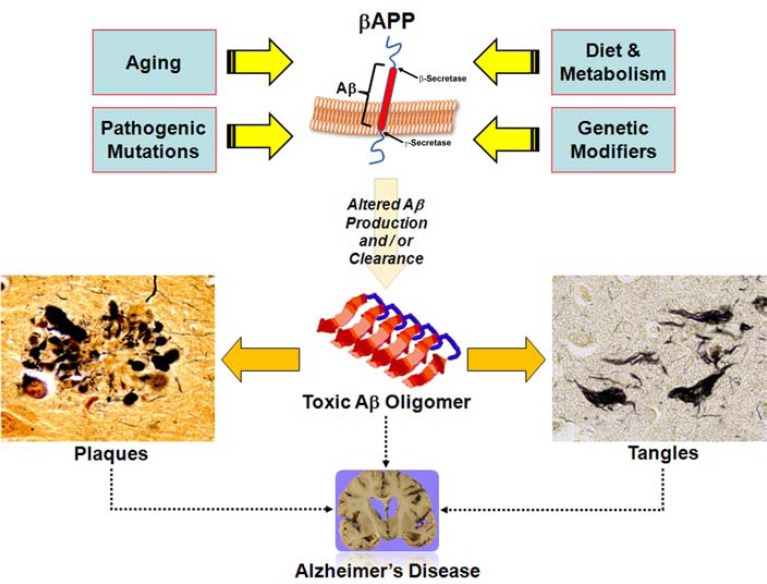
Factors Affecting Amyloid Accumulation and AD Pathology. In a broad sense, AD is characterized by neuronal degeneration, plaques and tangles. Strong evidence implicates the amyloid-β precursor protein (APP), the source of the amyloid-β peptide (Aβ), as the central player in the pathophysiology of the disease. Various factors (pathogenic mutations, genetic modifiers, diet and metabolism, and even the aging process itself) conspire so that the steady state levels of Aβ are extremely high in the AD brain. This can occur because of higher APP expression, increased APP metabolism (more β- and / or γ-secretase activity), decreased Aβ catabolism, faulty clearance of Aβ from the brain, or some combination of these processes. Elevated levels of Aβ, particularly aggregation prone species such as Aβ42, lead to an increase in the amount of higher order oligomeric forms of the peptide (made up of two or more Aβ molecules). These intermediates exist, at least transiently, in a toxic soluble form which probably exists both inside and outside the cell. There is evidence that oligomeric Aβ damages neurons, leads to neurofibrillary tangles and eventual cell death, and ultimately forms highly insoluble fibrils that eventually deposit as plaques in the brain parenchyma. Oligomeric Aβ also likely has other deleterious effects on neuronal function, only some of which have been characterized to date. Although AD is the best studied amyloidopathy, similar mechanisms (acting on proteins other than APP) may lie at the heart of many other neurodegenerative diseases. It is possible that knowledge of the common mechanisms contributing to these disease processes may lead to therapeutic approaches that are at least partially effective against neurodegeneration in general.
Fig. (3)
Fig. (3)
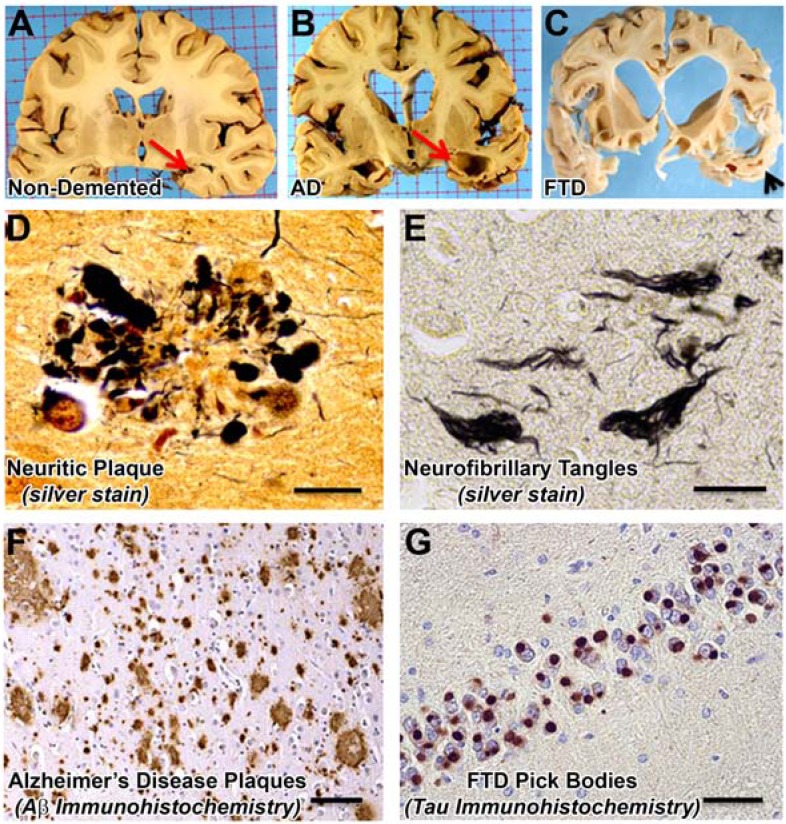
AD and FTD Pathologies. Representative gross photographs (A-C) and photomicrographs (D-G) demonstrate features of Alzheimer’s disease (AD) and frontotemporal dementia (FTD). Gross photographs of coronal slices of human brain at the level of the lateral geniculate nucleus show that AD brains can have extreme atrophy of the hippocampal formation (red arrows in A,B). A slightly more anterior slice from an FTD patient (C) depicts the atrophy in the region of the temporal pole (black arrowhead). Silver stains show both neuritic plaques (D) and neurofibrillary tangles (E) in AD. Immunohistochemistry is useful to stain disease-related antigens: Aβ peptide at low magnification in AD neocortex (F), and modified tau protein (“Pick bodies”) in the dentate granule cells in Pick’s disease, a subtype of FTD (G). Scale bars for photomicrographs: 20 μm in D,E; 1 mm in F, and 50 µm in G.
Fig. (4)
Fig. (4)
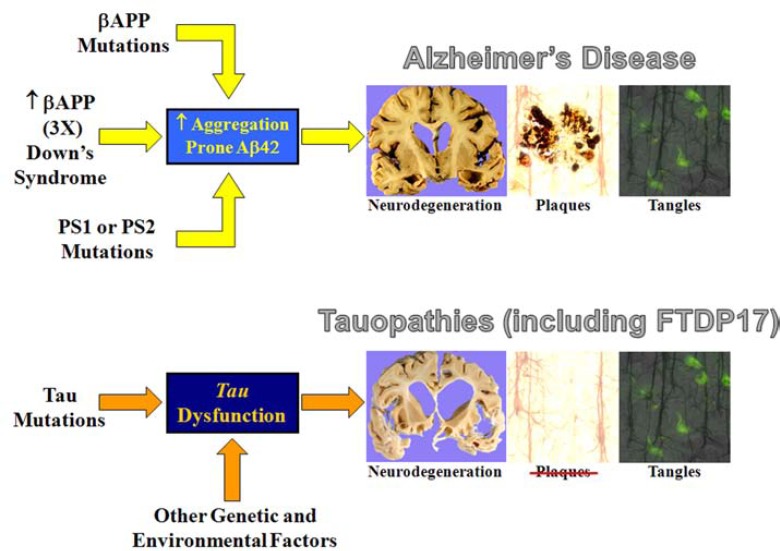
Comparison of AD and Tauopathies. In inherited or familial AD (FAD), the disease is characterized by neuronal degeneration, plaques, and tangles. FAD is caused by increased APP expression (such as in Down’s syndrome or in rare families with an extra copy of the APP gene), mutations in APP, or mutations in the presenilin genes, which all lead to an increase in aggregation- prone Aβ. In chromosome 17- linked frontotemporal dementia with parkinsonism (FTDP17), the disease is characterized by neuronal degeneration and tangles, but no plaques. In FTDP17, mutations in tau – the major component of neurofibrillary tangles – leads to tau dysfunction and / or aggregation. Other genetic and environmental factors can also lead to tauopathies. The most straight-forward conclusion is that tangle formation as a consequence of abnormalities in tau causes neurodegeneration. Since plaques are not a pathologic feature of tauopathies, we can also conclude that tau-induced neurodegeneration does not cause the formation of plaques. Since tangles occur in FAD along with Aβ pathology, a simple synthesis of what we know about both diseases indicates that Aβ (in some form) causes both tangles and neurodegeneration.

References

    1. He W, Sengupta M, Velkoff VA, DeBarros KA. 65+ in the United States. In: Commerce, U.S.D.o., Ed. Washington DC: US Government Printing Office; 2005. p. 254.
    1. Ferri CP, Prince M, Brayne C, Brodaty H, Fratiglioni L, Ganguli M, Hall K, Hasegawa K, Hendrie H, Huang Y, Jorm A, Mathers C, Menezes PR, Rimmer E, Scazufca M. Global prevalence of dementia: a Delphi consensus study. Lancet. 2005;366(9503):2112–2117. - PMC - PubMed
    1. Hardy J, Selkoe DJ. The amyloid hypothesis of Alzheimer's disease: progress and problems on the road to therapeutics. Science. 2002;297(5580):353–356. - PubMed
    1. Glenner GG, Wong CW. Alzheimer's disease and Down's syndrome: sharing of a unique cerebrovascular amyloid fibril protein. Biochem. Biophys. Res. Commun. 1984;122:1131–1135. - PubMed
    1. Masters CL, Multhaup G, Simms G, Pottgiesser J, Martins RN, Beyreuther K. Neuronal origin of a cerebral amyloid: neurofibrillary tangles of Alzheimer's disease contain the same protein as the amyloid of plaque cores and blood vessels. EMBO J. 1985;4:2757–2763. - PMC - PubMed

LinkOut - more resources