


Control of Brown Adipose Tissue Glucose and Lipid Metabolism by PPARγ
- PMID: 22654830
- PMCID: PMC3356105
- DOI: 10.3389/fendo.2011.00084
Control of Brown Adipose Tissue Glucose and Lipid Metabolism by PPARγ
Abstract
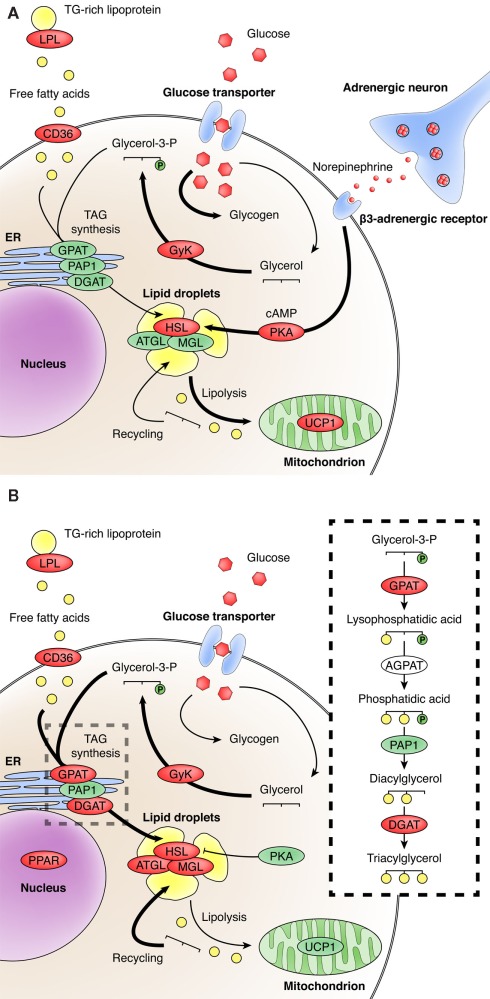
Brown adipose tissue (BAT) non-shivering thermogenesis impacts energy homeostasis in rodents and humans. Mitochondrial uncoupling protein 1 in brown fat cells produces heat by dissipating the energy generated by fatty acid and glucose oxidation. In addition to thermogenesis and despite its small relative size, sympathetically activated BAT constitutes an important glucose, fatty acid, and triacylglycerol-clearing organ, and such function could potentially be used to alleviate dyslipidemias, hyperglycemia, and insulin resistance. To date, chronic sympathetic innervation and peroxisome proliferator-activated receptor (PPAR) γ activation are the only recognized inducers of BAT recruitment. Here, we review the major differences between these two BAT inducers in the regulation of lipolysis, fatty acid oxidation, lipid uptake and triacylglycerol synthesis, glucose uptake, and de novo lipogenesis. Whereas BAT recruitment through sympathetic drive translates into functional thermogenic activity, PPARγ-mediated recruitment is associated with a reduction in sympathetic activity leading to increased lipid storage in brown adipocytes. The promising therapeutic role of BAT in the treatment of hypertriglyceridemic and hyperglycemic conditions is also discussed.
Keywords: PPARγ; brown adipose tissue; glucose metabolism; lipid metabolism; obesity; rosiglitazone; sympathetic nervous system.
Figures
References
-
- Bartelt A., Bruns O. T., Reimer R., Hohenberg H., Ittrich H., Peldschus K., Kaul M. G., Tromsdorf U. I., Weller H., Waurisch C., Eychmuller A., Gordts P. L., Rinninger F., Bruegelmann K., Freund B., Nielsen P., Merkel M., Heeren J. (2011). Brown adipose tissue activity controls triglyceride clearance. Nat. Med. 17, 200–205 10.1038/nm.2297 - DOI - PubMed
-
- Bronnikov G., Bengtsson T., Kramarova L., Golozoubova V., Cannon B., Nedergaard J. (1999). Beta1 to beta3 switch in control of cyclic adenosine monophosphate during brown adipocyte development explains distinct beta-adrenoceptor subtype mediation of proliferation and differentiation. Endocrinology 140, 4185–4197 10.1210/en.140.9.4185 - DOI - PubMed
LinkOut - more resources
Full Text Sources
Other Literature Sources
Research Materials
