


Tissue-Specific Effects of Loss of Estrogen during Menopause and Aging
- PMID: 22654856
- PMCID: PMC3356020
- DOI: 10.3389/fendo.2012.00019
Tissue-Specific Effects of Loss of Estrogen during Menopause and Aging
Abstract
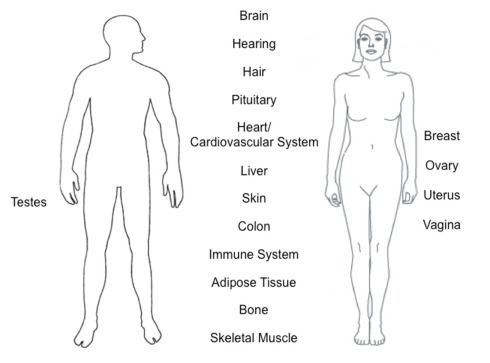
The roles of estrogens have been best studied in the breast, breast cancers, and in the female reproductive tract. However, estrogens have important functions in almost every tissue in the body. Recent clinical trials such as the Women's Health Initiative have highlighted both the importance of estrogens and how little we know about the molecular mechanism of estrogens in these other tissues. In this review, we illustrate the diverse functions of estrogens in the bone, adipose tissue, skin, hair, brain, skeletal muscle and cardiovascular system, and how the loss of estrogens during aging affects these tissues. Early transcriptional targets of estrogen are reviewed in each tissue. We also describe the tissue-specific effects of selective estrogen receptor modulators (SERMs) used for the treatment of breast cancers and postmenopausal symptoms.
Keywords: SERM; aging; estrogen; tissue specificity.
Figures
References
-
- Albright F., Bloomberg E., Smith P. H. (1940). Postmenopausal osteoporosis. Trans. Assoc. Am. Physicians 55, 298–305
-
- Arowojolu A. O., Gallo M. F., Lopez L. M., Grimes D. A., Garner S. E. (2009). Combined oral contraceptive pills for treatment of acne. Cochrane Database Syst. Rev. 3, CD004425. - PubMed
-
- Ashcroft G. S., Mills S. J., Lei K., Gibbons L., Jeong M. J., Taniguchi M., Burow M., Horan M. A., Wahl S. M., Nakayama T. (2003). Estrogen modulates cutaneous wound healing by downregulating macrophage migration inhibitory factor. J. Clin. Invest. 111, 1309–1318 10.1172/JCI16288 - DOI - PMC - PubMed
Grants and funding
LinkOut - more resources
Full Text Sources
