. 2012 Apr 3:3:49.
doi: 10.3389/fendo.2012.00049. eCollection 2012.

Integrating body and organ size in Drosophila: recent advances and outstanding problems

Affiliations

Integrating body and organ size in Drosophila: recent advances and outstanding problems

Christen Kerry Mirth et al. Front Endocrinol (Lausanne). .

Abstract

OVER THE PAST TWO DECADES, FUNDAMENTAL STRIDES IN PHYSIOLOGY AND GENETICS HAVE ALLOWED US TO FINALLY GRASP THE DEVELOPMENTAL MECHANISMS REGULATING BODY SIZE, PRIMARILY IN ONE MODEL ORGANISM: the fruit fly Drosophila melanogaster. In Drosophila, as in all animals, final body size is regulated by the rate and duration of growth. These studies have identified important roles for the insulin and the target of rapamycin (TOR) signaling pathways in regulating the growth rate of the larva, the stage most important in determining final adult size. Furthermore, they have shown that the insulin/TOR pathway interacts with hormonal systems, like ecdysone and juvenile hormone, to regulate the timing of development and hence the duration of growth. This interaction allows the growing larvae to integrate cues from the environment with environmentally sensitive developmental windows to ensure that optimal size and proportions are reached given the larval rearing conditions. Results from this work have opened up new avenues of studies, including how environmental cues are integrated to regulate developmental time and how organs maintain proportional growth. Other researchers interested in the evolution of body size are beginning to apply these results to studies of body size evolution and the generation of allometry. With these new findings, and with the developments to come, the field of size control finds itself in the fortunate position of finally being able to tackle century old questions of how organisms achieve final adult size and proportions. This review discusses the state of the art of size control from a Drosophila perspective, and outlines an approach to resolving outstanding issues.

Keywords: developmental timing; ecdysone; environmental effects on body size; genetics of body size and proportions; growth rates; insulin/target of rapamycin signaling; juvenile hormone; regulation of organ growth.


Figures
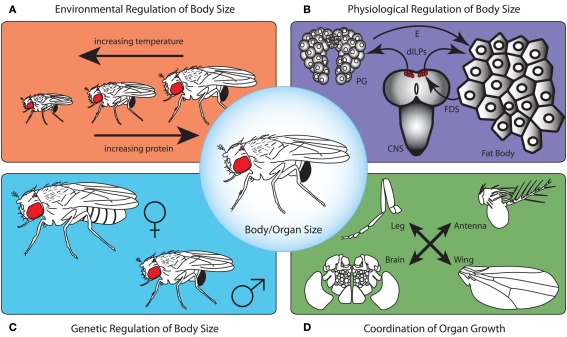
Figure 1
Figure 1
To produce a correctly proportioned animal whose physiology and size is appropriate for the environmental conditions in which it was reared, body size needs to be regulated on several levels. First, the environment controls developmental processes that determine final body size (A). As temperature increases, body size tends to decrease. Furthermore, as protein content in the larval food increases, adult size increases. This is due to the action of environmentally regulated signaling cascades on mechanisms that regulate growth rate and developmental timing (B). The fat body senses nutritional conditions and communicates this to the central nervous system (CNS) via a fat body derived signal (FDS). This FDS acts on the insulin producing neurosecretory cells to regulate the production of Drosophila insulin-like peptides (dILPs). dILPs, in turn regulate growth rate and the production of the steroid molting hormone ecdysone (E) by the prothoracic gland cells thereby determining the duration of the growth period. For any given environmental condition, the genetic background contributes to overall body size (C). For example, independent of rearing conditions, males are typically smaller than females. Lastly, in addition to this physiological regulation of whole body size, the size of individual organs is controlled by mechanisms that regulate organ-autonomous growth and those that ensure organs grow in proportion to one another (D).
Figure 2
Figure 2
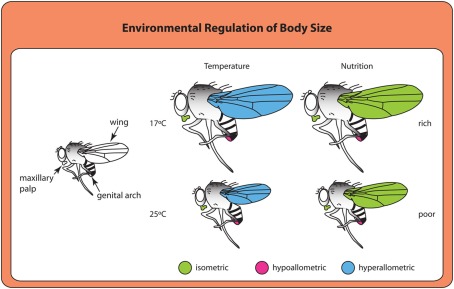
Organs differ in their scaling relationships to overall body size depending on the type of environmental cue (Shingleton et al., 2009). Isometric scaling indicates that a structure scales proportionally with body size. Hyperallometric scaling occurs when the size of a structure increases disproportionately with increasing body size. Structures that are hypoallometric do not increase or increase very little with increasing body size.
Figure 3
Figure 3
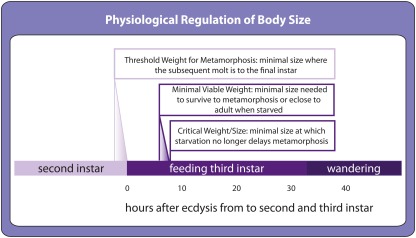
Environmentally sensitive developmental thresholds in the second and third instar as defined in Drosophila. Toward the end of the second instar, a size-dependent threshold called threshold size for metamorphosis determines whether the following molt will be the final larval molt before metamorphosis. The precise timing for this event has not yet been determined. At the beginning of the third instar, environmentally sensitive thresholds control the transition to metamorphosis. Minimal viable weights for pupariation and eclosion are the minimal sizes above which larvae can survive starvation to metamorphose and to eclose to adults respectively. Critical weight, also referred to as critical size, is the minimal size at which the onset of metamorphosis can no longer be delayed by starvation.
Figure 4
Figure 4
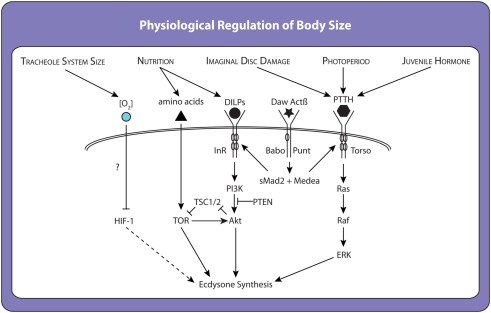
Factors and molecular mechanisms that influence ecdysone synthesis and the timing of critical weight attainment. Many environmentally sensitive pathways act to regulate the ecdysone synthesis pathway in a redundant manner. When one environmental signal is perturbed, another pathway steps in and allows pupariation, albeit with a delay. For example, starving larvae before they reach critical weight causes a delay because the prothoracic gland must rely on other inputs to initiate ecdysone synthesis. However, once ecdysone synthesis has been initiated it is irreversible. Thus, critical weight represents a switch rather than the maintenance of a state.
Figure 5
Figure 5
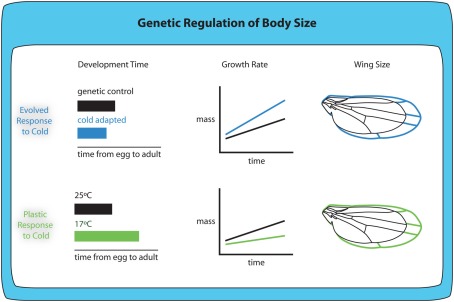
Evolved and plastic responses to cold temperature produce larger animals with different size-related phenotypes. Cold-adapted flies show shorter development times, increased growth rate and larger body and wing size when reared at the same temperature as non-adapted flies. Although the plastic response to cold temperature includes larger body and wing size, larvae raised at colder temperatures (17°C) show increased development time and reduced growth rates.
Figure 6
Figure 6
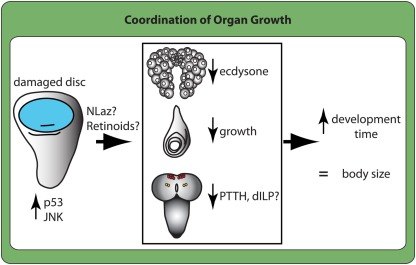
Damaged or slow-growing disks signal to the other tissues to reduce their growth and prolong development. Damaged or slow-growing disks signal their status within the tissue by upregulating stress signaling via the JNK pathway and the apoptotic machinery protein p53. They signal their slow growth to the rest of the body, at least in part, through retinoid signaling and potentially through Neural Lazarillo (NLaz). This reduces ecdysone synthesis by the prothoracic gland (top tissue in box), reduces growth of another normally growing disks (leg disk in middle), and reduces PTTH (PTTH cells in yellow) and may reduce the production of insulin like peptides (dILP) from the insulin producing cells (in red) in the brain (bottom tissue). In this manner, growth-perturbed disks delay development although the larvae eventually metamorphose to produce normally sized adults.

References

    1. Bai X., Ma D., Liu A., Shen X., Wang Q. J., Liu Y., Jiang Y. (2007). Rheb activates mTOR by antagonizing its endogenous inhibitor, FKBP38. Science 318, 977–980 10.1126/science.1147379 - DOI - PubMed
    1. Beadle G. W., Tatum E. L., Clancy C. W. (1938). Food level in relation to rate of development and eye pigmentation in Drosophila melanogaster. Biol. Bull. 75, 447–462 10.2307/1537573 - DOI
    1. Bennett F. C., Harvey K. F. (2006). Fat cadherin modulates organ size in Drosophila via the Salvador/Warts/Hippo signaling pathway. Curr. Biol. 16, 2101–2110 10.1016/j.cub.2006.01.058 - DOI - PubMed
    1. Bergantiños C., Corominas M., Serras F. (2010). Cell death-induced regeneration in wing imaginal discs requires JNK signalling. Development 137, 1169–1179 10.1242/dev.045559 - DOI - PubMed
    1. Bochdanovits Z., de Jong G. (2003). Experimental evolution in Drosophila melanogaster: interaction of temperature and food quality selection regimes. Evolution 57, 1829–1836 10.1554/02-740 - DOI - PubMed

LinkOut - more resources